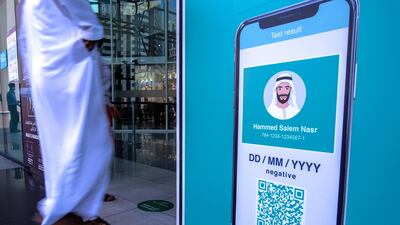
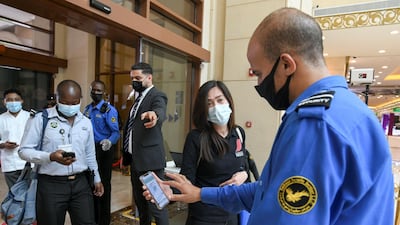
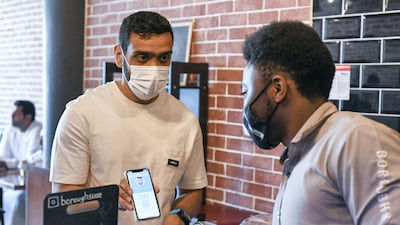
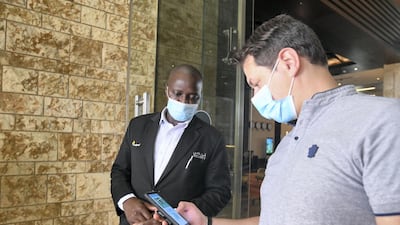
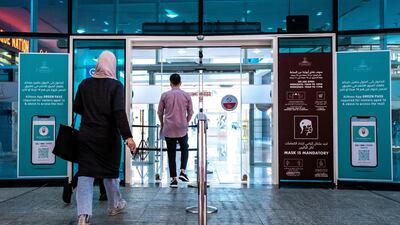
The high-tech scanning technology is being tested at various locations in Abu Dhabi.

WATCH: Smartphone scanners screen people for Covid-19 in Abu Dhabi


Gillian Duncan
  • English
  • Arabic

Authorities in Abu Dhabi have shared a video showing how a new app that screens people for Covid-19 works.

The technology, which is being trialled in three areas of Abu Dhabi, appears to scan people for the presence of viral particles.

In the video, a mobile phone is held in front of a person’s face briefly before a message flashes up to say they are negative, reading “the presence of Covid-19 viral nucleotides was not detected”.

Anyone who tests negative is permitted to enter.

Those who are positive are refused entry and referred to take a free Covid-19 test in 24 hours.

“It’s great technology that delivers results quickly,” said one person who was tested entering Yas Mall.

Others spoke about how efficient it was.

“It gave me amazing peace of mind and so quickly,” said another.

The high-tech scanning technology is being tested at various locations on Yas Island, including Yas Mall and the theme parks, in Ghantoot, as well as Mussaffah.

The decision to introduce the scanning technology in Mussaffah came after officials launched an extensive vaccination and testing drive in the area last Thursday.

The Abu Dhabi Emergency, Crisis and Disasters Committee approved the scheme, which will be gradually implemented in specific areas of Mussaffah without causing disruption to commercial activities.

On Tuesday, a system went live in Abu Dhabi that requires people to prove that they are vaccinated and have recently been screened for Covid-19.

The green pass system requires people to show their testing and vaccination status on Al Hosn, the UAE's test and tracing app, to enter parks, beaches, malls, hotels and large supermarkets.

The app is also needed to access gyms, swimming pools, entertainment centres, restaurants and cafes.

Users reported issues using Al Hosn on Thursday, prompting authorities to advise reinstalling the app.

Abu Dhabi launches Green Pass system: in pictures

F1 drivers' standings

1. Lewis Hamilton, Mercedes 281

2. Sebastian Vettel, Ferrari 247

3. Valtteri Bottas, Mercedes 222

4. Daniel Ricciardo, Red Bull 177

5. Kimi Raikkonen, Ferrari 138

6. Max Verstappen, Red Bull 93

7. Sergio Perez, Force India 86

8. Esteban Ocon, Force India 56

Mercer, the investment consulting arm of US services company Marsh & McLennan, expects its wealth division to at least double its assets under management (AUM) in the Middle East as wealth in the region continues to grow despite economic headwinds, a company official said.

Mercer Wealth, which globally has $160 billion in AUM, plans to boost its AUM in the region to $2-$3bn in the next 2-3 years from the present $1bn, said Yasir AbuShaban, a Dubai-based principal with Mercer Wealth.

Within the next two to three years, we are looking at reaching $2 to $3 billion as a conservative estimate and we do see an opportunity to do so,” said Mr AbuShaban.

Mercer does not directly make investments, but allocates clients’ money they have discretion to, to professional asset managers. They also provide advice to clients.

“We have buying power. We can negotiate on their (client’s) behalf with asset managers to provide them lower fees than they otherwise would have to get on their own,” he added.

Mercer Wealth’s clients include sovereign wealth funds, family offices, and insurance companies among others.

From its office in Dubai, Mercer also looks after Africa, India and Turkey, where they also see opportunity for growth.

Wealth creation in Middle East and Africa (MEA) grew 8.5 per cent to $8.1 trillion last year from $7.5tn in 2015, higher than last year’s global average of 6 per cent and the second-highest growth in a region after Asia-Pacific which grew 9.9 per cent, according to consultancy Boston Consulting Group (BCG). In the region, where wealth grew just 1.9 per cent in 2015 compared with 2014, a pickup in oil prices has helped in wealth generation.

BCG is forecasting MEA wealth will rise to $12tn by 2021, growing at an annual average of 8 per cent.

Drivers of wealth generation in the region will be split evenly between new wealth creation and growth of performance of existing assets, according to BCG.

Another general trend in the region is clients’ looking for a comprehensive approach to investing, according to Mr AbuShaban.

“Institutional investors or some of the families are seeing a slowdown in the available capital they have to invest and in that sense they are looking at optimizing the way they manage their portfolios and making sure they are not investing haphazardly and different parts of their investment are working together,” said Mr AbuShaban.

Some clients also have a higher appetite for risk, given the low interest-rate environment that does not provide enough yield for some institutional investors. These clients are keen to invest in illiquid assets, such as private equity and infrastructure.

“What we have seen is a desire for higher returns in what has been a low-return environment specifically in various fixed income or bonds,” he said.

“In this environment, we have seen a de facto increase in the risk that clients are taking in things like illiquid investments, private equity investments, infrastructure and private debt, those kind of investments were higher illiquidity results in incrementally higher returns.”

The Abu Dhabi Investment Authority, one of the largest sovereign wealth funds, said in its 2016 report that has gradually increased its exposure in direct private equity and private credit transactions, mainly in Asian markets and especially in China and India. The authority’s private equity department focused on structured equities owing to “their defensive characteristics.”

'The Sky is Everywhere'

Director:Josephine Decker

Stars:Grace Kaufman, Pico Alexander, Jacques Colimon

Rating:2/5

TOUCH RULES

Touch is derived from rugby league. Teams consist of up to 14 players with a maximum of six on the field at any time.

Teams can make as many substitutions as they want during the 40 minute matches.

Similar to rugby league, the attacking team has six attempts - or touches - before possession changes over.

A touch is any contact between the player with the ball and a defender, and must be with minimum force.

After a touch the player performs a “roll-ball” - similar to the play-the-ball in league - stepping over or rolling the ball between the feet.

At the roll-ball, the defenders have to retreat a minimum of five metres.

A touchdown is scored when an attacking player places the ball on or over the score-line.