


Doctors in the UAE have called for mass production of a three-layer face mask that gives more protection against the highly infectious Delta variant of Covid-19.
It is known as the FFP3 (filtering facepiece) and provides four times the protection of the commonly used two-layer N95 mask, medics say.
The FFP3 sits more tightly against the face, with three layers of protection to filter out 99 per cent of airborne particles.
It was also found to provide 100 per cent protection to healthcare workers in the UK working with Covid-19 patients in the critical ward, according to a recent study by UK's Cambridge University Hospitals National Health Service Foundation Trust.
Manufacturers are producing enough masks for hospital workers but doctors in the UAE are urging them to mass-produce the FFP3 types because supplies in the UAE are limited.
Hospitals buy them from medical suppliers but they are hard to find online for individual purchase.
The Delta variant accounts for one in three cases of Covid-19 in the UAE.
Dr Muhammed Shafeeq, a pulmonologist at Dubai's Aster Hospital in Al Qusais, said while supplies of FFP3 masks were low and they cost more, he hoped manufactures would start making more.
"Mass-producing the mask will help but right now, there are constraints of availability and higher cost," he told The National.
When asked if the FFP3 mask could provide protection against the Delta variant, he said: “It could help because it gives 100 per cent protection. For now, I’m suggesting people wear the masks they have properly, sanitise and social distance.”
Dr Aisha Al Zaabi, a family medicine consultant at Prime Medical Centre in Al Warqa, also said there were limited FFP3 supplies, but the masks could give the public higher protection against Covid-19 variants if they become widely available.
“I do recommend that more of these masks are produced,” she said. “It’s good protection but the resources are limited.”
How does FFP3 differ from other masks?
Healthcare workers caring for Covid-19 patients use either the FFP2, also known as the N95, or the FFP3 mask.
Some of the masks widely used by the public include the N95, surgical masks and reusable fabric masks.
The two-layer N95 mask helps filter out 94 per cent of airborne particles, said filter solutions company GVS Group.
Meanwhile, the FFP3 mask, which has three layers, will filter out a minimum of 99 per cent of airborne particles.
The difference between the two is the extra layer of protection, and that the FFP3 has been designed for a tighter facial fit to block out all particles.
‘Wear your mask properly’
Because the FFP3 mask is not yet widely available, doctors are recommending the public to wear their masks properly to filter out harmful airborne particles.
“What we are noticing is that people are not aware of how to use and remove the mask properly,” Dr Shafeeq said.
“People also need to social distance, avoid poorly ventilated and crowded areas, and properly sanitise.”
Abu Dhabi's door to door testing unit - in pictures
-
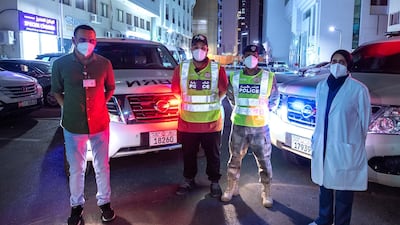
A team of medics, volunteers and police officers in central Abu Dhabi during a nighttime testing drive. Farha Sameer Baker, right, is head of operations at Tamouh Health Care. All photos by Victor Besa / The National -
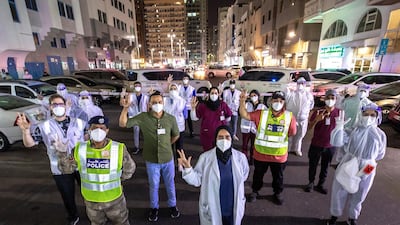
Abu Dhabi's government has run door-to-door testing since May 2020. The intention is to identify and isolate cases and drive down community transmissions. -
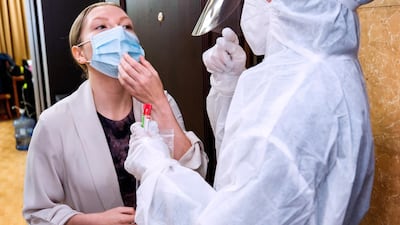
Maram Herzallah conducts a test on a resident in the corridor outside her home. -
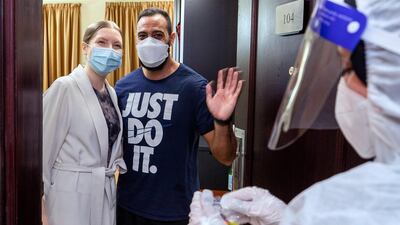
About 15,000 people a day are tested by the team across Abu Dhabi city and Al Ain. -
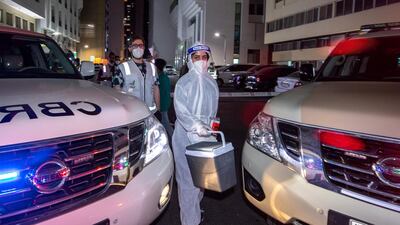
Medics work with the police given that they often have to close streets for periods of time. -
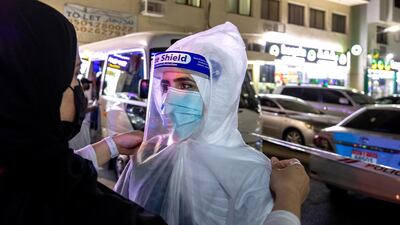
Nurse Maram Herzallah has her PPE gear checked by a colleague before starting her shift for the night. -
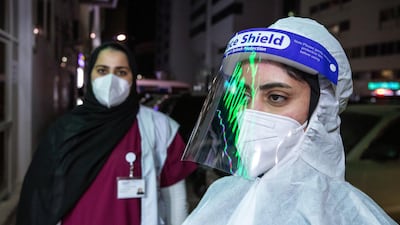
Screening staff are volunteers but most work in the emergency services or in hospitals by day. -
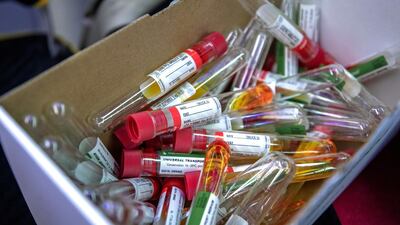
Staff must work diligently to process thousands of samples. People receive their results on the government's Al Hosn tracing app. -
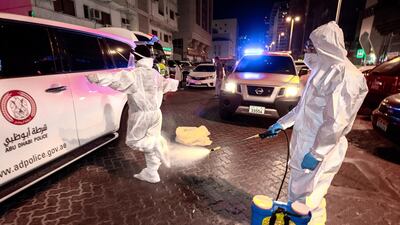
Police work with medics to perform door-to-door testing on an Abu Dhabi street. -
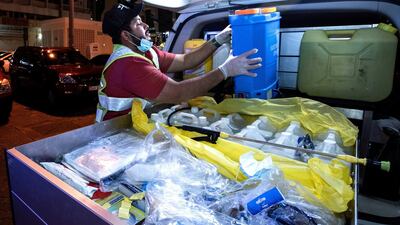
The crew is 100 per cent mobile and carries all the equipment they need to test thousands of people each night. -
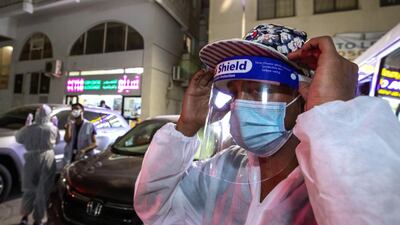
The nature of their work means changing their PPE gear frequently. -

Medics sort through Emirates IDs, which are needed to store data and deliver results. -
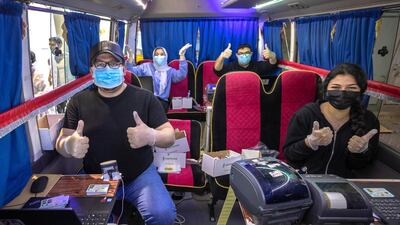
A group of residents are tested inside one of the crew's screening vans. Volunteers avoid going into people's homes as a precaution. -
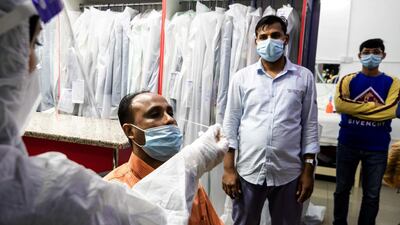
Staff at a dry cleaners receive a nasal swab test. -

A police officer stores samples in a cool box until they can be processed. -
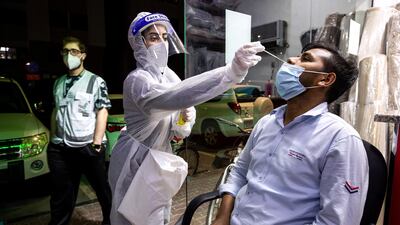
A shop worker is tested by a medic. -
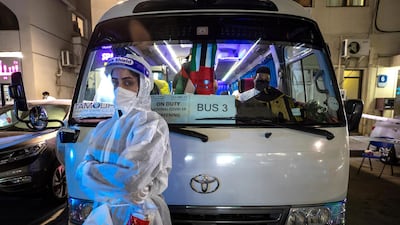
The volunteers cover several areas of the city each week. -
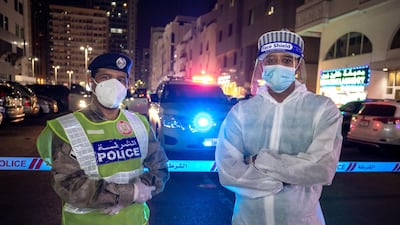
Volunteers says they are proud to play their part in tackling the pandemic and driving down cases.



