

Smokers in the Middle East are largely shunning e-cigarettes and other alternatives in favour of traditional tobacco, figures show.
Research company Euromonitor International found only a small minority of smokers used e-cigarettes to quit.
Previous trials showed such devices have helped people who were addicted, although medical opinion remains divided over the benefits of e-cigarettes and vapes.
Analysts found that only 1.8 per cent of smokers in the region took up alternatives to conventional cigarettes this year.
The figure is up from 1.4 per cent in 2017, but it remains significantly low when compared to other parts of the world.
This year, 28 per cent of smokers in the US opted for vapes or heated tobacco products that burn at lower temperatures and, it is claimed, emit fewer harmful chemicals.
Low adoption rates in the Middle East were largely dependent on factors such as government attitudes towards tobacco harm reduction, consumer awareness and product affordability.
“We believe a few factors explain why less than two per cent of smokers may have switched to less harmful tobacco products in the region,” said David Janazzo, chief financial officer at the Foundation for a Smoke-Free World.
“In several of the countries in this region, the tobacco industry is owned fully or in part by the local government, creating financial incentives to continue the sale of cigarettes.
“There are also bans or curbs on tobacco harm reduction products and pressure coming from organisations such as the World Health Organisation and The Union to block the use of these products.”
-

Tito Al Ghanaima prepares shisha at Orkied Cafe. Single use pipes must now be used by customers to prevent the potential spread of Covid-19. Chris Whiteoak / The National -
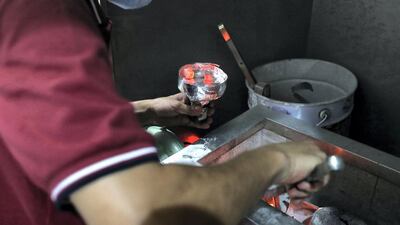
Tito Al Ghanaima places coals on the tobacco-filled shisha bowl at Orkied Cafe. Chris Whiteoak / The National -
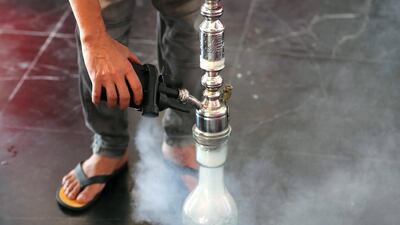
Tito Al Ghanaima uses a device to start the shisha for a customer. Previously staff would take a few puffs from the pipe to get the tobacco burning but this practice has been ceased amid the outbreak. Chris Whiteoak / The National -
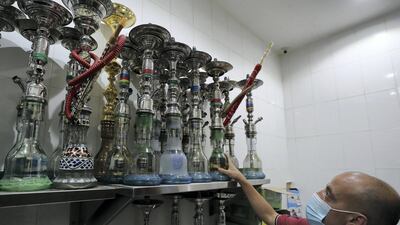
Shisha pipes must be taken apart and completely sanitised before use under safety measures imposed by the government. Chris Whiteoak / The National -
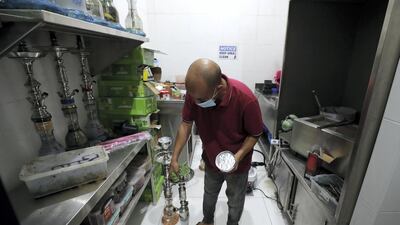
Tito Al Ghanaima assembles as shisha pipe for a customer after sanitising each part of the hookah for safe use. Chris Whiteoak / The National -

Tito Al Ghanaima pokes holes in the foil covering the shisha bowl, which contains tobacco. The pipe must be taken apart and completely sanitised before each use. Chris Whiteoak / The National -

Tito Al Ghanaima cleans the vase, or base, of a shisha pipe before assembling the hookah for a customer at Orkied Cafe. Chris Whiteoak / The National


Across western Europe, the adoption rate of alternatives was 16 per cent this year, while 13 per cent took them up in Eastern Europe.
Australia and New Zealand have some of the most stringent tobacco control measures, such as high taxation and blank packaging. A pack of Marlboro cigarettes in Australia today costs up to $35.
There, almost 12 per cent of smokers switched to alternatives this year, twice the 6 per cent rate of smokers who opted for them in 2017.
Only Asia Pacific nations (4 per cent) and Latin America (2.3 per cent) compare to the low adoption rate in the Middle East.
Every year, 1.9 million people die from tobacco-induced heart disease, according to a report by the World Health Organisation, World Heart Federation and the University of Newcastle, Australia.
In the Middle East, Oman has the lowest rate of adult smokers, where 15 per cent regularly use tobacco, compared with 40.7 per cent in Lebanon, according to WHO figures from 2019.
In the UAE, 37 per cent of adult men smoke, the same number as in Kuwait and Bahrain, with 25 per cent in Saudi Arabia.
Saudi Arabia and the UAE brought in a series of tax and minimum pricing measures in the past three years. Cigarettes cannot be sold for less than Dh8 ($2.20) in the Emirates.
Lung cancer is responsible for 7 per cent of all UAE cancer cases, 90 per cent of which are caused by smoking.
Dr Mohamed Rafique, a pulmonologist at Prime Hospital in Dubai, who runs a regular smoking cessation clinic, said e-cigarettes should not be used for a long time.
"We see about 15 smokers a week at the clinic who want to quit,” he said.
“We take measurements like carbon monoxide levels and try to know their level of addiction so we can offer targeted therapies like patches, gum or medication.
“There are good results. About 60 per cent give up altogether.
“Cigarettes contain a huge amount of chemicals, but these alternatives also contain toxic substances and there is not enough science available to support their use.”
In 2019, a WHO report on global tobacco use stated there was insufficient independent evidence to support the use of e-cigarettes as a population-level tobacco cessation intervention.

It said the products were "undoubtedly harmful" and that many of the damaging chemicals generated by heated tobacco products were similar to those generated by conventional cigarettes.
Even if generally released at lower levels, existing evidence does not show alternatives will reduce tobacco-related diseases, the report said.
Philip Morris International, which makes Marlboro cigarettes, was the first to market "heat-not-burn technology".
The company prices its Iqos, or “I Quit Original Smoking”, device in the UAE at about Dh250, with replacement tobacco sticks costing Dh20 for 20.
The Iqos releases real tobacco taste and nicotine without burning the tobacco, which, it is claimed, causes less harm to the lungs.
By 2025, the company wants at least 40 million of its cigarette smokers who would otherwise continue to smoke to have switched to smoke-free products.
But doctors said such e-cigarette devices could be harmful in the long run.
"We tell our patients if they have transferred to cigarette alternatives, it should only be as a temporary measure towards quitting altogether," Dr Rafique said.
“They are still at risk from severe respiratory infections and bronchial cancers.
“Products like the Iqos are becoming more common in people we see in the hospital when we ask about their smoking habits.
“But I’m not sure if it is cheaper than conventional smoking once the device is purchased and we know some vaping devices deliver even higher levels of nicotine.”

