


![“Testing campaign and sanitisation [are] to be conducted in gradual phases, and in coordination with targeted blocks,” said the Abu Dhabi Media Office.](https://www.thenationalnews.com/resizer/v2/X6KPEV2OECRQSFKWWPBB7JDE2Q.jpg?auth=784e8c30d4dcadd77576aec34a6545824c0a273ed4b3b17ba633f5966b213a8a&smart=true&width=800&height=450)


The polymerase chain reaction, or PCR, test is considered to be the gold standard for a Covid-19 diagnosis.
A positive result means you probably have Covid-19, whereas a negative test means you more than likely did not have the virus at the time of testing.
But there is a third possible result: PP, or presumptive positive. But what does that mean?
The National explains.
What is a PCR test?
It seeks to detect the presence of the Sars-CoV-2 virus, which causes Covid-19.
Sample collection is done using a swab on a long stick to collect respiratory material found inside the nose.
The sample is then sealed in a tube and sent off for analysis.
What happens next?
The lab performs a procedure called extraction, where they isolate genetic material from the sample to check if any virus is present.
Special chemicals are then used to create a reaction that makes millions of copies of a portion of the Sars-Cov-2 virus’s genetic material. One chemical creates a reaction that lights up in a fluorescent colour if the virus is detected.
What does a PP, or presumptive positive, result mean?
The result is inconclusive.
"It might be positive but it needs to be repeated again in three days," said Dr Engy Iskandar, a specialist in internal medicine at Dubai's International Modern Hospital.
"In Covid-19 tests, they look for several genes. If they find only one it means it is presumptive positive and it is not confirmed yet."
Doctors said all PCR testing looks for genes specific to Covid-19, but tests could pick up those in general coronaviruses too.
"A presumptive positive result indicates that not all genes were detected," said Dr Heba Sami, head of laboratory and consultant clinical pathologist at Saudi German Hospital, Ajman.
Perhaps genes specific to general coronaviruses were detected only. But it could alternatively indicate a low viral load, doctors said.
“As per National Crisis and Emergency Management Authority (NCEMA) guidelines provided by Dubai Health Authority, presumptive positive means only one of the multiple genes is isolated, or a low viral load is possible,” said Dr Surbhi Gupta, a specialist in clinical pathology at NMC Royal Hospital in Dubai.
At any event, anyone who receives this result should immediately begin quarantining and repeat the test in three days.
“Once the presumptive positive result is obtained, the patient should self-quarantine and repeat the test within 72 hours," Dr Gupta said.
Do all laboratories have the capacity to detect this result?
Yes, all testing facilities must be able to detect this.
“All testing laboratories have to provide it. It is part of NCEMA guidelines,” Dr Gupta said.
Is it common?
No. Laboratories say the result only accounts for a tiny percentage of samples.
“Based on the testing in our lab, the presumptive positive rate is 0.24 per cent,” Dr Gupta said.
Door to door with Abu Dhabi's testing squad
-
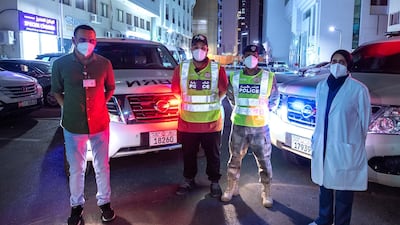
A team of medics, volunteers and police officers in central Abu Dhabi during a nighttime testing drive. Farha Sameer Baker, right, is head of operations at Tamouh Health Care. All photos by Victor Besa / The National -
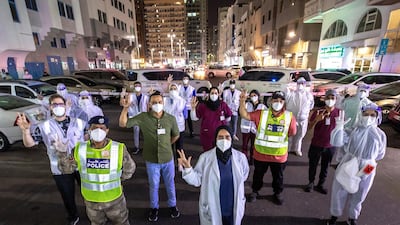
Abu Dhabi's government has run door-to-door testing since May 2020. The intention is to identify and isolate cases and drive down community transmissions. -
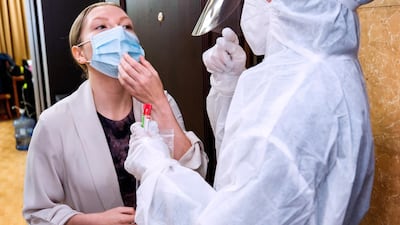
Maram Herzallah conducts a test on a resident in the corridor outside her home. -
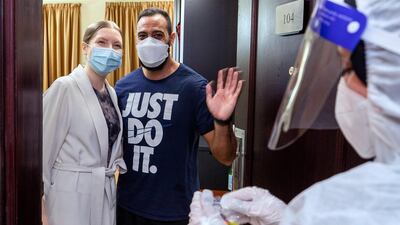
About 15,000 people a day are tested by the team across Abu Dhabi city and Al Ain. -
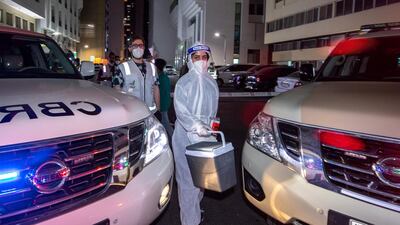
Medics work with the police given that they often have to close streets for periods of time. -
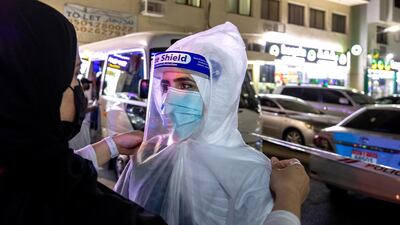
Nurse Maram Herzallah has her PPE gear checked by a colleague before starting her shift for the night. -
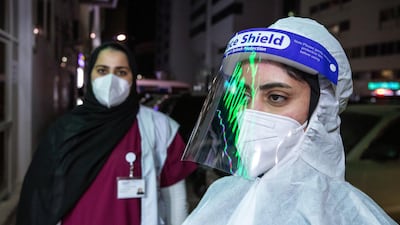
Screening staff are volunteers but most work in the emergency services or in hospitals by day. -
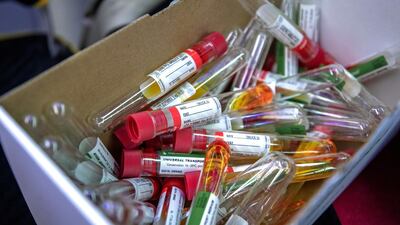
Staff must work diligently to process thousands of samples. People receive their results on the government's Al Hosn tracing app. -
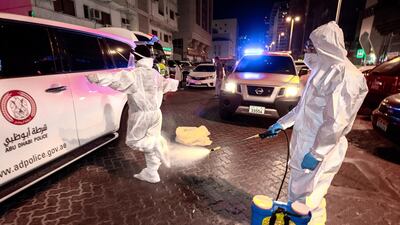
Police work with medics to perform door-to-door testing on an Abu Dhabi street. -
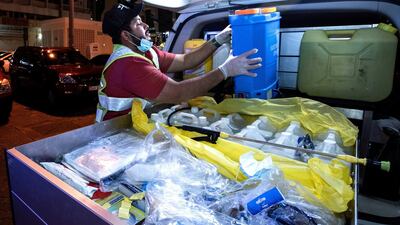
The crew is 100 per cent mobile and carries all the equipment they need to test thousands of people each night. -
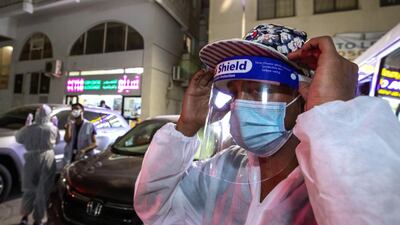
The nature of their work means changing their PPE gear frequently. -

Medics sort through Emirates IDs, which are needed to store data and deliver results. -
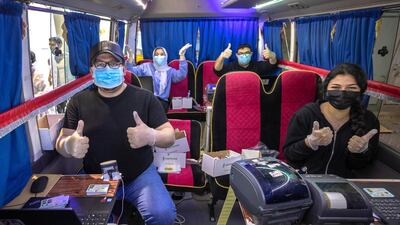
A group of residents are tested inside one of the crew's screening vans. Volunteers avoid going into people's homes as a precaution. -
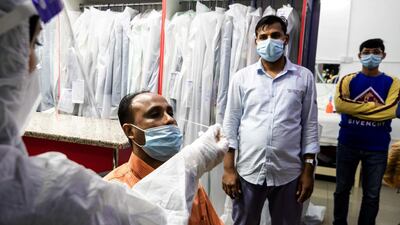
Staff at a dry cleaners receive a nasal swab test. -

A police officer stores samples in a cool box until they can be processed. -
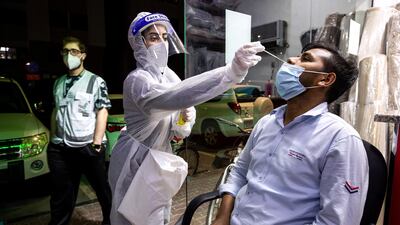
A shop worker is tested by a medic. -
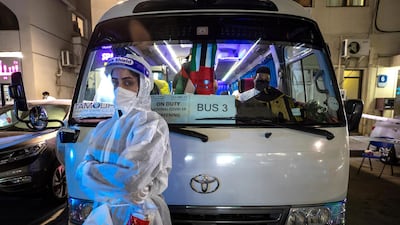
The volunteers cover several areas of the city each week. -
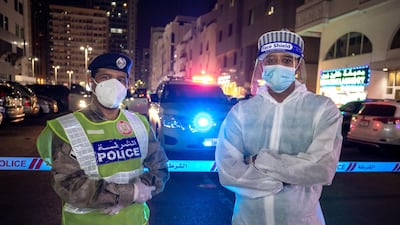
Volunteers says they are proud to play their part in tackling the pandemic and driving down cases.



