

New restrictions will be imposed on residents travelling abroad this summer, the UAE's federal crisis authority said.
Anyone planning an overseas trip must first apply for a permit from the Federal Authority for Identity and Citizenship (ICA).
Approval would be granted based on the level of risk in your destination country and the purpose of the journey.
Recent travel decisions have excluded Dubai, which has its own crisis authority and immigration service and which will accept inbound tourists from July 7. Officials were contacted on Thursday to clarify the situation.
Dr Saif Al Dhaheri, spokesman for the National Emergency Crisis and Disaster Management Authority (Ncema), said exemptions would be granted for people travelling for study, medical treatment, diplomacy or business.
Exemptions could be available for UAE residents who wish to visit their home country and return to the Emirates.
Travellers would need to take a PCR Covid-19 test within 48 hours of leaving the UAE and present a certificate proving they were clear before boarding. Passengers must also fill in a health declaration form.
Dr Al Dhaheri strongly advised against travelling to high-risk countries and said special permission must be sought for those nations.
On returning to the UAE, travellers must take another coronavirus test and isolate themselves for two weeks.
Anyone who does not adhere to the quarantine will face legal action.
-
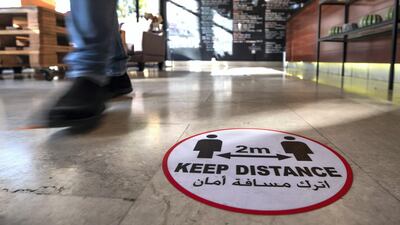
The Third Place Cafe on the Corniche in Abu Dhabi has a sticker to remind customers of Covid-19 precautions. Victor Besa / The National -
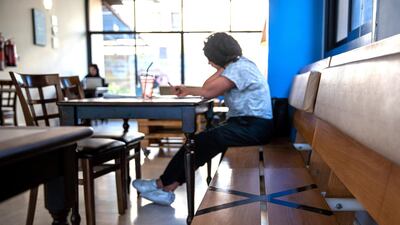
An 'X' reminds people of the need for physical distancing at the Third Place Cafe. Victor Besa / The National -

The Third Place Cafe in Abu Dhabi. Victor Besa / The National -
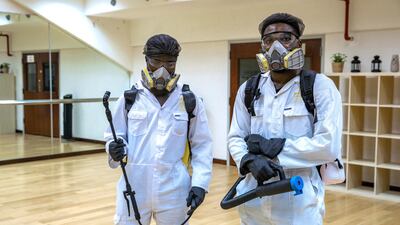
Sanitation workers at Haddins Fitness, Zayed Sports City. Victor Besa / The National -
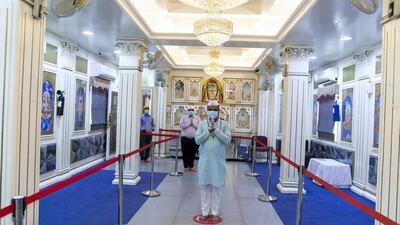
Places of worship, such as Shiva temple in Dubai, have been subject to restrictions during the pandemic. Reem Mohammed / The National -
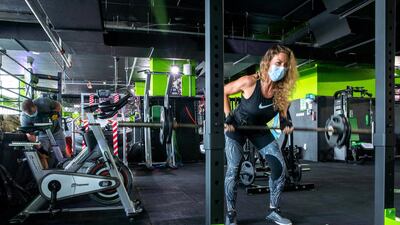
Fitness buff Natalie Navikova exercises at Cobra Fitness Abu Dhabi at Al Bandar. Victor Besa / The National -

CrossFit class at Vogue Fitness Yas Marina, Abu Dhabi. Victor Besa / The National -

A worshipper at Shiva temple in Dubai follows safety precautions. Reem Mohammed / The National -
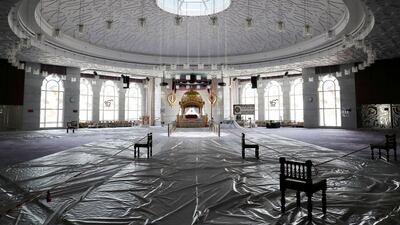
The floor of the main prayer hall at the Gurunanak Darbar in Jebel Ali, Dubai, is covered with plastic sheets to help tackle the spread of Covid-19. Pawan Singh / The National -
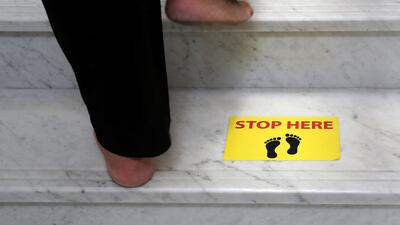
Safe distance marking stickers placed on the floor at Gurunanak Darbar in Jebel Ali, Dubai. Pawan Singh / The National -
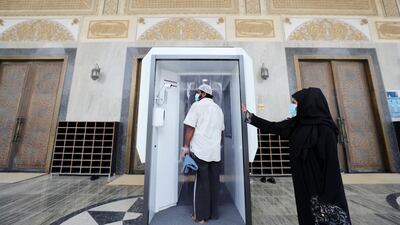
Midday prayers are performed at Al Farooq Omar Bin Al Khattab Mosque in Dubai. Chris Whiteoak / The National -
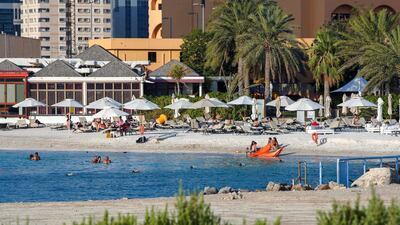
Hotel beaches are now open to guests at the Ramada Abu Dhabi Corniche after Covid-19 restrictions eased. Victor Besa / The National -
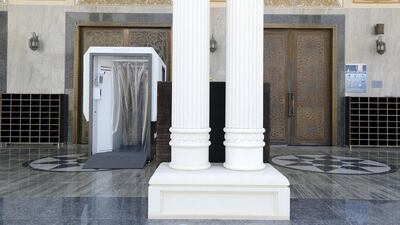
Al Farooq Omar Bin Al Khattab Mosque in Dubai has safety measures in place to help protect worshippers. Chris Whiteoak / The National -
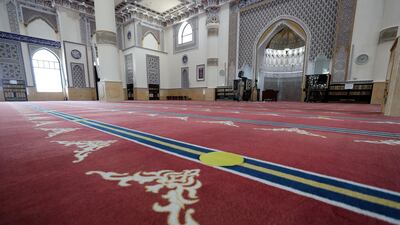
Al Farooq Omar Bin Al Khattab Mosque in Dubai. Chris Whiteoak / The National -
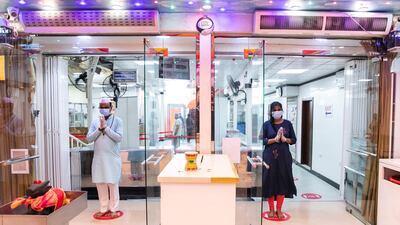
Shiva temple in Dubai put safety measures in place to protect worshippers. Reem Mohammed / The National -
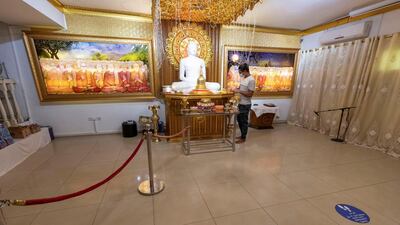
Covid-19 safety measures are put in place at Mahamevnawa Buddhist Temple in Dubai. Chris Whiteoak / The National -

Residents wear face masks as they walk in Abu Dhabi city centre. Victor Besa / The National -
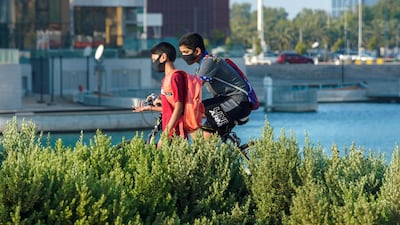
People walk along near the Ramada Hotel Abu Dhabi Corniche during the pandemic. Victor Besa / The National -

A visitor wears a protective face mask at Al Shindagha Museum in Dubai. EPA -
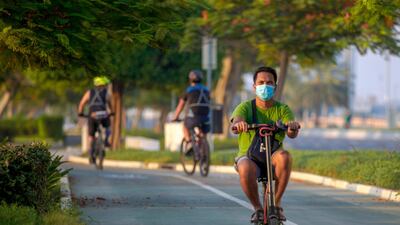
A man on his e-scooter travels along the Corniche in Abu Dhabi as the sun sets. Victor Besa / The National -
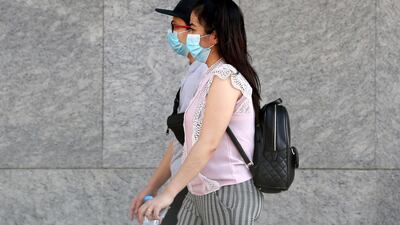
People wear face masks in Al Barsha, Dubai. Pawan Singh / The National


“Travellers must monitor themselves throughout their flight and, if they feel unwell, go to the medical centre in the airport at your destination, where you should use your international health insurance,” he said.
Emiratis must also contact the nearest UAE embassy when they arrive at their destination.
People returning to the UAE from low-risk countries may only need to isolate themselves for seven days after landing.
“These are national guidelines that must be carried out ahead of travel," Dr Al Dhaheri said.
"We are at a very critical stage we need commitment and co-operation from everyone. All national airlines are implementing the travel protocol for each destination."
At Wednesday night's briefing, officials announced 402 new cases of Covid-19, raising the country’s total to 49,069.
About 62,028 more tests were carried out, said Dr Amna Al Dhahak, a spokeswoman for the government.
That took the total number of coronavirus screenings to more than 3.5 million tests.
Dr Al Dhahak said 594 patients were cleared of the virus, raising the recovery tally to 38,160.
The average daily recoveries increased from 500 in May to 654 in June. There is also a drop in daily infections from 712 in May to 470 in June.
The UAE’s death toll from the pandemic now stands at 316, after one patient died of the virus on Wednesday. The number of patients still battling Covid-19 was 10,593.
The figures were released on the day on which places of worship and gyms reopened.
Dr Al Dhahak said the UAE’s regular briefings would no longer be held twice a week, but only when major announcements were to be made.
She said economic and social activities had mostly been resumed but the responsibility was on the public to adhere to safety measures to prevent a surge in cases.
“We must not waste away these achievements and must maintain them to have a complete recovery, God willing,” Dr Al Dhahak said.
“If there is no compliance, the outcome will be negative. Significant steps and measures still need to be taken in the coming period. Let us protect ourselves and our families.”
Salem Al Zaabi, acting director of the Federal Emergency, Crisis and Disasters Prosecution, displayed photos and names of people who had been caught flouting the rules and were fined.
“Some people are failing to wear masks and are behaving recklessly, which will have a negative impact and will prompt stricter measures,” Mr Al Zaabi said.
“We urge all individuals to comply with precautionary measures. Authorities want to create a balance of resuming social and economic activities and keeping people safe.
“Let us all be responsible.”
On Wednesday, the Abu Dhabi Health Services Company, or Seha, extended opening hours for its screening centres across the emirates.
Eight centres, including the drive-through sites, all operated by Seha, will now also test people for the virus on Fridays and Saturdays.
Daily opening hours have been extended to between 10am and 8pm to increase testing capacity.
The centres include those in City Walk, Mina Rashid and Al Khawaneej in Dubai, as well as those in Sharjah, Ajman, Umm Al Quwain, Ras Al Khaimah and Fujairah.
Officials in Abu Dhabi also announced that people from other emirates could enter the capital, provided they could present a medical certificate showing they were not infected with Covid-19.
The test results are valid for entry to Abu Dhabi for 48 hours.
The Seha screening centres were built across the country in March, on the orders of Sheikh Mohamed bin Zayed, Crown Prince of Abu Dhabi and Deputy Supreme Commander of the UAE Armed Forces.

