


Three quarters of people infected with Covid-19 in the UK were asymptomatic on the day they were tested, and more than 86 per cent had none of the main signs of infection, researchers say.
A study analysed data collected from more than 36,000 people in the three months from April to June.
Of those, 115 returned positive tests, 27, or 23.5 per cent, of whom were symptomatic, with 88, or 76.5 per cent, reporting no signs of illness at all.
The vast majority of those infected, 86.1 per cent, had none of the main symptoms, such as a cough, fever or loss of taste or smell when they were tested.
The survey was based on data collected by the Office for National Statistics.
It routinely tests people in households across the country to check for the prevalence of the disease.
The authors of the University College London study said Covid-19 said the data suggested symptoms are “poor markers” of the disease.
"Thus, 76.5 per cent of this random sample who tested positive reported no symptoms, and 86.1 per cent reported none of those specific to Covid-19," wrote the authors in the journal Clinical Epidemiology.
“A more widespread testing programme is necessary to capture ‘silent’ transmission and potentially prevent and reduce future outbreaks.”
However, it is not known how many of those people were pre-symptomatic, as opposed to asymptomatic.
Some people who have no signs of the disease when they are tested later go on to develop symptoms.
-

A Chinese health worker carries out a nucleic acid test on a journalist covering events around the National People's Congress. Getty -

An Afghan lab technician processes a test sample for the coronavirus at the Afghan-Japan Communicable Disease Hospital, Kabul’s main facility for coronavirus testing and treatment. AP -
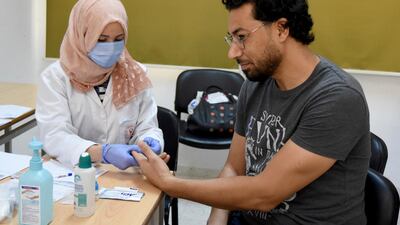
A teacher is tested in Tunis, Tunisia, ahead of a limited reopening of schools. AP -

Health workers visit riverside communities for Covid-19 coronavirus infections in Melgaco to test them at the mouth of the Amazon River in Brazil. AFP -

People wear protective masks and sit apart as they wait for the results of their coronavirus antibody tests in North Sumatra, Indonesia. AP -

A health worker takes a swab from a school worker in Cyprus. AFP -

Stephen Price winces as he receives a nasal swab to test for Covid-19 in the US state of Tennessee AP


In a study published in JAMA of 303 confirmed Covid-19 patients in South Korea in March, 110, or 36.3 per cent, were asymptomatic at the time of their isolation.
But 21 of them, 19.1 per cent, eventually went on to develop symptoms of the disease.
“The median interval of time from detection of SARS-CoV-2 to symptom onset in pre-symptomatic patients was 15 (13-20) days,” wrote the study authors.
Irene Petersen, who was an author on the study and professor of epidemiology and health informatics, told The Guardian while people may have gone on to develop symptoms, silent transmission was a risk.
“At the moment, the focus is on people who have symptoms, but if you are not catching all those who are asymptomatic or presymptomatic it may be really difficult to get outbreaks down in time, before they get out of control,” she said.
Experts estimate the true prevalence of asymptomatic Covid-19 infections to be around 40 per cent.
Last week, UCL researchers said loss of smell was a “highly specific” symptom of the virus, which may be a more reliable indicator than a cough or fever.
Researchers at the university polled 590 people who lost their sense of taste or smell earlier in the year.
Of those surveyed, 80 per cent had coronavirus antibodies, suggesting a previous infection.
Up to 40 per cent of the group did not report suffering from a cough or fever.

