• People mourn while they perform the last rites for their relatives who died with Covid-19 during their funeral at a cremation ground in Ahmedabad, India. EPA
    People mourn while they perform the last rites for their relatives who died with Covid-19 during their funeral at a cremation ground in Ahmedabad, India. EPA
  • Relatives wearing Personal Protective Equipment arrive for the funeral of their relative who died due to Covid 19 coronavirus, at a crematorium in New Delhi. AFP
    Relatives wearing Personal Protective Equipment arrive for the funeral of their relative who died due to Covid 19 coronavirus, at a crematorium in New Delhi. AFP
  • Relatives carry Jagdish Singh, 57, who is experiencing breathing problems, to a government-run hospital for treatment, amidst the coronavirus disease pandemic, in Bijnor district, Uttar Pradesh, India. Reuters
    Relatives carry Jagdish Singh, 57, who is experiencing breathing problems, to a government-run hospital for treatment, amidst the coronavirus disease pandemic, in Bijnor district, Uttar Pradesh, India. Reuters
  • Naman Sharma, a volunteer of Shri Devouthan Sewa Samiti, a non-profit organisation, sprinkles holy water on bags containing unclaimed ashes of victims who died from the coronavirus disease, at a crematorium in New Delhi, India. Reuters
    Naman Sharma, a volunteer of Shri Devouthan Sewa Samiti, a non-profit organisation, sprinkles holy water on bags containing unclaimed ashes of victims who died from the coronavirus disease, at a crematorium in New Delhi, India. Reuters
  • Relatives mourn as ambulance staff wearing Personal Protective Equipment carry the body of a Covid-19 coronavirus victim for a funeral at a crematorium in New Delhi. AFP
    Relatives mourn as ambulance staff wearing Personal Protective Equipment carry the body of a Covid-19 coronavirus victim for a funeral at a crematorium in New Delhi. AFP
  • Patients receive treatment inside a Covid-19 ward of a government-run hospital, amid the coronavirus disease pandemic, in Bijnor district, Uttar Pradesh, India. Reuters
    Patients receive treatment inside a Covid-19 ward of a government-run hospital, amid the coronavirus disease pandemic, in Bijnor district, Uttar Pradesh, India. Reuters
  • A suspected Covid-19 positive patient receives oxygen treatment at the Covid-19 hospital Ahmedabad, India. EPA
    A suspected Covid-19 positive patient receives oxygen treatment at the Covid-19 hospital Ahmedabad, India. EPA
  • A woman receives treatment inside a COVID-19 ward of a government-run hospital, amidst the coronavirus disease pandemic, in Bijnor district, Uttar Pradesh, India. Reuters
    A woman receives treatment inside a COVID-19 ward of a government-run hospital, amidst the coronavirus disease pandemic, in Bijnor district, Uttar Pradesh, India. Reuters
  • A man speaks on the phone as a doctor tries to revive his wife inside an emergency ward of a government-run hospital, amidst the coronavirus disease pandemic, in Bijnor district, Uttar Pradesh, India. Reuters
    A man speaks on the phone as a doctor tries to revive his wife inside an emergency ward of a government-run hospital, amidst the coronavirus disease pandemic, in Bijnor district, Uttar Pradesh, India. Reuters
  • Indian people after getting their oxygen cylinders refilled from an oxygen filling plant in New Delhi, India. EPA
    Indian people after getting their oxygen cylinders refilled from an oxygen filling plant in New Delhi, India. EPA

Coronavirus: Indian inactivated vaccine to be trialled in children as young as two


Gillian Duncan
  • English
  • Arabic

India gave approval for locally-produced Covid-19 vaccines to be tested on young children.

Bharat Biotech’s inactivated virus-based Covaxin is set for Phase 2 and 3 clinical trials on children between the ages of 2 and 18 years, the Drugs Controller General of India said.

More than 500 healthy children will receive two shots, 28 days apart, to test the safety and efficacy of the vaccine.

Covaxin, like Sinopharm, is an inactivated vaccine that uses the killed version of the germ that causes the coronavirus.

Several childhood vaccines are made the same way, including the polio vaccine, flu and meningitis B, which is used in the UK.

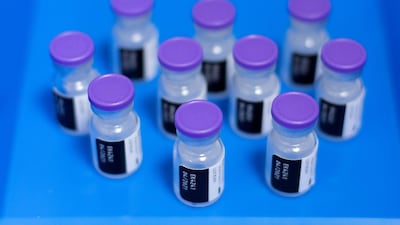
In late March, Pfizer-BioNTech embarked on a global study to test its vaccine on children in the following age groups: six months to two years; two years to five years; and five years to 11 years.

The findings from Phase 1 will help to decide the dosage level used for later stages of the trial.

In Phases 2 and 3, the company will study the immune response in children, the tolerance level in each age group and possible side effects.

Data on the age group five to 11 is expected as early as this summer, the company said.

If the trials go well, young children could be vaccinated by the end of the year, BioNTech co-founder and chief medical officer Dr Ozlem Tureci said.

“We expect the data at the end of the summer or autumn of this year. We will then file it with the regulators and, depending on how fast they react, by the end of the year we might get approval to also immunise younger children,” she said.

The Pfizer-BioNTech vaccine was recently cleared for use in adolescents between the ages of 12 and 15 in the US after a trial showed it was safe and 100 per cent effective.

In January, Chinese state media reported that the company had completed a trial in children aged three to 17 years and found Beijing’s Sinopharm vaccine, also known as BBIBP-CorV, to be safe.

But no data was made available on the efficacy rate or side effects at the time and it has not yet been approved for use in children in China or elsewhere.

In February, Oxford/AstraZeneca began a trial to test the efficacy of its vaccine in children aged between six and 17. It was later halted because of the link between the vaccine and rare blood clots.

  • The Al Hosn app can be used as official proof of vaccination, to show negative PCR test status, to travel and to enter certain live events.
    The Al Hosn app can be used as official proof of vaccination, to show negative PCR test status, to travel and to enter certain live events.
  • Asha Susan Philip, a nurse with Dubai Health Authority, receives the Pfizer vaccine. On Tuesday, Abu Dhabi also approved the Pfizer-BioNTech vaccine for use in the emirate.
    Asha Susan Philip, a nurse with Dubai Health Authority, receives the Pfizer vaccine. On Tuesday, Abu Dhabi also approved the Pfizer-BioNTech vaccine for use in the emirate.
  • A child, 9, is held by her mother as she receives the second dose of the Pfizer vaccine during a clinical trial for children at Duke University in the US. In the UAE, those who are 16 and above are eligible to receive the vaccine.
    A child, 9, is held by her mother as she receives the second dose of the Pfizer vaccine during a clinical trial for children at Duke University in the US. In the UAE, those who are 16 and above are eligible to receive the vaccine.
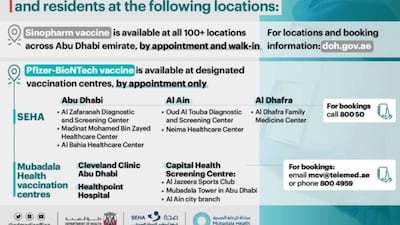
  • The Pfizer vaccine will be available at select clinics in Abu Dhabi city, Al Ain and Al Dhafrah, by appointment only.
    The Pfizer vaccine will be available at select clinics in Abu Dhabi city, Al Ain and Al Dhafrah, by appointment only.
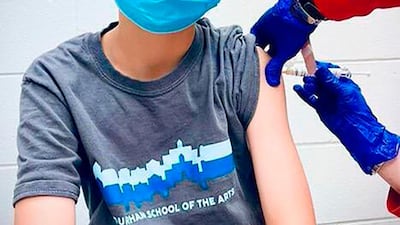
  • A boy receives an injection during a trial of the Pfizer-BioNTech coronavirus vaccine among children aged between 12 and 15, at Duke University in the US.
    A boy receives an injection during a trial of the Pfizer-BioNTech coronavirus vaccine among children aged between 12 and 15, at Duke University in the US.
  • Last week, Dubai Health Authority said recovered patients and breastfeeding mothers are now eligible for Pfizer-BioNTech vaccine.
    Last week, Dubai Health Authority said recovered patients and breastfeeding mothers are now eligible for Pfizer-BioNTech vaccine.
  • Pfizer received emergency approval in the UAE in December after trials showed it was 95 per cent effective. Dubai started distributing it in December and the vaccine is now available in the capital.
    Pfizer received emergency approval in the UAE in December after trials showed it was 95 per cent effective. Dubai started distributing it in December and the vaccine is now available in the capital.
  • The Pfizer-BioNTech vaccine is the second Covid-19 vaccine to be made available in Abu Dhabi, which began a mass vaccine campaign in mid-December using a shot produced by Chinese company Sinopharm.
    The Pfizer-BioNTech vaccine is the second Covid-19 vaccine to be made available in Abu Dhabi, which began a mass vaccine campaign in mid-December using a shot produced by Chinese company Sinopharm.

Experts said vaccinating children against the disease could change the course of the pandemic.

If children are unvaccinated, there is a significant risk of a resurgence of the virus.

Many children who contract Covid-19 have no symptoms, and those who become ill experience milder symptoms than adults, including a low-grade fever and cough. But a very small percentage become severely sick and even die.

Covid-19 can lead to a dangerous condition called multisystem inflammatory syndrome in children, which can affect the heart, lungs, kidneys, brain, skin, eyes, or gastrointestinal organs.