


Delaying or avoiding medical care to treat early signs of Covid-19 is leading to more deaths and patients suffering severe symptoms of the disease, UAE doctors said.
The seven-day average of new coronavirus cases diagnosed each day in the UAE has climbed above 3,000 since mid-January.
It led to more severe cases and deaths than during the first wave of the pandemic in May.
Dr Farida Al Hosani, spokeswoman for the health sector, said early treatment can save lives and help to reduce intensive care admissions.
“We call on all people to go to the nearest health centre if they display symptoms and provide health authorities with information on contacts to protect them and others – especially people most at risk of developing symptoms and complications of the disease,” Dr Al Hosani said on Tuesday.
“There are some people who neglect respiratory symptoms and do not go for an examination until their health deteriorates and they develop acute respiratory symptoms, such as shortness of breath."
A weekly average of 10 deaths or more has been recorded in the Emirates since early February – three times the numbers reported for most of 2020.
The trend is a worry for doctors. They said that while more tests were being done to identify cases, infected people were delaying medical treatment once symptoms appeared.
"People are taking it very lightly once they get a positive test," said Dr Sarla Kumari, an internal medicine specialist at Canadian Specialist Hospital in Dubai.
“We are having more numbers of tests so more detection of cases. This might be labelled as a surge of infection.”
Further safety measures have been introduced across Dubai as a result of soaring cases this year.
The number of people allowed in malls, hotels and beaches has been cut to 70 per cent, with capacity at indoor seated venues such as cinemas and theatres set at 50 per cent.
“People are only quarantining themselves once their health deteriorates, so they are seeking medical attention very late,” Dr Kumari said.
“As many people are still working from home or are scared to go to the gym or outside for physical activities we have seen more obesity among people, another contributing risk factor.

“If they get the Covid-19 infection, usually their prognosis is bad.”
Failure to properly manage existing health complaints such as hypertension and diabetes was also taking a toll on patients.
Young people may be more at risk of infection while the elderly and most vulnerable are given priority in the national vaccination programme, doctors said.
While the majority of patients seen by doctors were aged between 35 and 65, there was a growing trend of young people seeking medical help after a positive test.
“More young people are getting infected as they are having more interaction with people at workplaces and for leisure activities,” Dr Kumari said.
“Since last year many people in the old age group are usually confined to home and the majority have had their vaccinations.

“This could be the reason why we are seeing a surge in positive cases among the young and middle-aged.”
Dubai Health Authority issued a comprehensive list of guidelines this month that offered advice to those who tested positive for Covid-19, or have been in close contact with someone who has the virus.
Dr Adel Al Sisi, a critical care consultant and chief medical officer at Prime Hospital Dubai, said the hospital treated 10 critical cases during the second wave of the pandemic.
“The statistics are higher during this second wave and their symptoms are more severe,” he said.
“A response to treatment is much better in those who see us earlier compared with those who come to us at a later stage.
“If someone has a fever or a cough for 10 days before they see a doctor, usually the outcome is worse.
“They are more at risk of spending a prolonged period of time in hospital or even dying.”
The authority urged those in close contact with a positive case to isolate to help limit the spread of the virus after New Year celebrations and gatherings.
Health officials said people who took test should isolate until they received a negative result.
Dr Shahid Gauhar, chairman of the paediatric and neonatal unit at Prime Hospital, said new mutations of the virus presented different symptoms in younger children.
“The new mutations we are seeing are resulting in more severe symptoms in younger people, that is clear,” he said.
“In the previous wave, children were only presenting with upper respiratory tract infections and mild to moderate symptoms that responded very quickly to treatment.
“Unfortunately, the new strains are alarming for them.”
Doctors reported different symptoms of gastrointestinal problems such as diarrhoea and vomiting in children, along with more typical breathing problems and joint pain.
School-age children appear to be more vulnerable to being infected with the new strains than during the initial months of the pandemic, doctors said.
"Because of the experience we have had over the past year or so, many parents believe their children will not suffer from Covid-19, but they need to know that this is something different," Dr Gauhar said.
“This virus is now affecting children, so parents should be prepared to spot any signs or symptoms and immediately contact their health provider. Early intervention is very important.”
UAE vaccination drive – in pictures
-
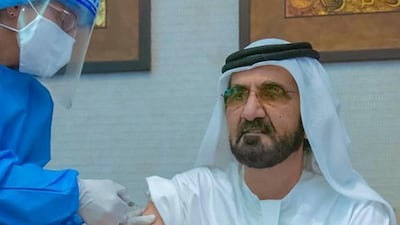
Sheikh Mohammed bin Rashid receives the Sinopharm vaccine to protect against Covid-19 on November 3, 2020. Courtesy: Dubai Media Office -
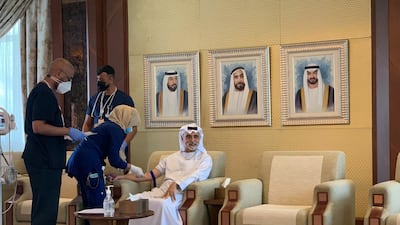
Sheikh Nahyan bin Mubarak receives the first of two shots of a vaccine that was trialled in the UAE. Wam -
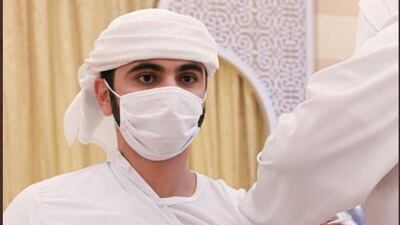
Sheikh Mansoor bin Mohammed, chairman of Dubai’s Supreme Committee of Crisis and Disaster Management, receives the Pfizer-BioNTech vaccine. Courtesy: Sheikh Mansoor -
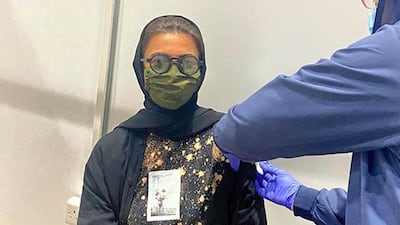
Noura Al Kaabi, Minister of Culture and Youth, gets the Sinopharm jab. -
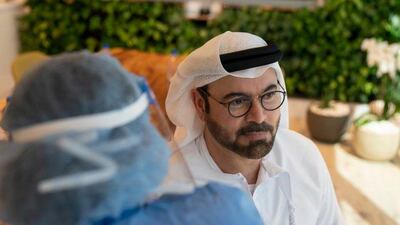
Mohammad Al Gergawi, Minister of Cabinet Affairs, receives the Covid-19 Sinopharm vaccine on Saturday, October 31. Courtesy: UAE Government Twitter -
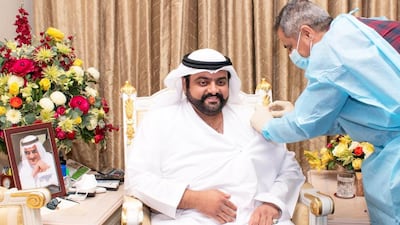
Sheikh Mohammed bin Hamad Al Sharqi, Crown Prince of Fujairah, receives his first dose of the Covid-19 vaccine on Wednesday. Wam -
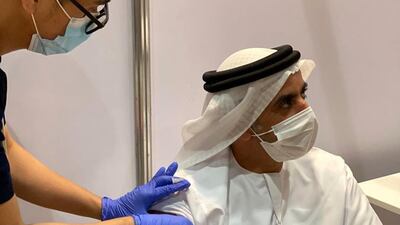
Sheikh Saif bin Zayed, Deputy Prime Minister and Minister of Interior, takes the Sinopharm vaccine. Courtesy: Sheikh Saif bin Zayed Twitter -
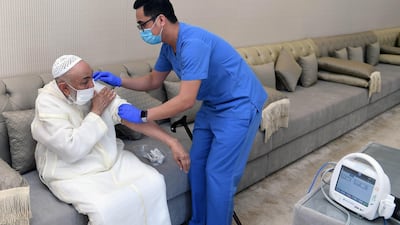
Sheikh Abdullah bin Bayyah, UAE Fatwa Council, is vaccinated with the Sinopharm innoculation on January 4, 2021. Wam -

Sheikh Khalid bin Mohammed, chair of Abu Dhabi's Executive Office, takes the first dose of the Sinopharm vaccine. Courtesy: Abu Dhabi Media Office -
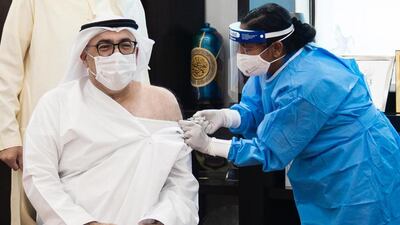
The UAE's health minister, Abdulrahman Al Owais, receives the Sinopharm vaccine. -
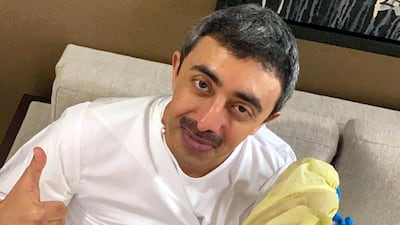
Sheikh Abdullah bin Zayed, Minister of Foreign Affairs and International Co-operation, gives a thumbs up as he is vaccinated against Covid-19. -
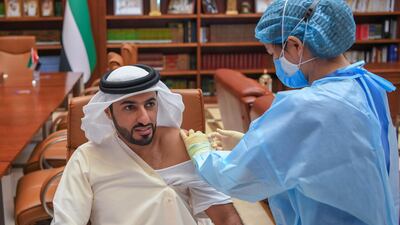
Sheikh Rashid bin Humaid Al Nuaimi, president of the UAE Football Association, receives the Covid-19 vaccine. -
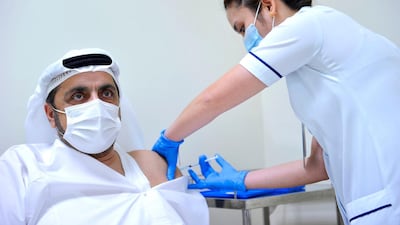
Khalifa bin Dary, executive director of Dubai Ambulance Services Corporation, receives his first dose of the Pfizer-BioNTech vaccine. Courtesy: Dubai Media Office -
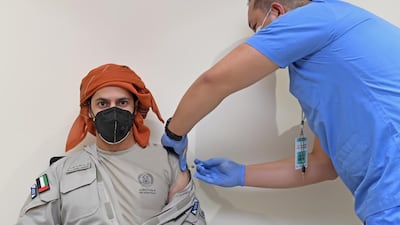
Lt Col Sheikh Zayed bin Hamad Al Nahyan, director of special patrols at Abu Dhabi Police, receives the Covid-19 vaccine. Courtesy: Abu Dhabi Police -
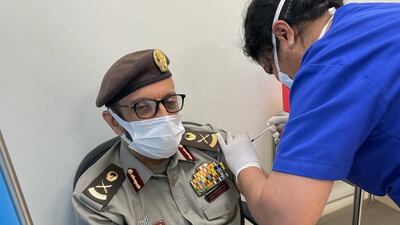
Maj Gen Mohammed Al Marri, director general of the General Directorate of Residency and Foreigners Affairs Dubai, receives his first dose of the Pfizer-BioNTech vaccine. Courtesy: Dubai Media Office -
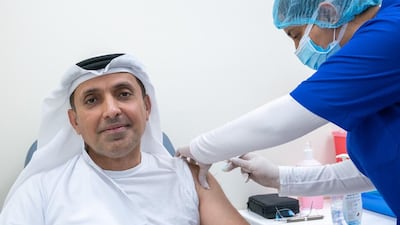
Maj Gen Talal Al Falasi, director general of Dubai's State Security Department, receives his first dose of the Pfizer-BioNTech vaccine. Courtesy: Dubai Media Office -
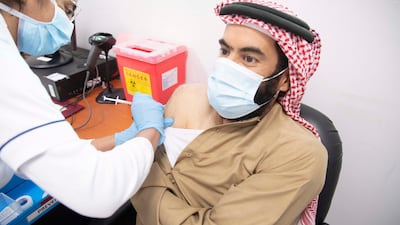
Abdullah Al Falasi, director general of Dubai Government Human Resources Department, receives his first dose of the Pfizer-BioNTech vaccine. Courtesy: Dubai Media Office -
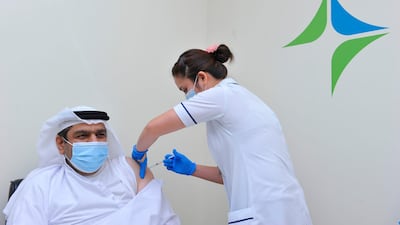
Amer Sharif, head of Dubai's Covid-10 Command and Control Centre, receives his first dose of the Pfizer-BioNTech vaccine. Courtesy: Dubai Media Office -
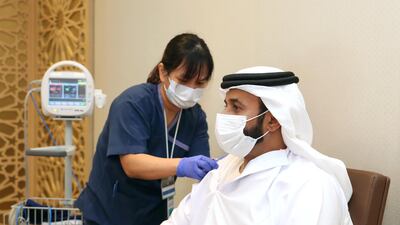
Obaid Al Shamsi, director general of the National Emergency Crisis and Disasters Management Authority, takes the first dose of Covid-19 vaccine



