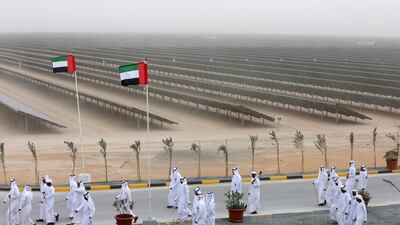

Clearer skies prompted by a dramatic drop in air and road traffic have offered an unexpected boost to solar power production.
Scaled-back industry brought pollution relief to many areas of China and much of Europe due to coronavirus-enforced restrictions.
A similar impact is being felt in the UAE with solar power set to reap the rewards, according to one expert.
“With flights grounded, schools and universities closed and many people working from home, this has resulted in less air traffic and cars on the road and has led to fewer pollutants in the air,” said Yousif Al Ali, executive director of clean energy at Masdar, the government-backed renewable power specialists.
“In principle, having less pollution in the air will have a minor increase in solar power generation.
“This will happen in cities due to two reasons: the improvement of the irradiation received by solar panels and the reduction of the soiling on the surface of the photovoltaic panels and concentrated solar power mirrors.”
-
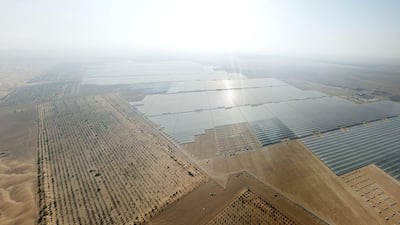
An aerial image of Noor solar park near Sweihan, Abu Dhabi. The array of 3.2 million panels make it the largest single-site solar site in the world. Courtesy: Noor Abu Dhabi -
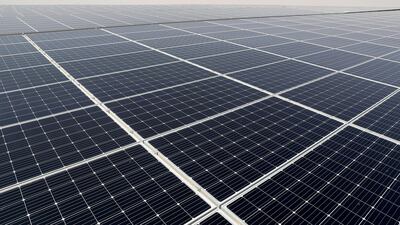
The plant produces enough electricity to power about 90,000 homes. Pawan Singh / The National -
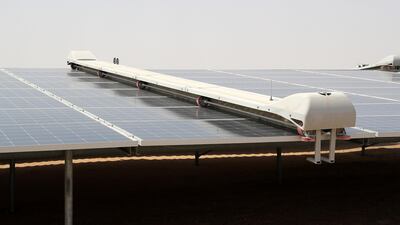
Cleaning dust from the solar panels is crucial to ensuring they work at maximum capacity. Robot cleaners run along the fields of panels throughout the day. Pawan Singh / The National -
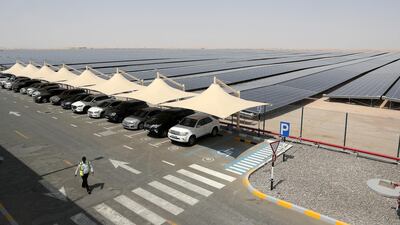
With the help of the latest technology and robots, a small management team and a daily workforce of about 70 run the huge plant. Pawan Singh / The National -
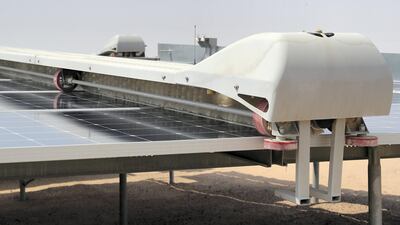
A robot cleaner goes to work on the solar panels. Although the country has an abundance of sun, the panels become covered with dust and lose their effectiveness if not regularly cleaned. Pawan Singh / The National -
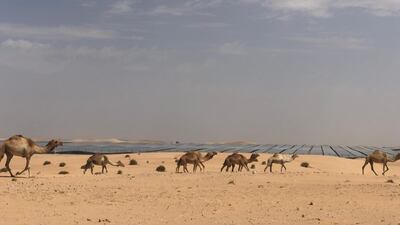
A herd of camels graze close to Abu Dhabi's Noor solar park. Courtesy: Noor Abu Dhabi -
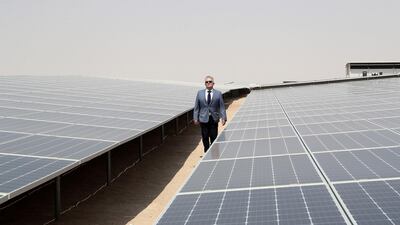
The site is so large it would take hours to cover it on foot. Pawan Singh / The National


According to Environment Agency Abu Dhabi, there has been a significant reduction in air pollution since the UAE announced safety measures to help combat the spread of Covid-19.
The latest agency data showed a 50 per cent reduction in the average nitrogen dioxide levels usually seen at this time of year.
A similar pattern has been experienced in Germany, Spain and the UK where the nation’s solar output record was broken on April 20.
According to research by the University of Sheffield, solar power generation peaked at 9.68 gigawatts, almost 30 per cent of the UK’s electricity demand.
New records were also set in Germany on April 20 and in Spain on March 26.
Reduced air pollution means solar panels require less cleaning, reducing maintenance costs and boosting power generation.
Despite the noticeable improvements in power generation elsewhere, experts said a quantifiable improvement in the UAE could be hard to assess.
Solar energy provider SirajPower provides solar energy services to the commercial and industrial sectors across the UAE.
“In general, the level of pollution due to industrial activities in the UAE is much less than in most other parts of the world,” said Laurent Longuet, SirajPower’s CEO.
“The only main source of emission that may affect the weather in the UAE is car traffic.
Read More
Abu Dhabi solar scheme receives lowest tariff in the world
UAE calls for accelerated shift towards green energy
“Due to its geographic location next to the Arabian Gulf and the desert, the sky in the UAE is much less sensitive to the pollution that may come from vehicles than the locations in Europe where significant improvements have been observed.
“Since the beginning of the lockdown, we have not observed any significant change in terms of the quantity of energy we receive daily from the sun radiation compared to last year.”
A drive towards more sustainable sources of energy is accelerating in Dubai where it is hoped renewable power will make up 75 per cent of the emirate’s requirements by 2050.
To aid that, the Dubai Electricity and Water Authority is building the world’s largest solar energy park in the emirate's desert.
The 900-megawatt fifth phase of the Mohammed bin Rashid Al Maktoum Solar Park will be commissioned in stages, starting from the third quarter of next year.
“We strongly believe that pursuing the efforts made to grow the share of renewable energies and especially solar is needed,” Mr Longuet said.
“The UAE has been pioneering the efforts in that respect by developing the largest solar plants in the world and allowing private consumers to do so with the net-metering policy in Dubai.
“When it comes to car traffic, electric and hydrogen vehicles are definitely solutions to be further developed.”

