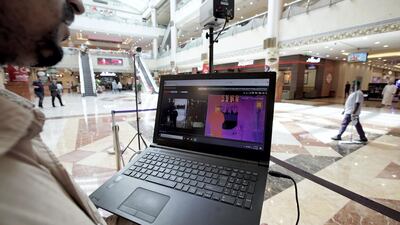

Artificial intelligence has been vital in controlling the spread of the coronavirus in the Arabian Gulf, a health conference has been told.
Technology has forecast the pandemic’s development and informed residents when they have been in contact with infected individuals, the Riyadh Global Digital Health Summit heard.
The summit was also told that the rapid growth in telemedicine – such as video or telephone consultations – is not likely to be reversed when the pandemic is over.
However, experts cautioned that organisations were not doing enough to share vital data that could save lives and certain ethical concerns about the use of data had not been resolved.
-
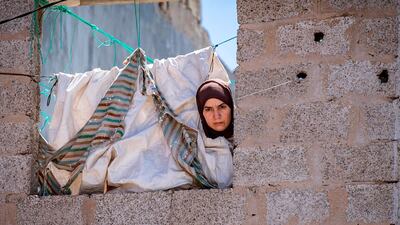
A Moroccan woman confined at home, peeks out a window in the southern port city of Safi during a lockdown ordered by the authorities following the detection of several new Covid-19 cases. AFP -
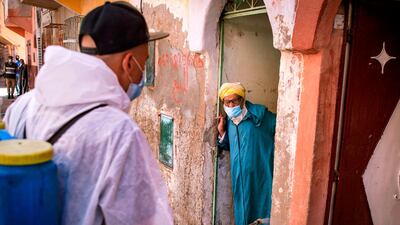
A man confined at home watches as a Moroccan municipal worker disinfects his street in the southern port city of Safi on June 9, 2020, during a lockdown ordered by the authorities following the detection of several new cases of Covid-19. AFP -
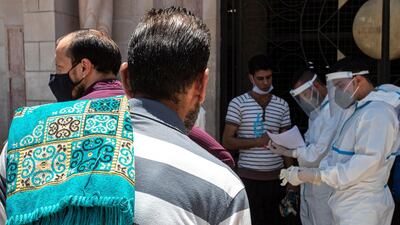
A man stands with a prayer rug on his shoulder as Jordanian medics get ready to perform a coronavirus test, in front of Husseini Mosque, before the Friday prayer in central Amman, Jordan. EPA -
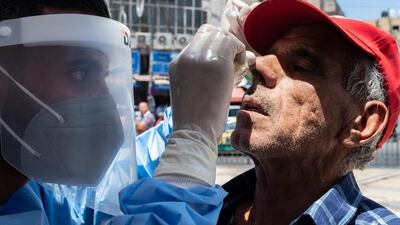
A Jordanian medic performs a coronavirus test, in front of Husseini Mosque, before the Friday prayer in central Amman, Jordan. EPA -

A member of the Syrian Civil Defence, also known as the 'White Helmets' disinfects a room at a physiotherapy centre in Syria's rebel-held northwest city of Idlib. AFP -

Men fly a handmade kite from a roof, following the outbreak of the coronavirus, in Cairo, Egypt. Reuters -
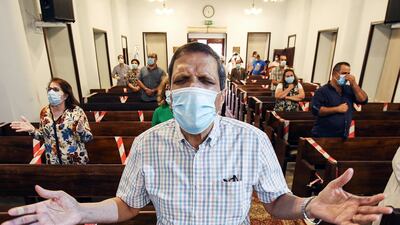
Mask-clad worshippers, adequately distanced from each other, sing together a prayer song during a service at the National Evangelical Church in Kuwait City. AFP -

A Saudi worshipper wearing a face mask to prevent the spread of Covid-19, prays at the Al Mirabi Mosque in Jeddah, Saudi Arabia. AP


Dr Esam Al Wagait, director of Saudi Arabia’s National Information Centre, said the Kingdom’s artificial intelligence (AI) based Covid-19 Index had been crucial in forecasting the virus’s spread locally, including which areas would be most heavily affected and how many people would fall ill. “It helps decision-makers,” he said. “We need to understand how many people will need help in an area, how many healthcare workers will be needed and how many medicines we [should] buy. To do the proper preparation, we need a proper prediction model.”
He highlighted two mobile phone apps developed by the Saudi Arabian authorities, Tawakkalna and Tabaud, which were, for example, informing residents when they have been in contact with infected individuals and warning them if they were near areas with high infection rates.
Globally, AI-based technologies have become vital in diagnosis, such as in determining if a person’s cough is characteristic of Covid-19. But Dr Al Wagait said there was much room for improvement in how data was used.
“When it comes to prediction, there’s an issue of a lack of good quality data,” he said. “We’re not realising the full potential of AI. We’re being reactive and not proactive.”
Data may not be complete because organisations work in “silos” and fail to share data. The conference also heard there were many unresolved issues around AI, such as ethical concerns over privacy, and liability issues if technology misdiagnosed illnesses.
It is not just healthcare data that can improve medical services, the conference was told. Information such as global flight patterns and data on animal and insect populations can also identify how diseases emerge or spread.
Data from outbreaks of other diseases, including Middle East Respiratory Syndrome (Mers), can be useful in understanding patterns of coronavirus spread, according to another delegate.
Dr Chiara Poletto, of the Pierre Louis Institute of Epidemiology and Public Health in Paris, said patterns of Mers infections in areas such as Europe were used to determine what the situation had been like where the disease originated.
“We could provide some assessment of the situation in the Middle East,” she said.
Similar techniques were subsequently employed by researchers outside China to infer coronavirus infection rates in Wuhan, where the pandemic originated.
The summit itself was an indication of how digital technology can be used to share healthcare information faster to larger numbers of people.
Instead of having hundreds of conference delegates visit the Saudi Arabian capital, it involved participants across the globe delivering lectures to thousands said to be watching online, with just a small number participating from a Riyadh conference centre.
Organised by, among others, the Saudi Arabian Ministry of National Guard – Health Affairs, the event ended with the announcement of the “Riyadh Declaration”, a “call to action” to share best practices in digital healthcare and real-time high-quality data. This was important, the declaration said, in creating resilient healthcare systems better able to cope with future pandemics.
Another issue to come under the spotlight was the growth during the pandemic of telemedicine, the diagnosis of illness using telecommunications technology.
Dr Louise Schaper, chief executive of the Australasian Digital Health Institute, said healthcare systems had seen “dramatic increases” in such remote working.
“We’re undergoing a paradigm shift,” she said. “Healthcare that was once delivered in … surgeries and hospitals will increasingly reach us consumers over the phone, over a video, over an app, in a retail clinic or in people’s homes.”
As well as acknowledging such rapid changes meant that clinicians often “felt burdened”, she also said they would create upheaval for healthcare organisations, all of which would have to “rewrite their business plan”.
There would, Dr Schaper said, be more “virtual-only” healthcare providers, which have sometimes sparked controversy.
Another concern over the growth of telemedicine was inequality, as some lack access to the technologies involved and so risk receiving poorer care.

