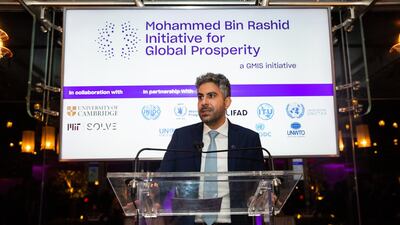
Twenty finalists for a $1 million prize set up by the Ruler of Dubai were revealed on Monday, ahead of an awards ceremony in September.
The group of start-ups will deliver their pitches for the Global Maker Challenge, against a backdrop of economic struggles and poverty linked to the coronavirus pandemic, organisers said.
The shortlisted 20 have harnessed technologies such as machine learning, artificial intelligence, smart materials or cloud networks that could help disadvantaged communities around the world.
Finalists include companies with products that connect farmers in the developing world with international buyers, and inventors of fibres that could cut pollution and waste in the global fashion industry.
We must double our efforts in utilising innovation to address humanitarian challenges and offer solutions to the unprecedented challenges caused by this crisis
The Mohammed bin Rashid Initiative for Global Prosperity, which runs the challenge, said the finalists were selected from more than 3,400 entries.
"Innovation is key to controlling the damage caused by Covid-19 and bringing us back to speed towards a more sustainable future," said Badr Al Olama, head of the organising committee for the Global Manufacturing and Industrialisation Summit, which hands out the prize each year.
"We must double up on our efforts in utilising innovation to address humanitarian challenges and offer solutions to the unprecedented challenges caused by this crisis."
The 20 finalists were chosen by Massachusetts Institute of Technology’s Solve initiative and a jury of 47 judges from UN agencies and charities, as well as academics.
Final pitches will be made to judges online because of the pandemic, and will focus on the social impact of their products and campaigns.
Last year, at the GMIS summit in Yekaterinburg, Russia, four companies were handed $100,000 each, while the 12 runners-up were awarded $10,000 each.
India's A2P Energy Solution created a way to turn paddy straw, which is widely burnt off in India generating huge pollution, into pellets to be used in renewable energy.
Canada's Rumie Initiative created a learning platform that required virtually no internet connection to use.
TruTrade impressed judges with its ability to connect smallholders to sustainable food markets in Sub-Saharan Africa, improving their businesses and families' lives.
And India's Garv Toilets was named winner of the Sustainable Cities challenge for its plan to provide low-income urban communities with low-cost sanitation, the lack of which has huge implications for public health and hygiene.
A full list of this year's finalists and details of the event on September 6 are available here.
This year's categories and finalists
Sustainable and Healthy Food for All: How can urban populations increase access to healthy and sustainable foods, despite rapid urbanisation?
The finalists are:
- ColdHubs – provides solar-powered, walk-in cold storage for perishable foods produced by rural farmers in developing countries.
- Ixon – develops advanced packaging technology that enables the sterilisation of food at room temperature.
- Xilinat – created a biotechnological and patented process to transform agricultural waste into a low-calorie sugar substitute that looks and tastes like sugar.
- Stixfresh – developed stickers that create a protective layer around fresh food produce to slow down spoiling, providing economic benefit for small farmers without climate-controlled warehouses.
- Nilus – a social enterprise platform that creates affordable and healthy food digital marketplace for low-income people.
Innovation for Inclusive Trade: How can rural communities increase their access to new supply chains and markets to create better livelihoods for themselves?
The finalists are:
- Agricycle Global – zero-electricity food dryer technology that connects rural farmers to international markets.
- Fantine – blockchain-enabled marketplace that allows coffee farmers to deal directly with roasters and buyers.
- Poket – crowd-sourced registry of offline merchants capable of mapping last-mile rural supply chains.
- Takachar – portable technology that enables small farms to convert crop residues into products.
- ChapChap – digital platform that helps small businesses keep track of transactions and perform basic accounting.
Innovation for Peace and Justice: How can displaced populations access affordable and quality services that are essential to their safety and well-being?
The finalists are:
- Peripheral Vision International – an app that uses gaming and voice response technology to ease learning for refugees.
- ID2020 – a digital platform that allows displaced people greater ownership of their own healthcare records, educational certificates and professional credentials.
- PeaceTech Lab – provider of legal services and technology skills training offered online in refugee camps.
- Simbi Foundation – developer of solar-powered learning hubs that provide access to digital education.
- Aiyin – run virtual reality learning spaces for facilities without the physical and monetary capacity to build real ones.
Climate Change: How can communities move towards a low-carbon circular economy by eliminating waste and using existing resources?
The finalists are:
- AlgiKnit – provides a sustainable fibre for the fashion industry, which is biodegradable, comfortable and low-cost.
- Aquacycl – has built a fuel cell capable of generating electricity from wastewater.
- Queen of Raw – an online marketplace designed for trading unused textiles to reduce landfill.
- Plastics for Change – an ethical sourcing platform that provides sustainable livelihoods and expedites transition towards a circular economy.
- Biocellection – an innovation capable of upcycling unrecyclable plastic waste into performance materials for fashion and 3D printing.

Winners
Ballon d’Or (Men’s)
Ousmane Dembélé (Paris Saint-Germain / France)
Ballon d’Or Féminin (Women’s)
Aitana Bonmatí (Barcelona / Spain)
Kopa Trophy (Best player under 21 – Men’s)
Lamine Yamal (Barcelona / Spain)
Best Young Women’s Player
Vicky López (Barcelona / Spain)
Yashin Trophy (Best Goalkeeper – Men’s)
Gianluigi Donnarumma (Paris Saint-Germain and Manchester City / Italy)
Best Women’s Goalkeeper
Hannah Hampton (England / Aston Villa and Chelsea)
Men’s Coach of the Year
Luis Enrique (Paris Saint-Germain)
Women’s Coach of the Year
Sarina Wiegman (England)
The specs: 2018 Nissan Altima
Price, base / as tested: Dh78,000 / Dh97,650
Engine: 2.5-litre in-line four-cylinder
Power: 182hp @ 6,000rpm
Torque: 244Nm @ 4,000rpm
Transmission: Continuously variable tranmission
Fuel consumption, combined: 7.6L / 100km
Our legal consultant
Name: Hassan Mohsen Elhais
Position: legal consultant with Al Rowaad Advocates and Legal Consultants
Russia's Muslim Heartlands
Dominic Rubin, Oxford
T20 WORLD CUP QUALIFIER
Results
UAE beat Nigeria by five wickets
Hong Kong beat Canada by 32 runs
Friday fixtures
10am, Tolerance Oval, Abu Dhabi – Ireland v Jersey
7.30pm, Zayed Cricket Stadium, Abu Dhabi – Canada v Oman
The specs
Engine: 4.0-litre V8 twin-turbocharged and three electric motors
Power: Combined output 920hp
Torque: 730Nm at 4,000-7,000rpm
Transmission: 8-speed dual-clutch automatic
Fuel consumption: 11.2L/100km
On sale: Now, deliveries expected later in 2025
Price: expected to start at Dh1,432,000
Ferrari 12Cilindri specs
Engine: naturally aspirated 6.5-liter V12
Power: 819hp
Torque: 678Nm at 7,250rpm
Price: From Dh1,700,000
Available: Now
Specs
Engine: Dual-motor all-wheel-drive electric
Range: Up to 610km
Power: 905hp
Torque: 985Nm
Price: From Dh439,000
Available: Now
The specs
Engine: 2.0-litre 4-cyl turbo
Power: 201hp at 5,200rpm
Torque: 320Nm at 1,750-4,000rpm
Transmission: 6-speed auto
Fuel consumption: 8.7L/100km
Price: Dh133,900
On sale: now
Mercer, the investment consulting arm of US services company Marsh & McLennan, expects its wealth division to at least double its assets under management (AUM) in the Middle East as wealth in the region continues to grow despite economic headwinds, a company official said.
Mercer Wealth, which globally has $160 billion in AUM, plans to boost its AUM in the region to $2-$3bn in the next 2-3 years from the present $1bn, said Yasir AbuShaban, a Dubai-based principal with Mercer Wealth.
“Within the next two to three years, we are looking at reaching $2 to $3 billion as a conservative estimate and we do see an opportunity to do so,” said Mr AbuShaban.
Mercer does not directly make investments, but allocates clients’ money they have discretion to, to professional asset managers. They also provide advice to clients.
“We have buying power. We can negotiate on their (client’s) behalf with asset managers to provide them lower fees than they otherwise would have to get on their own,” he added.
Mercer Wealth’s clients include sovereign wealth funds, family offices, and insurance companies among others.
From its office in Dubai, Mercer also looks after Africa, India and Turkey, where they also see opportunity for growth.
Wealth creation in Middle East and Africa (MEA) grew 8.5 per cent to $8.1 trillion last year from $7.5tn in 2015, higher than last year’s global average of 6 per cent and the second-highest growth in a region after Asia-Pacific which grew 9.9 per cent, according to consultancy Boston Consulting Group (BCG). In the region, where wealth grew just 1.9 per cent in 2015 compared with 2014, a pickup in oil prices has helped in wealth generation.
BCG is forecasting MEA wealth will rise to $12tn by 2021, growing at an annual average of 8 per cent.
Drivers of wealth generation in the region will be split evenly between new wealth creation and growth of performance of existing assets, according to BCG.
Another general trend in the region is clients’ looking for a comprehensive approach to investing, according to Mr AbuShaban.
“Institutional investors or some of the families are seeing a slowdown in the available capital they have to invest and in that sense they are looking at optimizing the way they manage their portfolios and making sure they are not investing haphazardly and different parts of their investment are working together,” said Mr AbuShaban.
Some clients also have a higher appetite for risk, given the low interest-rate environment that does not provide enough yield for some institutional investors. These clients are keen to invest in illiquid assets, such as private equity and infrastructure.
“What we have seen is a desire for higher returns in what has been a low-return environment specifically in various fixed income or bonds,” he said.
“In this environment, we have seen a de facto increase in the risk that clients are taking in things like illiquid investments, private equity investments, infrastructure and private debt, those kind of investments were higher illiquidity results in incrementally higher returns.”
The Abu Dhabi Investment Authority, one of the largest sovereign wealth funds, said in its 2016 report that has gradually increased its exposure in direct private equity and private credit transactions, mainly in Asian markets and especially in China and India. The authority’s private equity department focused on structured equities owing to “their defensive characteristics.”
The specs
Engine: 1.5-litre turbo
Power: 181hp
Torque: 230Nm
Transmission: 6-speed automatic
Starting price: Dh79,000
On sale: Now
Emergency phone numbers in the UAE
Estijaba – 8001717 – number to call to request coronavirus testing
Ministry of Health and Prevention – 80011111
Dubai Health Authority – 800342 – The number to book a free video or voice consultation with a doctor or connect to a local health centre
Emirates airline – 600555555
Etihad Airways – 600555666
Ambulance – 998
Knowledge and Human Development Authority – 8005432 ext. 4 for Covid-19 queries
COMPANY%20PROFILE
%3Cp%3E%3Cstrong%3EName%3A%3C%2Fstrong%3E%20PlanRadar%3Cbr%3E%3Cstrong%3EStarted%3A%20%3C%2Fstrong%3E2013%3Cbr%3E%3Cstrong%3ECo-founders%3A%20%3C%2Fstrong%3EIbrahim%20Imam%2C%20Sander%20van%20de%20Rijdt%2C%20Constantin%20K%C3%B6ck%2C%20Clemens%20Hammerl%2C%20Domagoj%20Dolinsek%3Cbr%3E%3Cstrong%3EBased%3A%20%3C%2Fstrong%3EVienna%2C%20Austria%3Cbr%3E%3Cstrong%3ESector%3A%20%3C%2Fstrong%3EConstruction%20and%20real%20estate%3Cbr%3E%3Cstrong%3ECurrent%20number%20of%20staff%3A%20%3C%2Fstrong%3E400%2B%3Cbr%3E%3Cstrong%3EInvestment%20stage%3A%20%3C%2Fstrong%3ESeries%20B%3Cbr%3E%3Cstrong%3EInvestors%3A%3C%2Fstrong%3E%20Headline%2C%20Berliner%20Volksbank%20Ventures%2C%20aws%20Gr%C3%BCnderfonds%2C%20Cavalry%20Ventures%2C%20Proptech1%2C%20Russmedia%2C%20GR%20Capital%3C%2Fp%3E%0A
Company profile
Company: Eighty6
Date started: October 2021
Founders: Abdul Kader Saadi and Anwar Nusseibeh
Based: Dubai, UAE
Sector: Hospitality
Size: 25 employees
Funding stage: Pre-series A
Investment: $1 million
Investors: Seed funding, angel investors
Marathon results
Men:
1. Titus Ekiru(KEN) 2:06:13
2. Alphonce Simbu(TAN) 2:07:50
3. Reuben Kipyego(KEN) 2:08:25
4. Abel Kirui(KEN) 2:08:46
5. Felix Kemutai(KEN) 2:10:48
Women:
1. Judith Korir(KEN) 2:22:30
2. Eunice Chumba(BHR) 2:26:01
3. Immaculate Chemutai(UGA) 2:28:30
4. Abebech Bekele(ETH) 2:29:43
5. Aleksandra Morozova(RUS) 2:33:01
THE%20HOLDOVERS
%3Cp%3E%3Cstrong%3EDirector%3A%20%3C%2Fstrong%3EAlexander%20Payne%3C%2Fp%3E%0A%3Cp%3E%3Cstrong%3EStarring%3A%3C%2Fstrong%3E%20Paul%20Giamatti%2C%20Da'Vine%20Joy%20Randolph%2C%20Dominic%20Sessa%3C%2Fp%3E%0A%3Cp%3E%3Cstrong%3ERating%3A%3C%2Fstrong%3E%204.5%2F5%3C%2Fp%3E%0A
The%C2%A0specs%20
%3Cp%3E%0D%3Cstrong%3EEngine%3A%20%3C%2Fstrong%3E6-cylinder%2C%204.8-litre%20%0D%3Cbr%3E%3Cstrong%3ETransmission%3A%20%3C%2Fstrong%3E5-speed%20automatic%20and%20manual%0D%3Cbr%3E%3Cstrong%3EPower%3A%20%3C%2Fstrong%3E280%20brake%20horsepower%20%0D%3Cbr%3E%3Cstrong%3ETorque%3A%20%3C%2Fstrong%3E451Nm%20%0D%3Cbr%3E%3Cstrong%3EPrice%3A%20%3C%2Fstrong%3Efrom%20Dh153%2C00%0D%3Cbr%3E%3Cstrong%3EOn%20sale%3A%20%3C%2Fstrong%3Enow%3C%2Fp%3E%0A
Asia Cup 2018 Qualifier
Sunday's results:
- UAE beat Malaysia by eight wickets
- Nepal beat Singapore by four wickets
- Oman v Hong Kong, no result
Tuesday fixtures:
- Malaysia v Singapore
- UAE v Oman
- Nepal v Hong Kong
