


Expo 2020 Dubai will have a specialised 3D printing area, Sheikh Hamdan bin Mohammed, the Crown Prince of Dubai, said during a meeting of the Executive Council on Sunday.
The hub will include a research centre, an academy and laboratories to help develop the technology.
Authorities will also set up business accelerators for 3D start-ups to attract investors and entrepreneurs.
Sheikh Hamdan first launched the 3D Printing Strategic Alliance last summer, to provide a platform to bring together interested government organisations, academics and businesses in the UAE and around the world.
The Dubai 3D Printing Strategy was first announced in 2016.
The initiative aims to position the UAE and Dubai as a leading hub of 3D printing by 2030. By then 25 per cent of all buildings in the emirate will be constructed using the innovative technology.
Dubai has already built two 3D buildings. The Office of the Future in Emirates Towers was the world’s first 3D-printed office. It is now fully operational.
The second one – the Dubai Municipality centre for innovation – won a Guinness World Record for being the first 3D-printed two-storey building in the world.
The Executive Council also approved a new higher education regulatory policy focused on attracting branches of international universities to Dubai.
3D printed Michelangelo at Italian pavilion - in pictures
-

Engineers in Florence used high-tech cameras and mounted laser scanners on stairs to capture microscopic details of the 16th-century marble statue. EPA -

The 3D-printed copy of Michelangelo's David statue at a laboratory in Florence. The reproduction will be flown to Dubai where it will represent Italy at the Expo. EPA -

The 3D-printed copy of Michelangelo's David statue is being assembled at a laboratory in Florence, Italy. EPA -

The statue, which is a replica of the masterpiece at the Academy Gallery in Florence, will be the striking centrepiece of Italy's pavilion when Expo opens later this year. EPA -
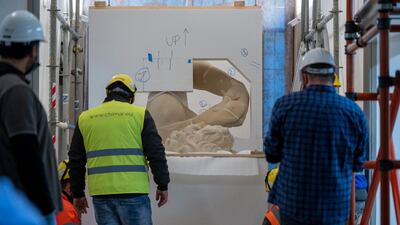
The copy of Michelangelo's David statue involved 3D printing of the various parts of the figure. EPA / Claudio Giovannini -
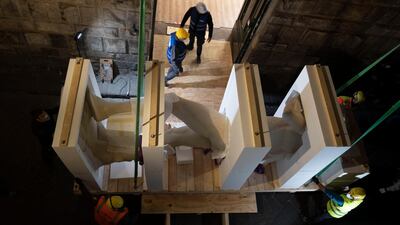
The statue was created thanks to a sophisticated digitalisation process that involved scanning the statue to create a three-dimensional digital twin. EPA -
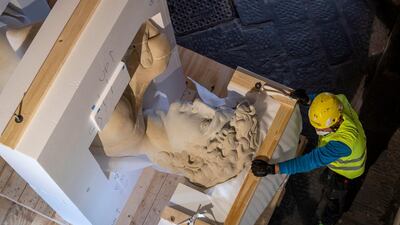
The 3D-printed copy of Michelangelo's David statue is made of acrylic resin covered with marble dust. EPA -
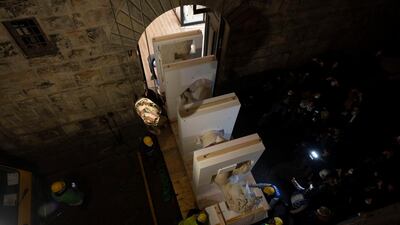
The 3D-printed copy of Michelangelo's David statue was assembled by team of restorers at the Opificio delle Pietre Dure in Florence. EPA -

The restorers' work includes adding the cracks, fractures and abrasions to give it the same character of the current statue. EPA -

Engineers in Florence used high-tech cameras and mounted laser scanners on stairs to capture microscopic details of the 16th-century marble statue. EPA



