

Pupils across the UAE will learn about the importance of nature conservation by studying the country’s long-standing efforts to save a species of bird from extinction.
Numbers of the houbara bustard, which has traditionally been favoured as prey in falconry, have dwindled over the years due to the sport.
It is now classed as vulnerable species by the International Union for Conservation of Nature.
Over the past 40 years, the UAE has been involved in a project to restore populations of the bird in the wild after Sheikh Zayed, the Founder of the UAE, initiated a successful breeding programme.
The first chick was born in 1982 and by 2016 more than 50,000 chicks were born each year. Around 350,000 chicks have been bred since the programme’s inception.
In 2006, the International Fund for Houbara Conservation (IFHC) was set up by Sheikh Mohammed bin Zayed, Crown Prince of Abu Dhabi and Deputy Supreme Commander of the Armed Forces, to accelerate the country’s conservation efforts.
And now the IFHC has teamed up with the Ministry of Education to teach pupils about the importance of the bird to the country’s heritage and the need to protect it.
“Last year, the IFHC worked hand in hand with the Ministry of Education to have a programme in our schools,” said the Minister of education, Hussain Al Hammadi at an event to launch the national education programme on Tuesday.
“This is the result of the programme — though it’s small it has great impact on our pupils as they care about sustainability and the environment.”
Last year, seven schools across the Emirates were chosen to take part in a pilot project to incorporate the topic into their teaching. One of the schools involved, Al Ittihad National Private School in Khalifa City A, explored the houbara in Arabic Social Studies, to art, English lessons and even maths.
______________
Read more:
European falconers recall charm of Sheikh Zayed: 'If there was a room, he filled it'
UAE's hunters agree that endangered wildlife must be protected
How illegal bird hunting in the Arab world could drive species to extinction
______________
“In the art lesson we had pictures and models,” said Sohir Elkhoueri, the school’s environmental co-ordinator.
“Within the maths lessons they did some calculations about the conservation. During biology lessons we spoke about the egg hatching and how it grows. We also integrated it within English lessons. They wrote a letter inviting the houbara to a dinner party and they were discussing with the houbara what kind of meal they need to prepare for it.”
Other subjects to cover the topic included social science, which studied the migratory patterns of the birds, said Ms Elkhoueri.
The pupils enjoyed learning about the importance of conserving the houbara as the bird is central to their heritage — the school predominantly comprises Emiratis, she said.
“It is part of their national identity,” said Ms Elkhoueri.
But conserving the wild bird populations is not about ending hunting involving the houbara, she said.
“It is designed to not only to conserve not only the bird, but the culture of hunting as well,” she said.
“A long time ago, the populations used to regulate themselves because people weren’t able to go deep in the desert.”
But with the advent of GPS technology and more powerful off-road vehicles, houbara could be reached, and hunted, everywhere.
“So the numbers started decreasing a lot and they were close to being extinct,” said Ms Elkhoueri.
Schools taking part in the pilot project gave the Ministry of Education feedback on what worked best ahead of the roll-out across the country.
“One of the tools is a guide for teachers and a website to provide diversification to teach our pupils in the best methods,” said Majid Ali Al Mansouri, the managing director of IFHC at the launch event in Abu Dhabi.
“The programme familiarises our students with the challenges of the future to give them hope for success through maintaining and preserving the houbara bird.”
Endangered animals of the UAE:
-
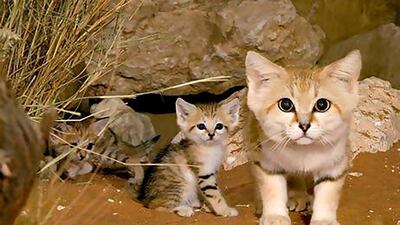
The sand dune cat (Felis margarita) is a nocturnal creature that lives in shallow burrows and hunts rodents. Research published in 2005 indicated that only 250 remained in Abu Dhabi emirate. Courtesy, Al Ain Zoo -

The Arabian leopard is currently listed as critically endangered. Pawan Singh / The National -
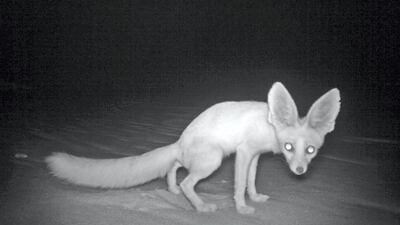
This is the first sighting of the rare Rüppell's fox (Vulpes rueppellii) in 13 years. Environment Agency – Abu Dhabi -
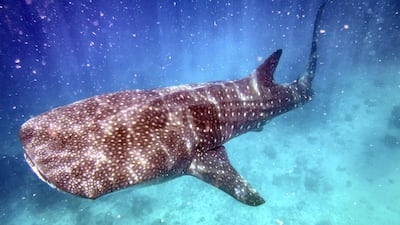
Whale sharks are known as jinbe zame in Japanese, inspiring their newly discovered residents' name.. Getty Images -
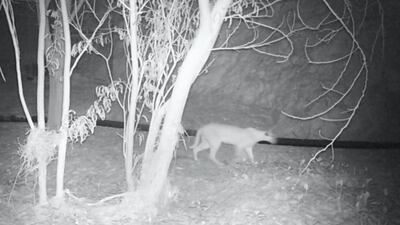
Arabian Caracal (Caracal caracal) - IUCN status: least concern - thought to be extinct, the environment agency captured daytime and nighttime footage of the creature for the first time since 1984. Courtesy EAD -
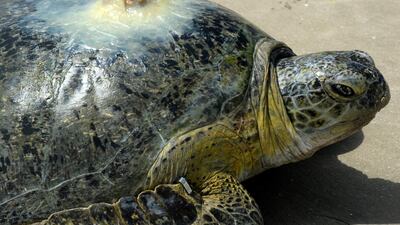
Green turtle (Chelonia mydas) - IUCN status: Endangered - The UAE is one of 140 countries where the green turtle is a native species; numbers have fallen worldwide - Two years ago Emirates Wildlife Society – WWF launched Gulf Green Turtle Conservation. Courtesy Paul Velasco/EWS-WWF -
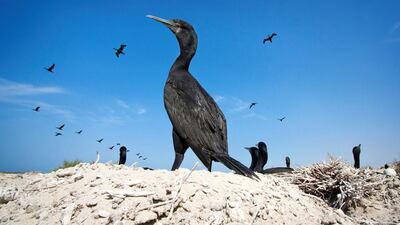
Socotra cormorant (Phalacrocorax nigrogularis) - IUCN status: Vulnerable - Found on islands of the coast of several Gulf states, including the UAE - Threatened by development and oil spills, the species has a total population of less than half a million. Courtesy- Rob Gubiani -
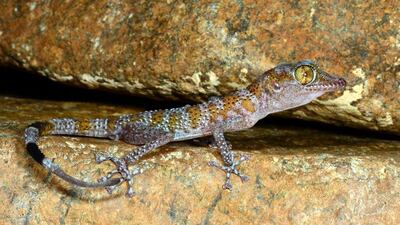
Emirati leaf-toed gecko (Asaccus caudivolvulus) - IUCN status: Least concern - Only found in mountainous regions of north-eastern UAE and northern Oman - More recent research suggests it actually consists of three species, one of which is unique to the UAE – making it the country's only endemic vertebrate – and threatened by development. Photo Courtesy: Johannes Els. -
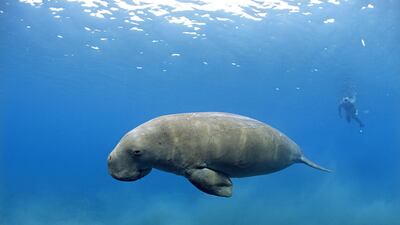
Sea cow (Dugong dugon) - IUCN status: Vulnerable - Locally, boat strikes and fishing net entanglement is a threat, although there are major conservation efforts - The population in UAE waters is thought to be several thousand -
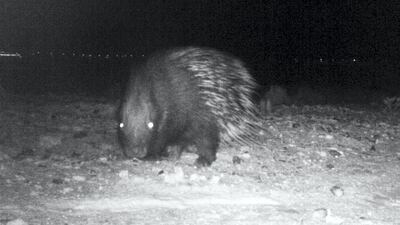
The Crested Porcupine, a rodent thought to be extinct in the UAE, was recorded by camera traps in Abu Dhabi. Environment Agency – Abu Dhabi -
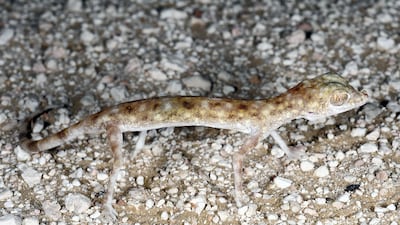
Gulf sand gecko (Pseudoceramodactylus khobarensis) - IUCN status: Least concern - Found widely in the Arabian peninsula, especially in the UAE - This species is not endangered but its population is declining, and in the UAE it faces threats from the development of coastal sabkha habitat. Photo courtesy-Salvador Carranza) -
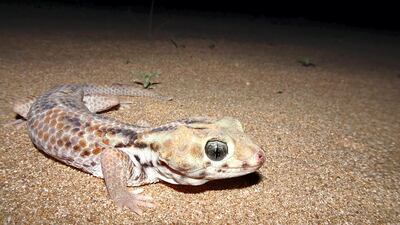
Keyserling's wonder gecko (Teratoscincus keyserlingii) - IUCN status: Not yet evaluated - Although this species is also found in Iran, the UAE population is the only one in Arabia - Heavily threatened by development, it could be driven to extinction locally, although the Mohamed bin Zayed Species. Pritpal Soorae / Environment Agency Abu Dhabi -

Hammerhead shark (Sphyrna mokarran) - IUCN status: Endangered - Widely distributed, but threatened by fishing for its fins and as accidental bycatch - Numbers have plummeted by four-fifths over the last quarter of a century. Image by © Norbert Wu/Science Faction/Corbis -
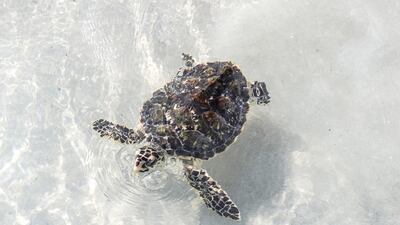
Hawksbill turtles, rated as Critically endangered on the International Union for Conservation of Nature Red List of Threatened Species, have begun laying their eggs on a beach in Dubai. Antonie Robertson / The National -
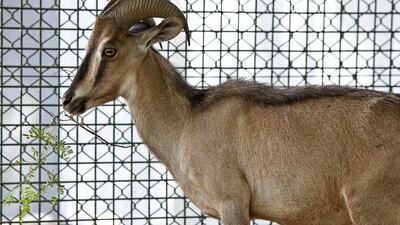
Arabian tahr (Arabitragus jayakari) - IUCN status: Endangered - Restricted to mountainous regions of north-eastern UAE and northern Oman - Worldwide population is probably below 5,000. ANTONIE ROBERTSON / The National -
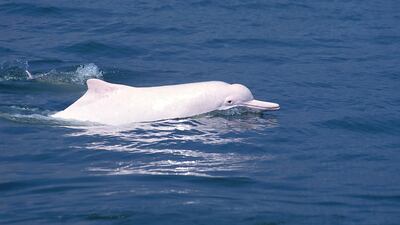
Indian Ocean humpback dolphin (Sousa plumbea) - IUCN status: Endangered - Often become entangled in fishing nets - A recent census found 701 individuals, so the waters off Abu Dhabi have the world's largest single population. Roland Seitre / Minden -
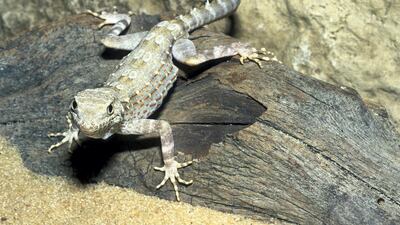
The semaphore gecko is one of several species we have learned a great deal about in recent years. Getty Images -
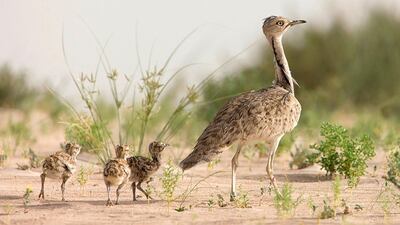
The Houbara bustard is classified as a vulnerable species by the International Union for Conservation of Nature. Courtesy International Fund For Houbara Conservation -
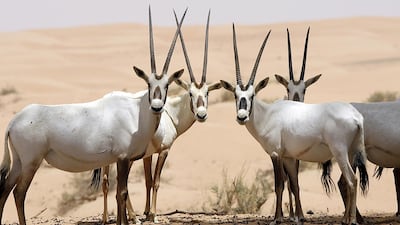
Arabian oryx (Oryx leucoryx) - IUCN status: Vulnerable - Formerly listed as endangered, the UAE's reintroduction programme has helped to increase numbers - The wild population is about 1,200, just over half of which are UAE reintroduced individuals. Mike Young / The National -
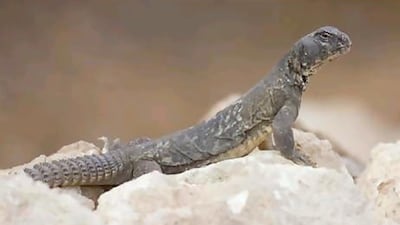
Egyptian spiny-tailed lizard (Uromastyx aegyptia) - IUCN status: Vulnerable - Found in much of the Middle East in gravelly and stony areas, but numbers have declined - Two sub-species exist in the UAE, where it is threatened by habitat loss -
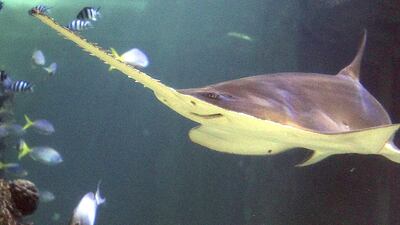
Green sawfish (Pristis zijsron) - IUCN status: Critically endangered - The largest sawfish, it can reach up to seven metres in length - This coastal species has declined across its range and has become extinct from some countries. AP Photo -
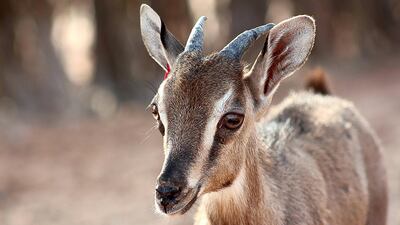
The Arabian tahr has been categorised as an endangered species, with a global population of less than 5,000. Courtesy TDIC -
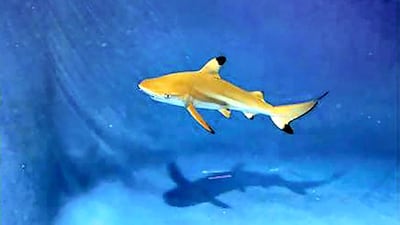
Blacktip reef shark (Carcharhinus melanopterus) - IUCN status: Near threatened - Populations have suffered because of fishing - This species was spotted this year off the UAE's east coast



