

Emirati astronaut Hazza Al Mansouri blasted off to the International Space Station on board a Soyuz rocket on Wednesday.
At the age of 35, Hazza Al Mansouri swapped Earth for space and made a safe landing on board the ISS, less than six hours after leaving the launch site in Kazakhstan. The rocket hurtled towards space at an impressive 13,000kmph.
Maj Al Mansouri will spend eight days on the ISS, where he will carry out a number of experiments before returning to Earth on October 3.
During his stay on board, the former military pilot will do a full video tour of the spacecraft in Arabic, which will be streamed across the world. But before then, here are some interesting details about his out-of-this-world lodgings.
Measuring 109 metres, end-to-end, the ISS is about the length of a football field. To date, more than 230 individuals have visited the space station and it has been continuously occupied since November 2000.
The ISS is a unique scientific laboratory that has many functions. It serves as a habitat for its crew, a command post for orbital operations, and as the landing and take-off site for smaller orbiting vehicles. Six space crafts can be connected to the space station at any one time.
Here is a glimpse of life on board the ISS.
Components of ISS
Made up of a number of shapes including spheres, triangles, beams, and flat panels, the ISS consists of pressurised habitation modules, solar arrays, docking ports, experiment bays and robotic arms, among others. The main larger modules of the ISS where the astronauts on board live and work are shaped like canisters and spheres. The solar array wingspan is about the same length as the world’s largest passenger aircraft, the Airbus A380, measuring 73m.
-
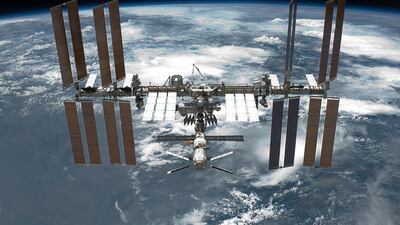
A view of the International Space Station backdropped by Earth. The station has four large, maroon-coloured solar array wings, two on either side of the station, mounted to a central truss structure. Further along the truss are six large, white radiators, three next to each pair of arrays. In between the solar arrays and radiators is a cluster of pressurised modules arranged in an elongated T shape, also attached to the truss. A set of blue solar arrays are mounted to the module at the aft end of the cluster. Wikicommons -
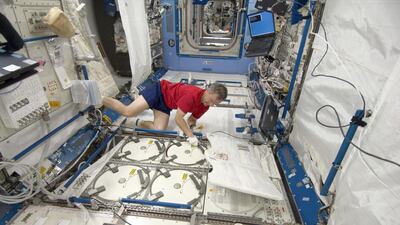
Canadian Space Agency astronaut Robert Thirsk, Expedition 20 flight engineer, inserts urine samples into the ISS Laboratory Freezer as part of the Nutritional Status Assessment study. Wikicommons -
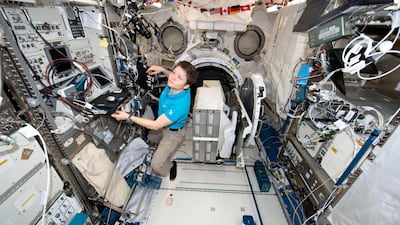
Nasa astronaut Anne McClain works inside the Japanese Kibo laboratory aboard the International Space Station in January 2019 in Earth Orbit. Alamy -

Japan Aerospace Exploration Agency astronaut Akihiko Hoshide exercises on the Cycle Ergometer in the Destiny laboratory on the International Space Station in June, 2008. Nasa / Reuters -
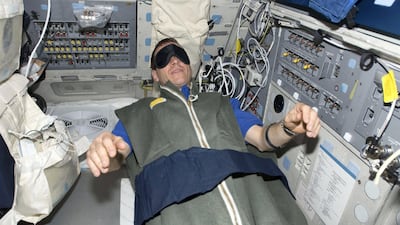
Astronaut Gregory C. Johnson, STS-125 pilot, rests in his sleeping bag on the flight deck of the Earth-orbiting space shuttle Atlantis in May 2009. Nasa / Reuters -
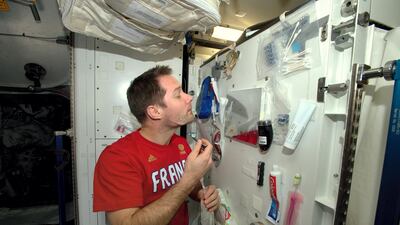
European Space Agency astronaut Thomas Pesquet shaves on board the station. ESA / AFP -

Japan Aerospace Exploration Agency astronaut Koichi Wakata performs the daily ambient flush of the potable water dispenser in the waste and hygiene compartment in the Destiny laboratory of the International Space Station in April 2009. Nasa TV / Reuters -

A set of NanoRacks CubeSats is photographed by an Expedition 38 crew member after the deployment by the NanoRacks Launcher attached to the end of the Japanese robotic arm. Wikicommons -

A portion of the International Space Station and the docked space shuttle Endeavour. Wikicommons


Where does the oxygen come from?
There are three ways that oxygen is generated on board the ISS. The main technique is by splitting water into it's two components: hydrogen and oxygen. The oxygen is vented into the breathable cabin air, the Oxygen Generation System, while the hydrogen is vented externally.
The splitting of the water, known as electrolysis, is powered through the station's massive solar panels. The OGS provides between 2.3kg and 9kg of oxygen daily.
Oxygen storage tanks are kept replenished by unmanned supply ships as a back up to the electrolysis method but the crew can also generate oxygen by igniting Solid Fuel Oxygen Generation canisters - also known as oxygen candles. These canisters each provide enough oxygen for one crew member for one day.
In future space stations or space colonies, Nasa scientists hope to create oxygen naturally by growing plants. These plants would supply breathable air and be a food source for the astronauts.
No cheat days
Here on Earth, health experts recommend at least 30 minutes exercise a day to stay in shape. Some of us choose to listen, some don’t. But in space, daily exercise is absolutely vital. The weightlessness environment of the ISS isn’t exactly hospitable to the human body.
A no gravity atmosphere can lead to bone and muscle loss, so to combat the adverse effects of this, astronauts have to exercise for at least two hours every day. With their very own personal gym, astronauts have access to a bicycle, treadmill and weightlifting machine, which have been specially designed for use in space.
A cycle ergometer vibration isolation system, or CEVIS, works with a computer. It has protocols that astronauts load into the system and they ride, on average, for about 30-40 minutes at different weight-bearing loads. Aerobic exercise help to keep the heart in good shape and a resistive exercise device, or RED, is used for strength building.
The machine utilises two canisters that create small vacuums that astronauts can pull against with a long bar. This allows them to do squats, bench presses and dead lifts. Astronauts use harnesses, which look similar to American football shoulder pads, to keep them grounded during exercise.
Sleep standing up?
Many think life on board the ISS is too close for comfort with little privacy, but the living and working space is larger than a six-bedroom house. In total, the space station has six sleeping quarters, two bathrooms, a gym, and a 360-degree view bay window.
The sleep arrangements on board may take some getting used to. Due to the weightlessness environment, the luxury of fluffy duvets and pillows is nowhere in sight. Instead, astronauts have to zip themselves into a vertically positioned sleeping bag which hangs from the wall, meaning they sleep upright, in the seating or standing position. Individual pods do provide some privacy though.
-
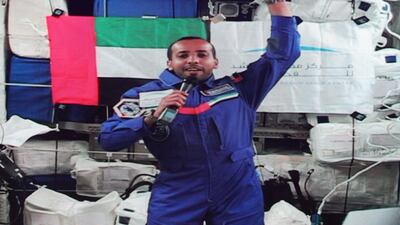
The UAE's first astronaut, Maj Hazza Al Mansouri, takes part in a Q&A session from the International Space Station with an audience at the Mohammed bin Rashid Space Centre, Dubai, in 2019. Chris Whiteoak / The National -
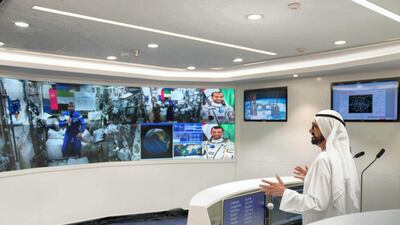
Sheikh Mohammed bin Rashid, Vice President and Ruler of Dubai, talks with Emirati astronaut Maj Hazza Al Mansouri, during a live satellite feed from the International Space Station. Courtesy: Dubai Media Office -
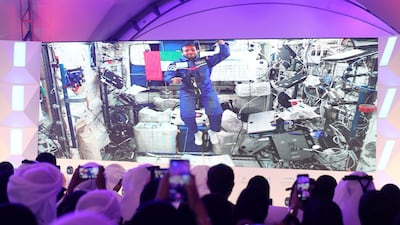
The Emirati astronaut takes questions from the audience gathered at the Mohammed bin Rashid Space Centre. Chris Whiteoak / The National -
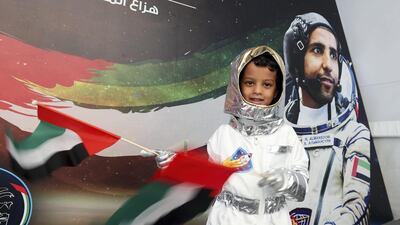
An aspiring young astronaut poses in front of a picture of the first Emirati in space, Maj Hazza Al Mansouri. Chris Whiteoak / The National -
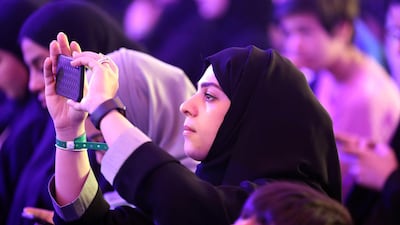
A woman films the Q&A session with Maj Hazza Al Mansouri from the International Space Station. Chris Whiteoak / The National -
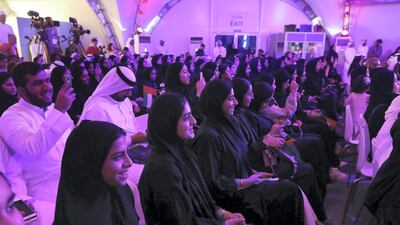
The audience at the Mohammed bin Rashid Space Centre are delighted to hear from Maj Hazza Al Mansouri. Chris Whiteoak / The National -
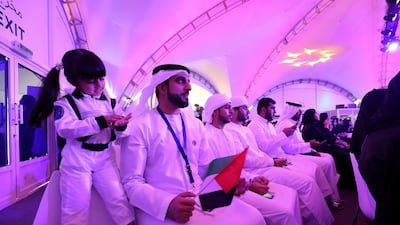
An aspiring young astronaut and her family at the Mohammed bin Rashid Space Centre event. Chris Whiteoak / The National -
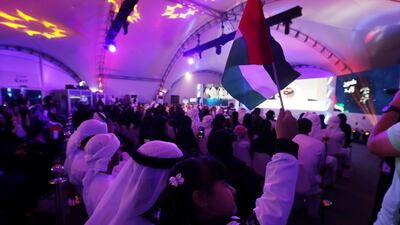
A young audience member celebrates the first Emirati in space. Chris Whiteoak / The National -
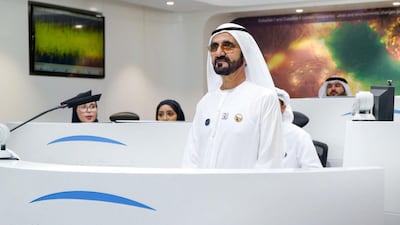
Sheikh Mohammed bin Rashid talks to Maj Hazza Al Mansouri. Courtesy Dubai Media Office -
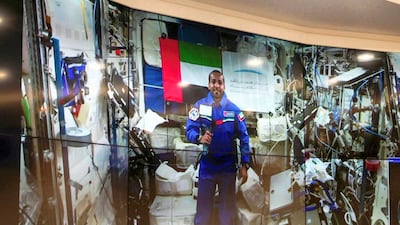
Emirati astronaut Hazza Al Mansouri, during a live satellite feed from the International Space Station. Courtesy Dubai Media Office -
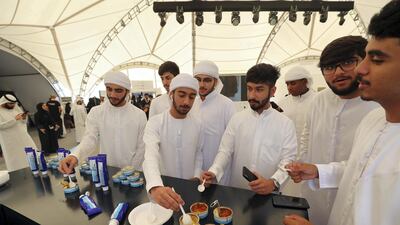
Audience members at the Mohammed bin Rashid Space Centre event sample space food. Chris Whiteoak / The National -
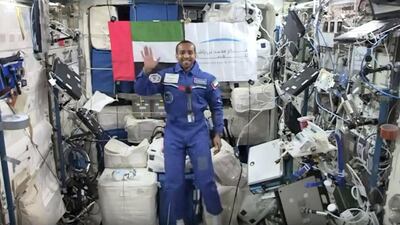
Emirati astronaut Maj Hazza Al Mansouri gives his audience on Earth a tour of the International Space Station. Screengrab via Youtube Live -
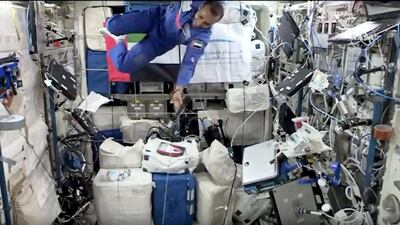
Maj Hazza Al Mansouri demonstrates the effects of weightlessness. Screengrab via Youtube Live -
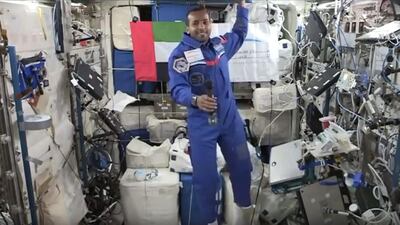
Hazza Al Mansouri takes a live Q&A from space. He spent eight days on the International Space Station, in a mission from September 25 to October 3, 2019. Screengrab via Youtube Live -
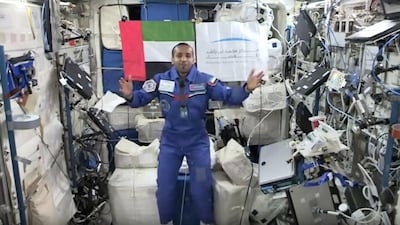
Emirati astronaut, Hazza Al Mansouri, takes live Q&A from space and gives a station tour. Screengrab via Youtube Live


The ‘tin can’
Bathroom etiquette in space is about as basic as it gets. But while it is not a pretty process (we’ll get into the details later), it is a sustainable one. On board filtration systems turn urine into drinking water. After passing through a urine processor, the liquid then filtrates through a water processor and becomes drinkable within a matter of hours.
Though not for the faint of heart, it is one of the most vital processes on board ISS and it provides a daily resource for astronauts. The Russian-built system separately channels liquid and solid waste. And when astronauts want to pass solid waste, they attach a small plastic pouch to a commode before doing their business. The pouch is then secured and dropped into the commode, which is emptied every eight to nine days, via a suction method, to the trash pod.
Trusted household item that every astronaut needs
Everything floats in space, which makes losing things like pens, paper and cutlery a regular occurrence. One thing you’ll notice when browsing videos on board the ISS is that almost everything that isn’t tied down is covered in tape. Astronauts use the simple but clever trick to make tables and surfaces useful again, by taping things down when not in use. The tape can be flipped around to be sticky-side-out or sticky side down, depending on their need.

