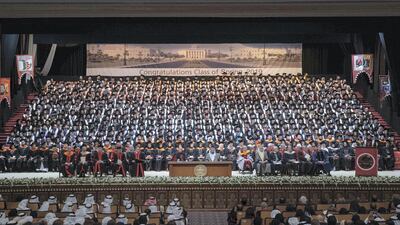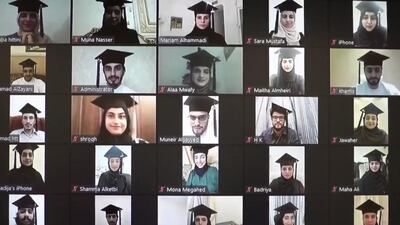
Archaeology and other university courses that require students to attend in-person classes could decline in popularity in the post-Covid world.
The claim was made in an online discussion among UAE academics about how higher education could change in the wake of the pandemic.
John Hatzadony, assistant professor and chairman of the Homeland Security Programme at Rabdan Academy in Abu Dhabi, said the future of university education would depend on the world’s recovery from the outbreak.
“Certain degrees that require a physical presence, such as archaeology or biology, will be eclipsed by degrees that can be done online,” he said.
Mr Hatzadony was speaking at a webinar co-hosted by Abu Dhabi School of Government and Rabdan Academy, which specialises in safety, security, defence, emergency readiness and crisis management.
It heard how the pandemic had accelerated an emerging trend in education - the rise of e-learning - which will continue to persist after the coronavirus.
“Covid-19 fostered a major transformation that had been ongoing,” said Dr Susanna Karakhanyan, higher education policy and regulation director, Abu Dhabi Department of Education and Knowledge.
Hybrid classes that combine online learning components, with less in-person classes will probably come to dominate
“Currently, uncertainty is the only certainty. And we have to think of how to be ready for this.”
Mr Hatzadony said western universities, which have struggled financially as a result of the pandemic, could continue to come under pressure.
“Western universities will be under severe strain due to budget deficits,” he said.
“For that reason, universities will most likely opt to decrease labour costs."
That could result in online classes being taught all over the world, delivered by professors via laptops "at a fraction of the original cost".
Foreign state-funded institutions could also witness a decline in government support, leading to a "de-emphasising of arts and humanities, having an ultimate cultural and societal impact," he added.
Universities could offer joint degrees to survive tough times.
And several could disappear off the map altogether, he said.
“Hybrid classes that combine online learning components, with less on campus class meetings will probably come to dominate,” said Mr Hatzadony.
However, he cautioned that the future had to take into account “wild cards,” of which a pandemic was one.
Wild cards that could affect the future of higher education include the rise of artificial intelligence, he said.
“These scenarios are not fixed,” added Mr Hatzadony.
Last month, six of Harvard’s schools announced they would be switching to online-only classes in the next academic year, as the university joined a growing list of higher education institutions that will keep students off campus until at least 2021.
The University of Cambridge has also confirmed that all “face-to-face lectures” will be held remotely during the next academic year.
They are among several top international universities which plan to hold classes online only for the autumn term, at least.
Others are opting for a hybrid mode of teaching, which will include a mix of online and physical classroom learning.
But many universities are still assessing the situation before announcing a final decision.
The UAE Ministry of Education has kept its options open and would take into account the evolving dangers from coronavirus before taking a final decision.
Last month, Minister of Education Hussain Al Hammadi said the possibility of resuming classes, including the reopening of public and private universities and schools, would be made in line with precautionary health measures.

Spider-Man%202
%3Cp%3E%3Cstrong%3EDeveloper%3A%3C%2Fstrong%3E%20Insomniac%20Games%0D%3Cbr%3E%3Cstrong%3EPublisher%3A%3C%2Fstrong%3E%20%20Sony%20Interactive%20Entertainment%0D%3Cbr%3E%3Cstrong%3EConsole%3A%20%3C%2Fstrong%3EPlayStation%205%0D%3Cbr%3E%3Cstrong%3ERating%3A%3C%2Fstrong%3E%205%2F5%3C%2Fp%3E%0A
Who's who in Yemen conflict
Houthis: Iran-backed rebels who occupy Sanaa and run unrecognised government
Yemeni government: Exiled government in Aden led by eight-member Presidential Leadership Council
Southern Transitional Council: Faction in Yemeni government that seeks autonomy for the south
Habrish 'rebels': Tribal-backed forces feuding with STC over control of oil in government territory
Top financial tips for graduates
Araminta Robertson, of the Financially Mint blog, shares her financial advice for university leavers:
1. Build digital or technical skills: After graduation, people can find it extremely hard to find jobs. From programming to digital marketing, your early twenties are for building skills. Future employers will want people with tech skills.
2. Side hustle: At 16, I lived in a village and started teaching online, as well as doing work as a virtual assistant and marketer. There are six skills you can use online: translation; teaching; programming; digital marketing; design and writing. If you master two, you’ll always be able to make money.
3. Networking: Knowing how to make connections is extremely useful. Use LinkedIn to find people who have the job you want, connect and ask to meet for coffee. Ask how they did it and if they know anyone who can help you. I secured quite a few clients this way.
4. Pay yourself first: The minute you receive any income, put about 15 per cent aside into a savings account you won’t touch, to go towards your emergency fund or to start investing. I do 20 per cent. It helped me start saving immediately.
Key findings of Jenkins report
- Founder of the Muslim Brotherhood, Hassan al Banna, "accepted the political utility of violence"
- Views of key Muslim Brotherhood ideologue, Sayyid Qutb, have “consistently been understood” as permitting “the use of extreme violence in the pursuit of the perfect Islamic society” and “never been institutionally disowned” by the movement.
- Muslim Brotherhood at all levels has repeatedly defended Hamas attacks against Israel, including the use of suicide bombers and the killing of civilians.
- Laying out the report in the House of Commons, David Cameron told MPs: "The main findings of the review support the conclusion that membership of, association with, or influence by the Muslim Brotherhood should be considered as a possible indicator of extremism."
Tamkeen's offering
- Option 1: 70% in year 1, 50% in year 2, 30% in year 3
- Option 2: 50% across three years
- Option 3: 30% across five years
RUGBY CHAMPIONSHIP FIXTURES
September 30
South Africa v Australia
Argentina v New Zealand
October 7
South Africa v New Zealand
Argentina v Australia
Living in...
This article is part of a guide on where to live in the UAE. Our reporters will profile some of the country’s most desirable districts, provide an estimate of rental prices and introduce you to some of the residents who call each area home.
Mercer, the investment consulting arm of US services company Marsh & McLennan, expects its wealth division to at least double its assets under management (AUM) in the Middle East as wealth in the region continues to grow despite economic headwinds, a company official said.
Mercer Wealth, which globally has $160 billion in AUM, plans to boost its AUM in the region to $2-$3bn in the next 2-3 years from the present $1bn, said Yasir AbuShaban, a Dubai-based principal with Mercer Wealth.
“Within the next two to three years, we are looking at reaching $2 to $3 billion as a conservative estimate and we do see an opportunity to do so,” said Mr AbuShaban.
Mercer does not directly make investments, but allocates clients’ money they have discretion to, to professional asset managers. They also provide advice to clients.
“We have buying power. We can negotiate on their (client’s) behalf with asset managers to provide them lower fees than they otherwise would have to get on their own,” he added.
Mercer Wealth’s clients include sovereign wealth funds, family offices, and insurance companies among others.
From its office in Dubai, Mercer also looks after Africa, India and Turkey, where they also see opportunity for growth.
Wealth creation in Middle East and Africa (MEA) grew 8.5 per cent to $8.1 trillion last year from $7.5tn in 2015, higher than last year’s global average of 6 per cent and the second-highest growth in a region after Asia-Pacific which grew 9.9 per cent, according to consultancy Boston Consulting Group (BCG). In the region, where wealth grew just 1.9 per cent in 2015 compared with 2014, a pickup in oil prices has helped in wealth generation.
BCG is forecasting MEA wealth will rise to $12tn by 2021, growing at an annual average of 8 per cent.
Drivers of wealth generation in the region will be split evenly between new wealth creation and growth of performance of existing assets, according to BCG.
Another general trend in the region is clients’ looking for a comprehensive approach to investing, according to Mr AbuShaban.
“Institutional investors or some of the families are seeing a slowdown in the available capital they have to invest and in that sense they are looking at optimizing the way they manage their portfolios and making sure they are not investing haphazardly and different parts of their investment are working together,” said Mr AbuShaban.
Some clients also have a higher appetite for risk, given the low interest-rate environment that does not provide enough yield for some institutional investors. These clients are keen to invest in illiquid assets, such as private equity and infrastructure.
“What we have seen is a desire for higher returns in what has been a low-return environment specifically in various fixed income or bonds,” he said.
“In this environment, we have seen a de facto increase in the risk that clients are taking in things like illiquid investments, private equity investments, infrastructure and private debt, those kind of investments were higher illiquidity results in incrementally higher returns.”
The Abu Dhabi Investment Authority, one of the largest sovereign wealth funds, said in its 2016 report that has gradually increased its exposure in direct private equity and private credit transactions, mainly in Asian markets and especially in China and India. The authority’s private equity department focused on structured equities owing to “their defensive characteristics.”
How%20to%20avoid%20getting%20scammed
%3Cul%3E%0A%3Cli%3ENever%20click%20on%20links%20provided%20via%20app%20or%20SMS%2C%20even%20if%20they%20seem%20to%20come%20from%20authorised%20senders%20at%20first%20glance%3C%2Fli%3E%0A%3Cli%3EAlways%20double-check%20the%20authenticity%20of%20websites%3C%2Fli%3E%0A%3Cli%3EEnable%20Two-Factor%20Authentication%20(2FA)%20for%20all%20your%20working%20and%20personal%20services%3C%2Fli%3E%0A%3Cli%3EOnly%20use%20official%20links%20published%20by%20the%20respective%20entity%3C%2Fli%3E%0A%3Cli%3EDouble-check%20the%20web%20addresses%20to%20reduce%20exposure%20to%20fake%20sites%20created%20with%20domain%20names%20containing%20spelling%20errors%3C%2Fli%3E%0A%3C%2Ful%3E%0A