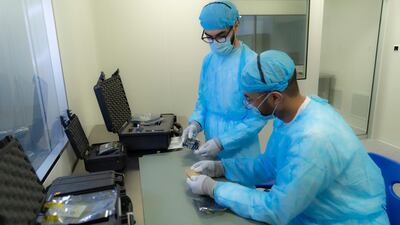
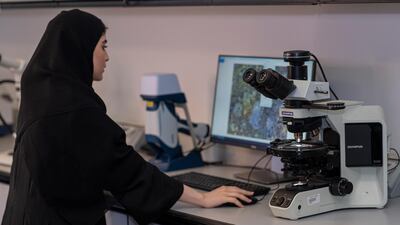
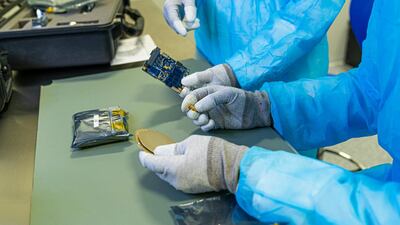
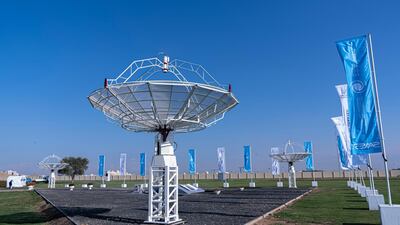
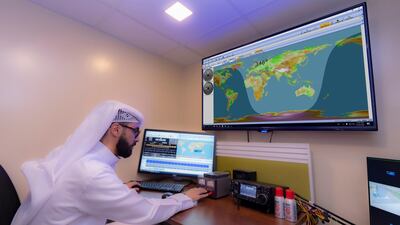
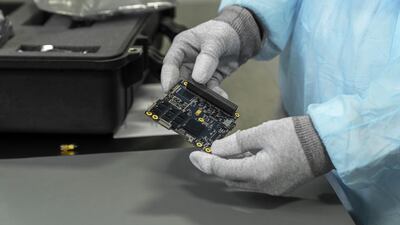
• Amity University in Dubai is one of the few institutes in the UAE to offer aerospace engineering degrees to students. Here, students work at the on-campus satellite ground control station that helps gain hands-on training. All photos by Pawan Singh / The National
    Amity University in Dubai is one of the few institutes in the UAE to offer aerospace engineering degrees to students. Here, students work at the on-campus satellite ground control station that helps gain hands-on training. All photos by Pawan Singh / The National
  • The programme had more than 15 students when it was first launched in 2015.
    The programme had more than 15 students when it was first launched in 2015.
  • Now, there are more than 50 students enrolled in the programme.
    Now, there are more than 50 students enrolled in the programme.
  • Aerospace and other engineering students can use the ground control station to track satellites, predict weather patterns and pollution levels.
    Aerospace and other engineering students can use the ground control station to track satellites, predict weather patterns and pollution levels.
  • Students can analyse the data they receive.
    Students can analyse the data they receive.
  • In this picture Sarath Raj, programme leader of Aerospace Engineering (right) explains about the Armfield Subsonic Wind Tunnel to students
    In this picture Sarath Raj, programme leader of Aerospace Engineering (right) explains about the Armfield Subsonic Wind Tunnel to students
  • The university is located in Academic City, Dubai.
    The university is located in Academic City, Dubai.

Two universities now offer master’s degree in space science in a first for UAE


Sarwat Nasir
  • English
  • Arabic

Two universities in the UAE introduced a master's programme in space sciences to cater to an increasing number of students interested in pursuing a degree in the field.

The University of Sharjah and the UAE University in Al Ain have, this academic year, welcomed their first batch of students for the course.

Academics said the Middle East's thriving space industry was inspiring young people to follow a career path in disciplines such as space science, engineering and astronomy.

The increasing interest of students for the space sciences is fuelled by the important and inspiring space sciences programme of the UAE

“The increasing interest of students for the space sciences is fuelled by the important and inspiring space sciences programme of the UAE,” said Prof Nouar Tabet, dean of the College of Sciences at the University of Sharjah.

“This is good news because this national initiative is going to generate a huge amount of data that will need to be analysed.”

The university started its master’s programme in astronomy and space science this academic year, with six students registered so far and more expected to join.

It has 95 students enrolled in undergraduate and postgraduate courses that offer a career in space science, such as applied physics, petroleum geophysics and remote sensing.

A decade ago, only 10 students were enrolled in these programmes. Since then, the university has recorded slow but steady growth.

In 2018, there were 32 students enrolled in applied physics. This year, there are more than 50.

The numbers are still low compared to international figures, but are gradually increasing each year.

"We should not forget that the UAE space programme is very young," said Ilias Fernini, vice general director for research laboratories and scientific projects at the Sharjah Academy of Astronomy, Space Sciences and Technology – a centre overseen by the university.

“It just started in 2014 with the creation of the UAE Space Agency. Compared to other international space agencies that date back to the mid-20th century, the UAE has crossed a tremendous step.”

The UAE launched its first Emirati-built satellite KhalifaSat in 2018 and sent the first Emirati astronaut, Maj Hazza Al Mansouri, into space in 2019.

The country launched the Mars Hope probe this summer.

Mr Ilias said he believed the number of students pursuing space-related degrees and universities offering them will increase significantly once the space sector matures.

"The UAE must look into having satellite and space rocket launch capabilities, design and construct robotics for lunar and Martian missions, and apply artificial intelligence and machine learning for space applications," he said.

Enrolments in science-related programmes that can pave a career path in space sector are gradually increasing at the University of Sharjah. University of Sharjah

"This is the future trend and these programmes will attract hundreds of young minds to science, technology, engineering and maths education. The UAE can be a real space hub for the Mena world."

The Sharjah Academy of Astronomy, Space Sciences and Technology admits 20 interns from the university every semester to work across its five laboratories, including a meteorite centre, cube satellites, space weather and ionosphere and radio astronomy.

The UAE University is also offering master's degrees in space sciences, with courses such as spacecraft systems, space physics, astronomy and astrophysics, remote sensing of terrestrial and planetary surfaces and digital image processing in remote sensing.

Because of a growing interest among students, a space centre in Al Ain, overseen by the university, will expand many of its projects.

It will soon have a fully equipped satellite assembly, integration and testing centre that can be used by students for practical learning, as well as a radio array observatory, as reported by The National last week.

  • University of Sharjah is now one of two varsities in the UAE to offer a master's in Space Science. Here, students work on a cube satellite at the Sharjah Academy of Space, Science and Technology (SAASST), which is overseen by the university. All photos courtesy University of Sharjah
    University of Sharjah is now one of two varsities in the UAE to offer a master's in Space Science. Here, students work on a cube satellite at the Sharjah Academy of Space, Science and Technology (SAASST), which is overseen by the university. All photos courtesy University of Sharjah
  • The master's programme has six students registered so far, but the university expects more to join.
    The master's programme has six students registered so far, but the university expects more to join.
  • It has 95 students enrolled this year in undergraduate and postgraduate courses that offer a career in space.
    It has 95 students enrolled this year in undergraduate and postgraduate courses that offer a career in space.
  • A decade ago, only 10 students were enrolled in these programmes.
    A decade ago, only 10 students were enrolled in these programmes.
  • SAASST takes on 20 interns per semester from the university to work across its five laboratories, including a meteorite centre, cube satellites, high energy astrophysics, space weather and ionosphere and radio astronomy.
    SAASST takes on 20 interns per semester from the university to work across its five laboratories, including a meteorite centre, cube satellites, high energy astrophysics, space weather and ionosphere and radio astronomy.
  • Students gain hands-on training at the academy.
    Students gain hands-on training at the academy.
  • Work at the academy ranges from studying space rocks, developing CubeSats, radio astronomy, to analysing weather data.
    Work at the academy ranges from studying space rocks, developing CubeSats, radio astronomy, to analysing weather data.

Students will be able to work on major projects, including the first pan-Arab satellite, known as 813, and two navigation satellites.

It is not only space science degrees that build a career path in space; engineering degrees also help.

Sarah Al Amiri, head of the UAE Space Agency and the Emirates Mars Mission science team leader, graduated from the American University of Sharjah with a bachelor's degree and a master's degree in computer engineering.

She started her career at the department of research and development at the Mohammed bin Rashid Space Centre, where she worked as a programme engineer on Dubai Sat-1 and Sat-2 – the UAE's first satellites.

Before the UAE Cabinet reshuffle this year, she was the Minister of State for Advanced Sciences.

Many universities in the Emirates offer undergraduate degrees in engineering but only a handful have degrees in aerospace engineering.

Amity University Dubai started its four-year aerospace engineering programme in 2015 with more than 15 students.

“After the programme launched, we had a growth of over 50 per cent every academic year,” said Dr Vajahat Hussain, chief executive of Amity Education Middle East.

"We have over 50 students currently studying aerospace engineering at Amity University Dubai and have seen two batches of aerospace engineering students graduate.

"We have also seen a 30 per cent increase in student numbers over the past two years.”

The university has a ground control station where students can track satellites and predict weather patterns and pollution levels by analysing data.

An aerospace engineering graduate from the university, Sahith Reddy Madara, works at the Sharjah Academy of Astronomy, Space Sciences and Technology as a research engineer, and several other former students work internationally in space-related fields.

"As an emerging area of study, the field of space science and interest around the profession has increased over the past two years," said Dr Hussain.

"The region’s investment in space research and development is the main motivating factor for students who have enrolled in our aerospace engineering programme."

Other universities that offer space science, maths or engineering degrees in the UAE are Khalifa University, New York University Abu Dhabi and the American University of Ras Al Khaimah.


UPI facts

More than 2.2 million Indian tourists arrived in UAE in 2023
More than 3.5 million Indians reside in UAE
Indian tourists can make purchases in UAE using rupee accounts in India through QR-code-based UPI real-time payment systems
Indian residents in UAE can use their non-resident NRO and NRE accounts held in Indian banks linked to a UAE mobile number for UPI transactions

The%20specs
%3Cp%3E%3Cstrong%3EEngine%3A%20%3C%2Fstrong%3E2.0-litre%20four-cylinder%20turbo%20hybrid%0D%3Cbr%3E%3Cstrong%3EPower%3A%20%3C%2Fstrong%3E680hp%0D%3Cbr%3E%3Cstrong%3ETorque%3A%20%3C%2Fstrong%3E1%2C020Nm%0D%3Cbr%3E%3Cstrong%3ETransmission%3A%20%3C%2Fstrong%3E9-speed%20auto%0D%3Cbr%3E%3Cstrong%3EFuel%20consumption%3A%20%3C%2Fstrong%3E7.5L%2F100km%0D%3Cbr%3E%3Cstrong%3EOn%20sale%3A%20%3C%2Fstrong%3EEarly%202024%0D%3Cbr%3E%3Cstrong%3EPrice%3A%20%3C%2Fstrong%3EFrom%20Dh530%2C000%20(estimate)%3C%2Fp%3E%0A
JAPAN SQUAD

Goalkeepers: Masaaki Higashiguchi, Shuichi Gonda, Daniel Schmidt
Defenders: Yuto Nagatomo, Tomoaki Makino, Maya Yoshida, Sho Sasaki, Hiroki Sakai, Sei Muroya, Genta Miura, Takehiro Tomiyasu
Midfielders: Toshihiro Aoyama, Genki Haraguchi, Gaku Shibasaki, Wataru Endo, Junya Ito, Shoya Nakajima, Takumi Minamino, Hidemasa Morita, Ritsu Doan
Forwards: Yuya Osako, Takuma Asano, Koya Kitagawa

Key developments

All times UTC 4

How to watch Ireland v Pakistan in UAE

When: The one-off Test starts on Friday, May 11
What time: Each day’s play is scheduled to start at 2pm UAE time.
TV: The match will be broadcast on OSN Sports Cricket HD. Subscribers to the channel can also stream the action live on OSN Play.

The five pillars of Islam

1. Fasting

2. Prayer

3. Hajj

4. Shahada

5. Zakat 

57%20Seconds
%3Cp%3E%3Cstrong%3EDirector%3A%3C%2Fstrong%3E%20Rusty%20Cundieff%0D%3Cbr%3E%3Cstrong%3EStars%3A%20%3C%2Fstrong%3EJosh%20Hutcherson%2C%20Morgan%20Freeman%2C%20Greg%20Germann%2C%20Lovie%20Simone%0D%3Cbr%3E%3Cstrong%3ERating%3A%20%3C%2Fstrong%3E2%2F5%0D%3Cbr%3E%0D%3Cbr%3E%3C%2Fp%3E%0A

Mercer, the investment consulting arm of US services company Marsh & McLennan, expects its wealth division to at least double its assets under management (AUM) in the Middle East as wealth in the region continues to grow despite economic headwinds, a company official said.

Mercer Wealth, which globally has $160 billion in AUM, plans to boost its AUM in the region to $2-$3bn in the next 2-3 years from the present $1bn, said Yasir AbuShaban, a Dubai-based principal with Mercer Wealth.

Within the next two to three years, we are looking at reaching $2 to $3 billion as a conservative estimate and we do see an opportunity to do so,” said Mr AbuShaban.

Mercer does not directly make investments, but allocates clients’ money they have discretion to, to professional asset managers. They also provide advice to clients.

“We have buying power. We can negotiate on their (client’s) behalf with asset managers to provide them lower fees than they otherwise would have to get on their own,” he added.

Mercer Wealth’s clients include sovereign wealth funds, family offices, and insurance companies among others.

From its office in Dubai, Mercer also looks after Africa, India and Turkey, where they also see opportunity for growth.

Wealth creation in Middle East and Africa (MEA) grew 8.5 per cent to $8.1 trillion last year from $7.5tn in 2015, higher than last year’s global average of 6 per cent and the second-highest growth in a region after Asia-Pacific which grew 9.9 per cent, according to consultancy Boston Consulting Group (BCG). In the region, where wealth grew just 1.9 per cent in 2015 compared with 2014, a pickup in oil prices has helped in wealth generation.

BCG is forecasting MEA wealth will rise to $12tn by 2021, growing at an annual average of 8 per cent.

Drivers of wealth generation in the region will be split evenly between new wealth creation and growth of performance of existing assets, according to BCG.

Another general trend in the region is clients’ looking for a comprehensive approach to investing, according to Mr AbuShaban.

“Institutional investors or some of the families are seeing a slowdown in the available capital they have to invest and in that sense they are looking at optimizing the way they manage their portfolios and making sure they are not investing haphazardly and different parts of their investment are working together,” said Mr AbuShaban.

Some clients also have a higher appetite for risk, given the low interest-rate environment that does not provide enough yield for some institutional investors. These clients are keen to invest in illiquid assets, such as private equity and infrastructure.

“What we have seen is a desire for higher returns in what has been a low-return environment specifically in various fixed income or bonds,” he said.

“In this environment, we have seen a de facto increase in the risk that clients are taking in things like illiquid investments, private equity investments, infrastructure and private debt, those kind of investments were higher illiquidity results in incrementally higher returns.”

The Abu Dhabi Investment Authority, one of the largest sovereign wealth funds, said in its 2016 report that has gradually increased its exposure in direct private equity and private credit transactions, mainly in Asian markets and especially in China and India. The authority’s private equity department focused on structured equities owing to “their defensive characteristics.”

The National's picks

4.35pm: Tilal Al Khalediah
5.10pm: Continous
5.45pm: Raging Torrent
6.20pm: West Acre
7pm: Flood Zone
7.40pm: Straight No Chaser
8.15pm: Romantic Warrior
8.50pm: Calandogan
9.30pm: Forever Young