


A Dubai schoolgirl won a design competition for adults with her prototype of an armchair that is fit to be used on Mars.
Krisha Vaidhya, 8, participated in the iForDesign competition, organised by the Dubai Institute of Design and Innovation.
The competition was open to students, entrepreneurs and the wider community to redesign the humble chair. More than 250 people took part in the contest last year and the results were announced on November 8.
Krisha’s mother, Navita Hakim, obtained special permission from the organisers as she was too young to participate in the contest.
The pupil opted to enter the "future" category with her design for a chair to be used on Mars once the country colonises the planet.
Krisha, who studies at Dubai International Academy in Emirates Hills, created the prototype using recycled materials and made a short video to explain its many features, earning herself an honourable mention from the judges.
There were two prizes for the category she entered. A designer won the first prize and Krisha was honoured for her "idea and purpose" behind the design for her chair.
She won Dh3,000 and a small 3D-printed version of her chair. She hopes to have a large 3D version printed one day too.
Krisha said the chair, which is designed to be used both inside and outside of the house, features legs that double as a levitation device, with boosters to keep it afloat while manoeuvring the harsh volcanic surface of Mars.
"It was inspired by the recent launch of the Hope probe from the UAE," said Krisha, who is from India.

“It also has a temperature-controlled seat and bullet and ash-proof glass, which helps during volcanic eruptions, as there are many on Mars," she said.
Ms Hakim said her daughter was an avid reader.
She named the prototype Krisha's Kursi, a reference to chair in both Hindi and Arabic.
Krisha said she was surprised, but delighted, to earn a mention from the judges of the competition.
Ms Hakim said she initially dissuaded her daughter from entering the contest.
"I was on Instagram one day and she kept peeping into my phone. She was trying to see what I was doing," she said.
When Krisha saw the competition posters, she started pestering her mom to let her enter the competition.
“I said sorry, you are not a design professional or a design student,” Ms Hakim said.
“But she kept pleading. So that night I messaged them to see if they would allow Krisha, who was seven then, if she could participate. They came back and said why not? If she has ideas, she can definitely go ahead and participate.”
Ms Hakim said her daughter had always been creative.
"This is a perfect example of how technology and screen time can actually be used for good by children."
Images sent by Hope Probe
-

The first image of Mars as taken by the UAE's Hope probe, which arrived at the planet on February 9. -
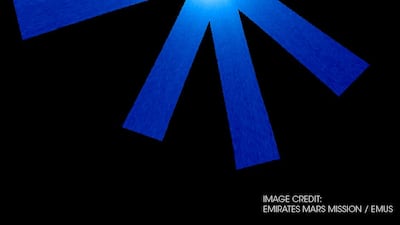
This image taken by the Hope probe's ultraviolet spectrometer (one of its three scientific instruments) shows sunlight reflecting off the extended cloud of atomic hydrogen gas that surrounds the planet Mars. The sunlight is visible only as a dark disk hidden inside the fog of gas. The Emirates Mars Mission team said that no other mission have made such kind of recordings before. -
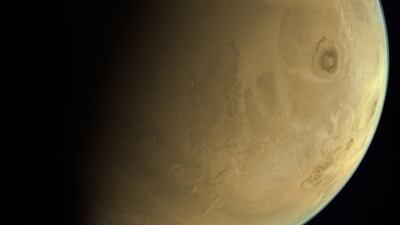
The UAE's Hope probe captured a high-resolution photo of Mars. -
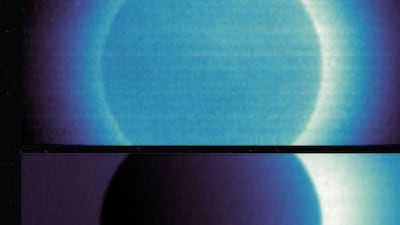
The Hope probe has shared new images from its journey in the orbit of Mars. -
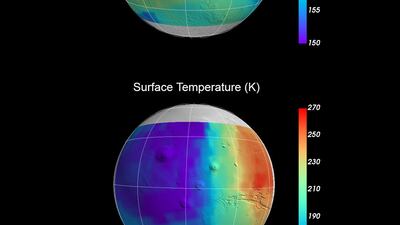
This image was taken by the infrared spectrometer, another instrument on the Hope probe, from an altitude of about 15,000 kilometres. The image shows the surface temperature (left), centred on the Tharsis region of Mars. Dawn can be seen towards the right side. The low surface temperatures observed are due to the dusty nature of the Martian surface. An elevated nighttime atmospheric temperature at 25 km altitude (right) is also observed over the Tharsis region. -
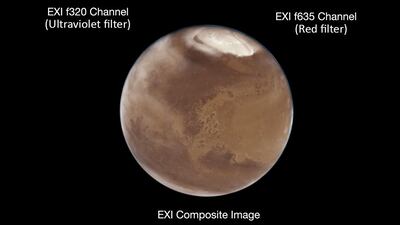
These images were captured by the eXploration imager, a high-resolution camera on the Hope probe. The red channel clearly shows the dark and light features of the Martian surface, while the water ice clouds stand out in the ultraviolet channel. -
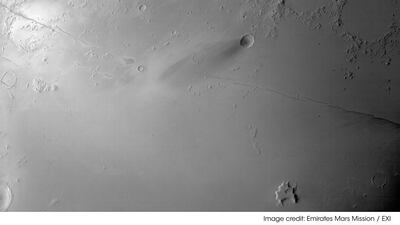
Hope probe sent back an image of the Cerberus Fossae, an area on the planet known for 'Marsquakes'. -
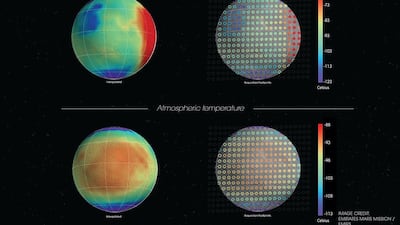
Surface and atmospheric temperature readings collected by the UAE's Hope probe. -

Discrete aurora on Mars captured by UAE's Hope probe -

Discrete aurora on Mars captured by UAE's Hope probe



