


Schools in the UAE are finding new ways to keep pupils active as contact sports remains banned in an effort to curb the spread of Covid-19.
Sports such as basketball, rugby and football are not allowed in educational facilities nationwide as part of strict safety measures in place.
Swimming is also banned, even though community pools in residential areas and ones in hotels and resorts were re-opened in July.
The National spoke to three Dubai schools to find out how they have redesigned physical education classes for pupils in the times of a pandemic.
Socially-distanced sports
At Fairgreen International School, sports such as badminton and tennis are going to be adapted, as they can be played while adhering to social distancing.
“There are many ways our children can be active and energetic, yet maintain physical distancing,” said Daniel Walker, athletic director at the school.
“It's a great challenge to educators to use their creativity to design ways of keeping children physically fit but remaining within the parameters we have.”
The school’s goal is to hold mainly outdoor sports if the weather permits, so pupils will have plenty of space.
Some other physical activities pupils will be taking part in are personal fitness, gymnastics, track and field, and yoga and dance.
Pupils at Gems Wellington Primary School will be also be focusing on individual sports and activities during the first term – such as gymnastics, dance and fitness.
“They will be implemented to ensure our students are physically active but still maintain a minimum distance of two metres between each other,” said Sarah O’Regan, principal of the school.
“Games such as football, netball and touch rugby will be reintroduced when the time is ready and via approval from the Knowledge and Human Development Authority.”
Dunecrest American School has a capped enrolment and will use the free space to carry out physical education classes.
Their capacity is 1,200 pupils, but only 450 pupils are allowed to attend in-person classes as part of Covid-19 safety measures.
Pupils will be using individual sports equipment that will be sanitised after each use.
-
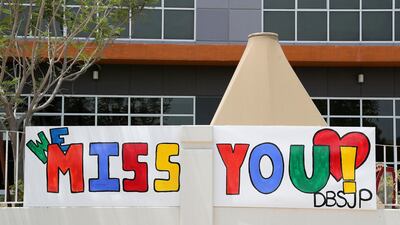
‘We Miss You’ banner posted on the boundary wall of the building. Pupils are being welcomed back after more than five months. -

The Dubai British School in Jumeirah Park will welcome back 1,230 pupils on August 30. 'The National' takes a look at the Covid-19 precautionary measures taken to ensure staff and pupil safety. Campuses are beign reopened after more than five months of closure. All photos by Pawan Singh / The National -
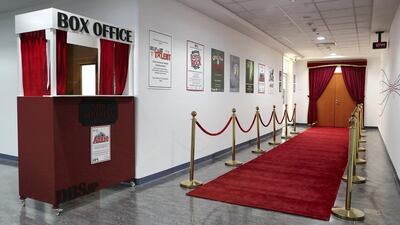
The entrance of the school will soon include thermal scanners. There are dedicated entry and exit points for primary and secondary sections. -
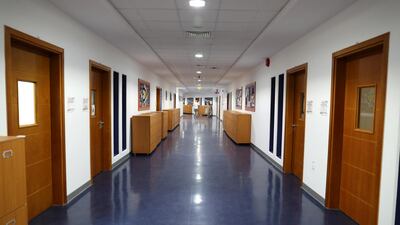
Storage units have been placed at a distance to prevent gathering. -
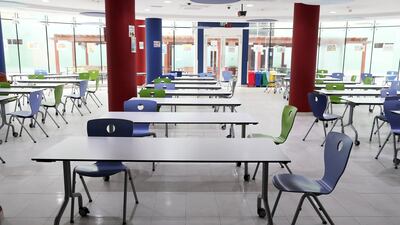
Tables in the canteen area are distanced by two metres. -
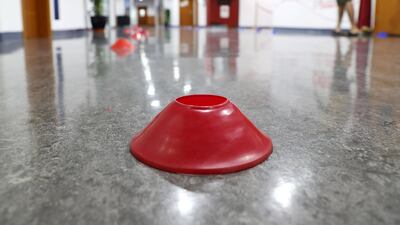
Markings have been placed in hallways throughout the school to encourage social distancing. -
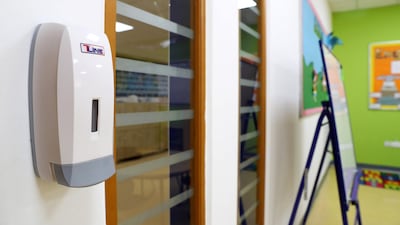
A total of 130 automatic hand sanitisers have been fitted across the school. -
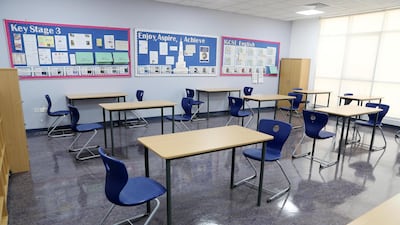
Desks inside classrooms have been distanced and only two pupils per table will be allowed. -
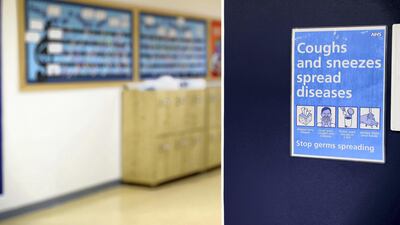
Posters promoting good hygiene are placed in hallways and different areas of the school. -
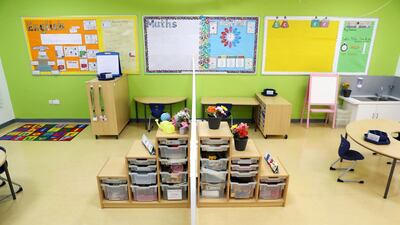
Partitions are placed in Year 1 classrooms.


“Our recess time will allow students to stay active as well. For this we have divided the outside areas into six different zones which will be monitored by our teachers,” said Bill Delbrugge, the school’s director.
“This allows students to spread out while playing. We are also reintroducing our highly popular mileage club, where students can start off the day by running timed laps around our regulation-sized soccer pitch and compete for the best times.”
There are class rotations and separate schedules, which offers more space to pupils.
How long is the contact sports ban for?
School staff have said they are waiting for the go-ahead from education authorities.
However, that is unlikely to be in the immediate future, as the country continues to works towards containing the virus.

Graeme Scott, director of Fairgreen International School, said individual sports with social distancing are going to be the focus at his school.
“For the last five months, many children have missed out on the physical activity that is so important for their overall well-being, and the competitiveness that team sports and games provide,” he said.
“We all hope for a return to these aspects of school life soon, but of course the most important thing is that our children are safe and feel safe.
"It will take some time to establish new systems and procedures that help combat Covid-19. Only when these are in place and the threat of the virus is diminished will schools reintroduce contact sports.”
Over in Abu Dhabi, the Global Indian International School is also taking similar measures.
Dr Heena Rachh, the school’s principal, said their teachers could offer virtual fitness classes to pupils if needed.
“Contact sports like basketball, football are prohibited in schools as per Abu Dhabi Department of Education and Knowledge guidelines to mitigate the spread of the coronavirus,” she said.
“According to us, these sports can be resumed in schools only once everyone around is confident about their health and safety. Since prevention is better than treatment.”

