


The economic impact of Ramadan in the Middle East is still not fully understood, but regional experts say its effect on the well-being of participants would outweigh any negative conclusions drawn.
Despite several global in-depth studies into the financial disruption caused by Christmas, the month-long period marked annually by Muslims working shorter hours has yet to be seriously studied under the microscope of how it affects national productivity.
Experts have said the lack of good data regionally means Ramadan is “understudied”. However, certain trends have emerged over the years.
“Family expenditure, particularly on food and clothes, increases,” economist and Gulf specialist Dr Frederic Schneider told The National.
economist
"Certain food sales peak during Ramadan, such as dates, while other items are consumed less, like caffeinated drinks and tobacco."
Dr Schneider said electricity consumption tends to increase ... because of increased night-time activities and media consumption shifts too, "especially with Ramadan TV shows and associated media [and] ad campaigns".
"That being said, the effects of Ramadan are smaller compared to the overwhelming effect that Christmas has on retail in Christian-majority countries.”
Decades-old data
Globally, efforts have been made to understand the business of Ramadan. A report by Dinar Standard stated the UAE lost about $1.4 billion in GDP during the holy month due to the wind down.
While the study was from 2011, before the days of remote work, widespread online shopping and home delivery, it also showed up to one in four Muslim professionals stating they did not maintain the same level of productivity as compared with other months.
Three years later, a study by the US-based National Bureau of Economic Research found longer Ramadan fasting “had a negative effect" on output growth in Muslim countries but, crucially, “increases subjective well-being among Muslims”.
“We have established causal evidence for a negative effect of Ramadan fasting on economic growth in Muslim countries,” the report found.
“This is accompanied by an increase in the levels of self-reported happiness and life satisfaction among Muslims,” it said.

The NBER study cautioned that the results should not be interpreted as implying that religion, broadly understood, necessarily causes poor economic performance as trends vary across countries.
In tune with the wider mood surrounding the topic, it said that more studies were needed.
“Economic studies, in general, do find a significant decrease in aggregate economic activity,” Dr Omar Al Ubaydli, director of studies and research at think-tank Derasat in Bahrain, told The National.
“This is driven primarily by people working fewer hours and being less likely to enter the labour market.
“However, there is also a redistribution of gross domestic product from certain sectors to others as people's habits change. For example, people travel less but spend more on food at the grocery store. People are less likely to go to the cinema, but they are more likely to purchase new clothes.”
Adapting work deadlines around Ramadan
As Islam follows the lunar calendar, Ramadan takes place earlier every year and now coincides with the traditional tourist season in the Gulf.
“One thing that has changed is government regulations, which have been relaxed, for example, with regard to secluding daytime customers of restaurants,” said Dr Schneider.
Another long-term trend, he said, has been the gradual commercialisation of Ramadan, with increased retail sales.
When asked if there was there any sector that was negatively affected by the changed routines of Ramadan, Dr Schneider cautioned the effect was more on “consumption and work schedules than on volume”, with many Muslim countries having adapted to the month by finishing some projects by Ramadan and picking up after Eid Al Fitr in the same way as organisations in Christian-majority countries work around Christmas and New Year.
In higher latitudes, Ramadan closer to the winter solstice means shorter fasting hours than summer but the effect is “minor” in the Gulf, he said.
“The largest impact of extended fasting times tends to fall on manual/outdoor labour, but, in the Gulf, this is mostly performed by non-Muslim foreign workers,” he said.
But perhaps what is more important to consider is the impact of Ramadan beyond numbers and economic trends. Even the current studies find that fasting and adhering to Ramadan makes those partaking happier and less fixated on work.
“Ramadan is a complex event whose effects are far more wide-ranging than mere economic figures,” said Dr Schneider.
“In my opinion, its primary value lies in strengthening the social fabric of the nation.”
Dr Al Ubaydli said that “the negative effect on headline gross domestic product” must be compared with the positive spiritual effect.
“The same studies that detect decreasing economic activity also find significantly increasing happiness among Muslims,” he said. “So, it's not all about money.”
The first week of Ramadan around the MENA region - in pictures
-
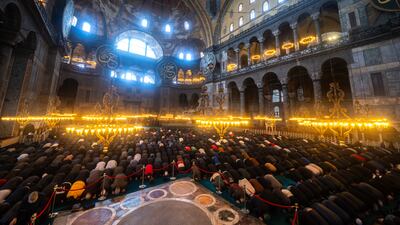
Worshippers at Hagia Sophia Mosque in Istanbul. AP Photo -
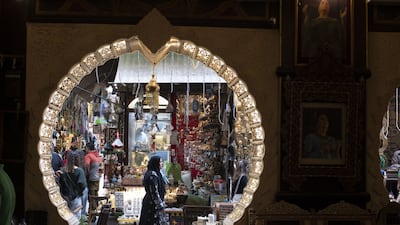
Stores in the Khan Al Khalili bazaar in Cairo, Egypt, during the first week of Ramadan. Bloomberg -
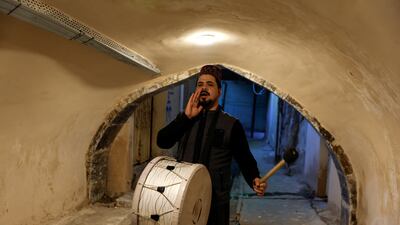
A drummer sounds the wake-up call for residents of the Old City of Mosul, in northern Iraq, before the start of the day's fast. Reuters -

Volunteers prepare food for displaced people to break their fast in Al Qadarif, eastern Sudan. The country is experiencing its second consecutive Ramadan in the grip of conflict. AFP -
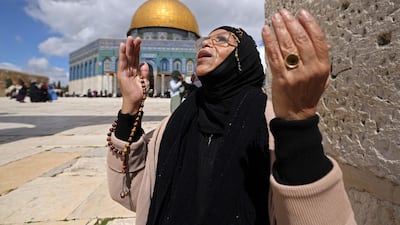
A woman offers first Friday noon prayers of Ramadan near the Dome of the Rock shrine, at the Al Aqsa Mosque compound, in the Old City of occupied East Jerusalem. AFP -
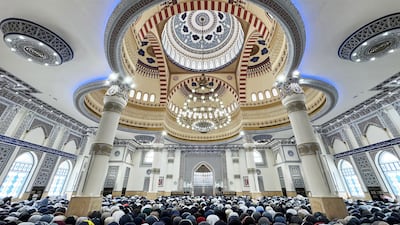
First Friday prayers of Ramadan at Al Farooq Omar bin Al Khattab mosque in Dubai. Pawan Singh / The National -
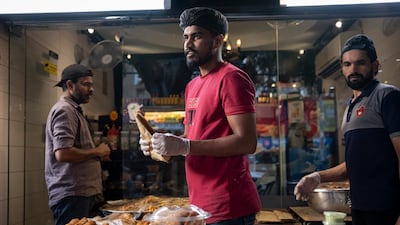
Restaurant staff sell Subcontinent street food to patrons on the streets of Bur Dubai as Iftar approaches. Antonie Robertson/The National -
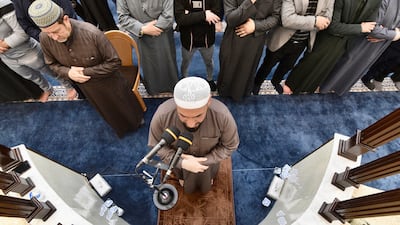
A cleric guides Iraqi devotees as they perform an evening prayer known as 'Tarawih' at the Mohammed Amin mosque near Mosul. AFP -
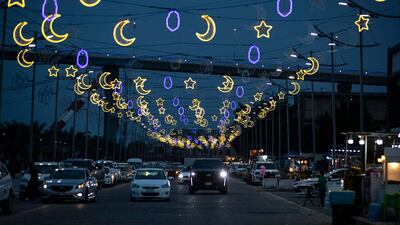
Decorations adorn the streets of the Iraqi southern city of Basra ahead of the Muslim holy fasting month of Ramadan. AFP -
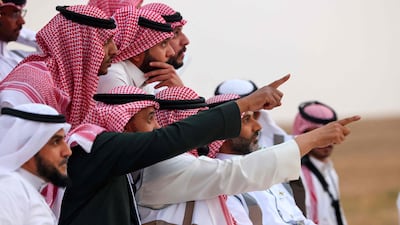
Saudi men look to spot the first crescent of the moon marking the start of the Muslim holy fasting month of Ramadan, in the southern Saudi city of Hautat Sudair. AFP -
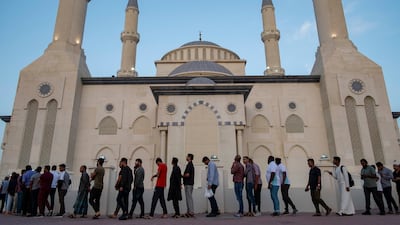
First Ramadan Iftar at the The Al Farooq Omar Bin Al Khattab Mosque located in Dubai, United Arab Emirates. The mosque is named after Umar bin Al Khattab, a companion of The Prophet Muhammad (PBUH) who became the second Caliph after Abu Bakr and was given the title Al Farooq, meaning someone who distinguished truth from falsehood. Antonie Robertson/The National -

Palestinians break their fast amid the rubble of their destroyed home during the Muslim holy fasting month of Ramadan, as the conflict between Israel and Hamas continues, in Rafah, in the southern Gaza Strip. Reuters -
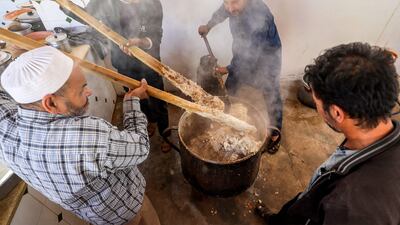
Volunteers cook together portions of the traditional Libyan dish "Bazin", which consists of a dough made with barley, water, and salt in the coastal city of Tajura east of Tripoli, to be distributed to needy families during the Muslim holy fasting month of Ramadan. AFP -
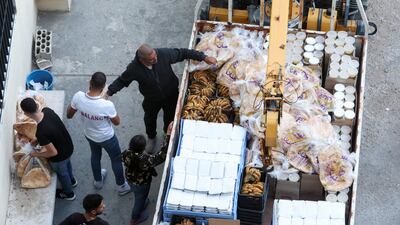
Volunteers prepare to distribute Iftar meals to internally displaced people who fled from their border villages due to ongoing cross-border hostilities between Hezbollah and Israeli forces, at a school turned into shelter, during the holy month of Ramadan, in Tyre, southern Lebanon. Reuters -
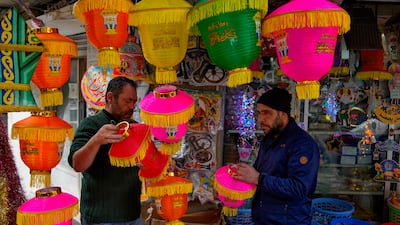
People shop for decorations for the Muslim holy month of Ramadan at a shop in Beirut, Lebanon. AP -
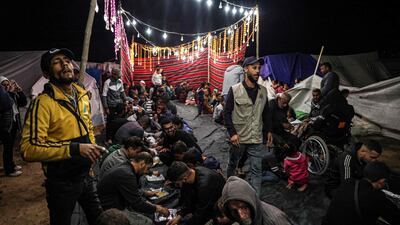
Palestinians share an iftar meal, the breaking of fast, on the first day of the Muslim holy fasting month of Ramadan, at a camp for displaced people in Rafah in the southern Gaza Strip. AFP -
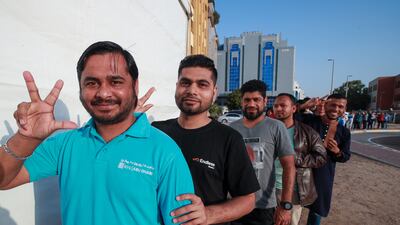
Residents queue outside the iftar tent set up by Emirates Red Crescent and Oxy beside the Abu Dhabi Central Bus Station. Victor Besa / The National -
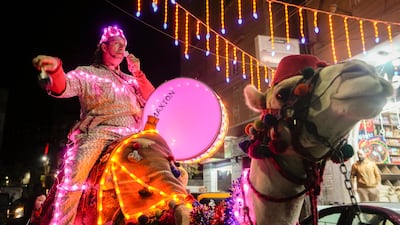
Mohammed El-Dahshan, a 39-year-old "Mesaharati," or dawn caller, rides his camel wrapped with colored led lights to wake Muslims up for a meal before sunrise, during the Islamic holy month of Ramadan, in the Delta city of Dikernis, Egypt, about 93 miles (150 kilometers) north of Cairo. AP -
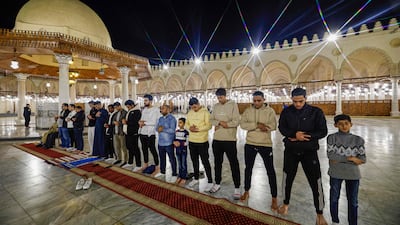
Egyptians perform an evening prayer known as 'Tarawih' on the eve of the Muslim holy fasting month of Ramadan at Cairo's historic mosque of Amr Ibn al-Aas. AFP -
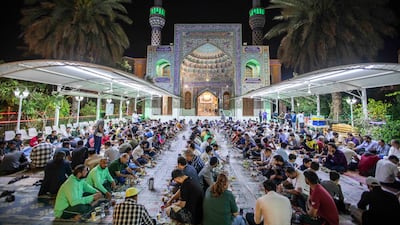
Iftar at Imam Hussein Mosque also known as Iranian Mosque in Al Satwa, Dubai. Leslie Pableo for The National -

First Ramadan Morning Prayer at the The Al Farooq Omar Bin Al Khattab Mosque located in Dubai, United Arab Emirates. The mosque is named after Umar bin Al Khattab, a companion of The Prophet Muhammad (PBUH) who became the second Caliph after Abu Bakr and was given the title Al Farooq, meaning someone who distinguished truth from falsehood. Antonie Robertson/The National -
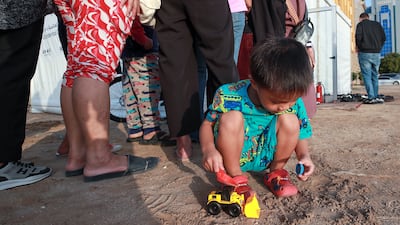
A boy plays with his toys outside the iftar tent set up by Emirates Red Crescent and Oxy beside the Abu Dhabi Central Bus Station. Victor Besa / The National -
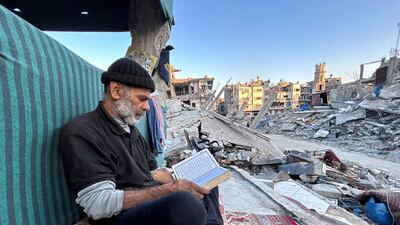
Palestinian man Ismail Al-Khlout reads the Koran as he waits to break his fast while sitting on the rubble of his house, which was destroyed during Israel's military offensive as the conflict between Israel and Hamas continues, during the holy month of Ramadan, in Beit Lahia in the northern Gaza Strip. Reuters -
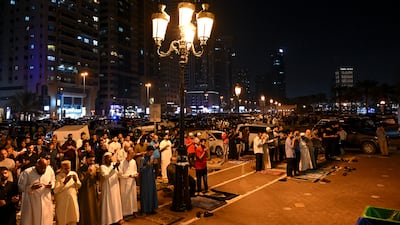
Muslims offering taraweeh prayers at Al Noor mosque in Sharjah. 11th March 2024 Photo Credit:Ahmed Ramzan for The National -

A sells cotton candy for iftar (breaking of the fast) on the first day of the Muslim holy fasting month of Ramadan in the northern Syrian city of Al-Bab. AFP -
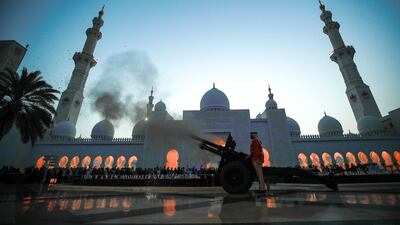
A cannon at Sheikh Zayed Grand Mosque in Abu Dhabi is fired to mark the end of the day's fasting. Victor Besa / The National



