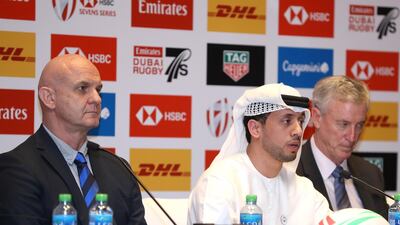
Asia Rugby president Qais Al Dhalai is remaining hopeful rugby could return this year. Getty Images

Asia Rugby chief Qais Al Dhalai backs Agustin Pichot as the man to reform rugby's 'unfair' global structure


Paul Radley
  • English
  • Arabic

Asia Rugby’s president Qais Al Dhalai insists the sport’s global governance must be reformed if it wants to truly expand the game.

Votes have been cast to decide the next chairman of World Rugby, with the decision set to be officially announced on May 12.

The governing body for the sport on the continent have backed challenger Agustin Pichot's bid to replace Bill Beaumont in the role.

Even though the continent hosted a highly successful World Cup last year, as well as the two most popular legs of the annual Sevens World Series, Asia has just four of 51 votes in the election process.

Japan accounts for two votes, while the rest of Asia have two between them.

Of the 28 voting member unions in Asia Rugby, 24 went for Pichot, two for Beaumont, and there were two abstentions.

Al Dhalai believes the current system of how the sport is run needs to be overhauled, and he believes Pichot is the man to do it.

“The governance structure does not seem fair to me, and does not seem fair to many,” Al Dhalai said. “It was inherited from a long, long time ago.

"For me, as the leader of the region with the biggest potential, the region which staged the most successful World Cup, and will be staging the Olympics, I think this should change. And it should change now.”

Because of the way the World Rugby Council is made up, powerhouse nations like England, France, and New Zealand get three votes each.

Elsewhere, countries like United States, Fiji and Georgia get one vote apiece, while many smaller unions are grouped together and given two votes between them – as is the case in Asia.

Al Dhalai says it is undemocratic, and cites the International Olympic Committee as having the sort of governance structure rugby should aspire to.

“In the Olympics charter, it is clearly outlined that each union should have their own vote,” Al Dhalai said. “That is the principal of equality. That is the principal of democracy.

"How can an international federation have 51 votes only, when they are more than 100 full members?”

Both of the candidates to be chairman of World Rugby have said they will change the system.

In his manifesto, Pichot says, “it is a time for change, to focus our attention, love and dedication on all unions equally”.

“It is time to think of a sport where professional and commercial income is becoming a true benefit for all, by empowering rugby’s growth around the world and by moving on from a time when those benefits were for just a few,” the former Argentina scrum-half said.

Agustin Pichot has launched a bid to become the next chairman of World Rugby. PA

Beaumont, for his part, has said there will be an independent review into the “organisational structure” of World Rugby, including its executive councils.

But Al Dhalai says little has changed in Beaumont’s time in the role so far, and he believes Pichot would bring about change immediately.

“It should happen,” Al Dhalai said. “You need to give a chance to Georgia, you need to give a chance to Romania, to Canada, to Fiji, to USA.

“They are not given a fair chance to compete. Also there is Russia. They are a good market and their national team is doing really well.

“Those people need a voice. You can’t always ring-fence the global calendar to suit just a few. You need to embrace change and equality.

“If Pichot gets in, he will directly start this change. He won’t waste a moment.  He has already said that he has struggled internally, that he wanted a nations championship, but it didn’t work.”

Rugby has often spoken of expanding the game beyond its established countries.

Judged on World Cups, little progress has been made in that regard.

At last year’s World Cup in Japan, six of the quarter-finalists were the same as had played at the same stage of the first World Cup 32 years earlier. Seven of them reached the same stage in the 1995 World Cup.

Al Dhalai says a more even spread of World Rugby funding beyond the usual unions would help develop the sport.

And he points to the popularity of sevens in Asia as evidence of the sport's potential on the continent.

“The two biggest tournaments are in Dubai and Hong Kong, and Singapore is aspiring to be like that, too,” Al Dhalai said. “You can’t neglect Asia. One country, one vote, is more sensible than 51 votes.

"How can you give a single country three votes and a region two? On what basis can you give Wales three, when you give Uruguay or Georgia one? Are you trying to protect something?

“Open it. Let it be an equal sport. Let everyone benefit from the commercial value of World Rugby.”


Who are the Soroptimists?

The first Soroptimists club was founded in Oakland, California in 1921. The name comes from the Latin word soror which means sister, combined with optima, meaning the best.

The organisation said its name is best interpreted as ‘the best for women’.

Since then the group has grown exponentially around the world and is officially affiliated with the United Nations. The organisation also counts Queen Mathilde of Belgium among its ranks.

COMPANY%20PROFILE
%3Cp%3E%3Cstrong%3EName%3A%20%3C%2Fstrong%3EKinetic%207%3Cbr%3E%3Cstrong%3EStarted%3A%3C%2Fstrong%3E%202018%3Cbr%3E%3Cstrong%3EFounder%3A%3C%2Fstrong%3E%20Rick%20Parish%3Cbr%3E%3Cstrong%3EBased%3A%3C%2Fstrong%3E%20Abu%20Dhabi%2C%20UAE%3Cbr%3E%3Cstrong%3EIndustry%3A%3C%2Fstrong%3E%20Clean%20cooking%3Cbr%3E%3Cstrong%3EFunding%3A%3C%2Fstrong%3E%20%2410%20million%3Cbr%3E%3Cstrong%3EInvestors%3A%3C%2Fstrong%3E%20Self-funded%3C%2Fp%3E%0A
%20Ramez%20Gab%20Min%20El%20Akher
%3Cp%3E%3Cstrong%3ECreator%3A%3C%2Fstrong%3E%20Ramez%20Galal%3C%2Fp%3E%0A%3Cp%3E%3Cstrong%3EStarring%3A%3C%2Fstrong%3E%20Ramez%20Galal%3C%2Fp%3E%0A%3Cp%3E%3Cstrong%3EStreaming%20on%3A%20%3C%2Fstrong%3EMBC%20Shahid%3C%2Fp%3E%0A%3Cp%3E%3Cstrong%3ERating%3A%20%3C%2Fstrong%3E2.5%2F5%3C%2Fp%3E%0A
COMPANY%20PROFILE
%3Cp%3E%3Cstrong%3ECompany%20name%3A%3C%2Fstrong%3E%20OneOrder%3Cbr%3E%3Cstrong%3EStarted%3A%3C%2Fstrong%3E%20March%202022%3Cbr%3E%3Cstrong%3EFounders%3A%3C%2Fstrong%3E%20Tamer%20Amer%20and%20Karim%20Maurice%3Cbr%3E%3Cstrong%3EBased%3A%3C%2Fstrong%3E%20Cairo%3Cbr%3E%3Cstrong%3ENumber%20of%20staff%3A%20%3C%2Fstrong%3E82%3Cbr%3E%3Cstrong%3EInvestment%20stage%3A%3C%2Fstrong%3E%20Series%20A%3C%2Fp%3E%0A
The alternatives

• Founded in 2014, Telr is a payment aggregator and gateway with an office in Silicon Oasis. It’s e-commerce entry plan costs Dh349 monthly (plus VAT). QR codes direct customers to an online payment page and merchants can generate payments through messaging apps.

• Business Bay’s Pallapay claims 40,000-plus active merchants who can invoice customers and receive payment by card. Fees range from 1.99 per cent plus Dh1 per transaction depending on payment method and location, such as online or via UAE mobile.

• Tap started in May 2013 in Kuwait, allowing Middle East businesses to bill, accept, receive and make payments online “easier, faster and smoother” via goSell and goCollect. It supports more than 10,000 merchants. Monthly fees range from US$65-100, plus card charges of 2.75-3.75 per cent and Dh1.2 per sale.

2checkout’s “all-in-one payment gateway and merchant account” accepts payments in 200-plus markets for 2.4-3.9 per cent, plus a Dh1.2-Dh1.8 currency conversion charge. The US provider processes online shop and mobile transactions and has 17,000-plus active digital commerce users.

• PayPal is probably the best-known online goods payment method - usually used for eBay purchases -  but can be used to receive funds, providing everyone’s signed up. Costs from 2.9 per cent plus Dh1.2 per transaction.

Attacks on Egypt’s long rooted Copts

Egypt’s Copts belong to one of the world’s oldest Christian communities, with Mark the Evangelist credited with founding their church around 300 AD. Orthodox Christians account for the overwhelming majority of Christians in Egypt, with the rest mainly made up of Greek Orthodox, Catholics and Anglicans.

The community accounts for some 10 per cent of Egypt’s 100 million people, with the largest concentrations of Christians found in Cairo, Alexandria and the provinces of Minya and Assiut south of Cairo.

Egypt’s Christians have had a somewhat turbulent history in the Muslim majority Arab nation, with the community occasionally suffering outright persecution but generally living in peace with their Muslim compatriots. But radical Muslims who have first emerged in the 1970s have whipped up anti-Christian sentiments, something that has, in turn, led to an upsurge in attacks against their places of worship, church-linked facilities as well as their businesses and homes.

More recently, ISIS has vowed to go after the Christians, claiming responsibility for a series of attacks against churches packed with worshippers starting December 2016.

The discrimination many Christians complain about and the shift towards religious conservatism by many Egyptian Muslims over the last 50 years have forced hundreds of thousands of Christians to migrate, starting new lives in growing communities in places as far afield as Australia, Canada and the United States.

Here is a look at major attacks against Egypt's Coptic Christians in recent years:

November 2: Masked gunmen riding pickup trucks opened fire on three buses carrying pilgrims to the remote desert monastery of St. Samuel the Confessor south of Cairo, killing 7 and wounding about 20. IS claimed responsibility for the attack.

May 26, 2017: Masked militants riding in three all-terrain cars open fire on a bus carrying pilgrims on their way to the Monastery of St. Samuel the Confessor, killing 29 and wounding 22. ISIS claimed responsibility for the attack.

April 2017Twin attacks by suicide bombers hit churches in the coastal city of Alexandria and the Nile Delta city of Tanta. At least 43 people are killed and scores of worshippers injured in the Palm Sunday attack, which narrowly missed a ceremony presided over by Pope Tawadros II, spiritual leader of Egypt Orthodox Copts, in Alexandria's St. Mark's Cathedral. ISIS claimed responsibility for the attacks.

February 2017: Hundreds of Egyptian Christians flee their homes in the northern part of the Sinai Peninsula, fearing attacks by ISIS. The group's North Sinai affiliate had killed at least seven Coptic Christians in the restive peninsula in less than a month.

December 2016A bombing at a chapel adjacent to Egypt's main Coptic Christian cathedral in Cairo kills 30 people and wounds dozens during Sunday Mass in one of the deadliest attacks carried out against the religious minority in recent memory. ISIS claimed responsibility.

July 2016Pope Tawadros II says that since 2013 there were 37 sectarian attacks on Christians in Egypt, nearly one incident a month. A Muslim mob stabs to death a 27-year-old Coptic Christian man, Fam Khalaf, in the central city of Minya over a personal feud.

May 2016: A Muslim mob ransacks and torches seven Christian homes in Minya after rumours spread that a Christian man had an affair with a Muslim woman. The elderly mother of the Christian man was stripped naked and dragged through a street by the mob.

New Year's Eve 2011A bomb explodes in a Coptic Christian church in Alexandria as worshippers leave after a midnight mass, killing more than 20 people.

Du Football Champions

The fourth season of du Football Champions was launched at Gitex on Wednesday alongside the Middle East’s first sports-tech scouting platform.“du Talents”, which enables aspiring footballers to upload their profiles and highlights reels and communicate directly with coaches, is designed to extend the reach of the programme, which has already attracted more than 21,500 players in its first three years.

Company Profile

Name: Thndr
Started: 2019
Co-founders: Ahmad Hammouda and Seif Amr
Sector: FinTech
Headquarters: Egypt
UAE base: Hub71, Abu Dhabi
Current number of staff: More than 150
Funds raised: $22 million

HOW TO WATCH

Facebook: TheNationalNews  

Twitter: @thenationalnews  

Instagram: @thenationalnews.com  

TikTok: @thenationalnews 

The five pillars of Islam

1. Fasting

2. Prayer

3. Hajj

4. Shahada

5. Zakat 

Real estate tokenisation project

Dubai launched the pilot phase of its real estate tokenisation project last month.

The initiative focuses on converting real estate assets into digital tokens recorded on blockchain technology and helps in streamlining the process of buying, selling and investing, the Dubai Land Department said.

Dubai’s real estate tokenisation market is projected to reach Dh60 billion ($16.33 billion) by 2033, representing 7 per cent of the emirate’s total property transactions, according to the DLD.

Our legal consultant

Name: Hassan Mohsen Elhais

Position: legal consultant with Al Rowaad Advocates and Legal Consultants.