

For Mads Davidsen, the tangible trophy was simply evidence of what he hopes to be an early step on the path to sustainable success.
Last month, Al Jazira clinched the UAE top-flight title for the third time in the club's history, an achievement made all the more commendable given the capital side boasted the youngest team in the division.
Less than a year into his role as sporting director, and with an ambitious long-term project in mind, Davidsen had helped oversee almost instant reward.
Although, even if the championship was richly deserved - Jazira possessed the best attack and joint second-best defence, losing only three of 26 Arabian Gulf League matches - the Dane concedes success arrived slightly sooner than anticipated.
"It's been a little bit surprising," Davidsen, whose experience includes a similarly rewarding tenure in China with Shanghai SIPG, tells The National. "To already achieve something within 10 months of course is not something we could predict.
“But you can still improve. Many things we need to add, we need to develop, and this group of players has not seen their peak yet. So for me, it’s just a good sign of what’s to come in the future.
“It’s important for the path. It’s proof that what we described as our club strategy is already working.”
Appointed 12 months ago, and despite having an impressive CV already in Asia, Davidsen was still new to the UAE, the culture and its football. Like many, he had to adapt to working immediately amid the confines of a pandemic. An initial survey of Jazira and UAE football was completed remotely, before Davidsen relocated from Spain to Abu Dhabi with his young family to begin fully his new position. Patently, the move has worked out well.
“When I came in here, we did what we call a landscape analysis,” Davidsen says. “It’s a little bit like a war-strategy element: we looked at what landscape we are competing in, who are the opponents, what are the benchmarks, how can we find our competitive edge.
“We could see some elements where we could be competitive - for example with a very clear style of play that wouldn’t change, even if the head coach changed. We could also see that we have a bigger path of academy players, a better production line than other clubs. So these two became parameters for us that could be, over time, our successful way.”
Faith in youth
With the long-term the focus, tough decisions had to be made in the short-term. In February, Jazira surprised observers of UAE football by releasing Omar Abdulrahman, Amer Abdulrahman and Sultan Al Ghaferi, part of a raft of players sold or their contracts terminated since last summer as Jazira placed faith in youth. Before the season was out, that number swelled into double figures.
Of the aforementioned trio, Omar Abdulrahman was especially unexpected. Before the pandemic struck, the 2016 Asian player of the year had been rediscovering form following a lengthy injury.
Months after his release, though, Jazira had captured the league crown with a side whose average age tallied a little more than 25 years.
“Now it’s easy to say it was the right decision,” Davidsen says. “But we had to be brave, we had to look at our budgets, we had to look at also the future. There was nothing bad about these players; they are all in this region of the world very good players.
“But if you really say out loud that, ‘We believe in young players, we’re a club that plays young players’, you also have to walk the talk. And this was a way of walking the talk.
“You have to trust them and open the path for them. And we’ve seen inside the club that now young players see, wow, there is a path; it’s not just words. Actually, to negotiate contracts with academy players is getting easier because players want to play for Al Jazira now. Because they can see there is a clear path.”

The make-up of the first-team squad certainly attests to that. Academy graduates form the nucleus of the current side, with the likes of Khalifa Al Hammadi (22) and Mohammed Al Attas (23) in defence, while Abdullah Ramadan (23) has excelled in midfield. UAE manager Bert van Marwijk recently labelled Ramadan one of the best footballers in the Emirates.
The trust in academy talent has been married to savvy recruitment in youth. Malian Omar Traore joined last summer from Stade Malien, age 18, arriving for trial when Covid-19 restrictions meant only small groups were permitted on the pitch at one time. Training was even confined to passing drills. So, using limited empirical evidence, Jazira signed Traore without seeing him play a game.
Little fear, however: the winger rounded off a stellar debut season by scoring twice against Khorfakkan last month for Jazira to clinch the title. He has since been rewarded with a contract extension until 2024.
Traore has clearly integrated well, with Davidsen highlighting the squad’s togetherness, its blend of locals and foreigners, young and experienced – goalkeeper Ali Kasheif and star striker Ali Mabkhout are pivotal figures in the dressing room - as key to the recent rude health.
It has led, apparently, to Jazira being recognised far and wide as a desirable destination.
“Definitely during this season, not just with the title but also before, we’ve managed to create a group and an environment that players want to be part of,” Davidsen says. “I don’t know how the players know this, but we’re being approached by players who want to join Al Jazira because of this.
“Foreigners and local players, because they sense now, or maybe they also watch the games thinking, ‘Wow, this is a nice style of play; I want to attack; I want to score; a good group; a passionate group to play with; good teammates; good dressing room’.
“This environmental aspect has already spread that we sense now that players really want to come here.”
The wish is that it contributes to the sustainable success Davidsen was employed to help deliver. Jazira captured the UAE championship in the 2010/11 and 2016/17 campaigns, but in the succeeding seasons finished fourth and seventh, respectively.
Understandably, Davidsen is intent on ensuring that does not happen again. This Jazira is to be built to last, strengthened late last month by manager Marcel Keizer signing a new, two-year contract.
Continuity can be pillars to prolonged prosperity. Jazira want last season’s success to represent the beginning, not the end point.
-
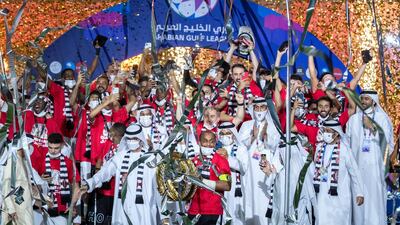
Al Jazira were presented with the Arabian Gulf League trophy after easing past Khorfakkan 3-1 in the final game of the season on Tuesday, May 11. Victor Besa / The National. -

Jazira ended the season with 17 wins from 26 games, suffering only three defeats. Victor Besa / The National. -

Jazira celebrate after winning 3-1 over Khorfakkan to be crowned UAE champions. Victor Besa / The National -
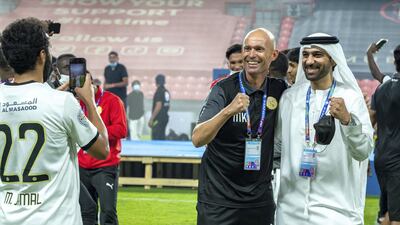
The victory means Jazira have become UAE champions for the third time. Victor Besa / The National -

The Arabian Gulf League final game was held at the Mohamed bin Zayed Stadium in Abu Dhabi. Victor Besa / The National. -

Al Jazira players during the first half. Victor Besa / The National -

Jazira's Abdullah Ramadan, right, battles for possession with Ismail Al Hammadi of Khorfakkan. Victor Besa / The National -

Jazira's Thulani Serero heads the ball. Victor Besa / The National -
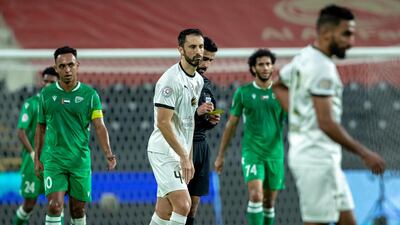
Milos Kosanovic of Jazira is booked in the first half. Victor Besa / The National -
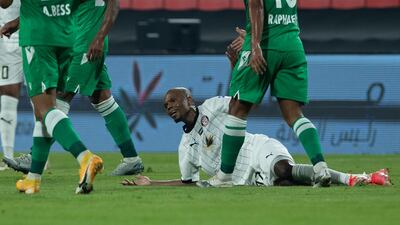
Jazira's Thulani Serero goes down looking for a foul. Victor Besa / The National -

Khorfakkan's Bruno Lamas challenges Jazira's Thulani Serero for a header. Victor Besa / The National -

Paulinho of Khorfakkan claims a foul. Victor Besa / The National -
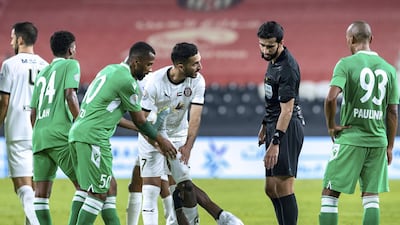
Play is stopped after a Jazira player is injured in the second half. Victor Besa / The National


“Exactly, because I always said that it’s fun to win something, but only if you know why you did it,” Davidsen says. “Otherwise, it could just be a coincidence, and then maybe five or six years of bad results and it can be a bit of a waste. So we have to continue, of course.
“Next season will be difficult because we will have a lot of games, because now we also qualified directly for the Asian Champions League.
“But like I said, our group has not peaked yet. If you look at peak years as a footballer, it’s between 26 and 29 - that’s when a player plays his best years of football, statistically. And we have a lot of players around 22, 23, 24.
“So for me this group can only improve: by training, by continuously working within our style of play, and by individual development. That’s what we have to rely on. We don’t need to change 10 players; we can actually continue with the same group.”
The Champions League - Jazira last competed on the continent in 2018 - should provide a steep learning curve, both physically and mentally for a rapidly developing, but still fledgling, group.
Having sampled Asian football’s premier club competition with SIPG, where he worked alongside manager Sven-Goran Eriksson and international names such as Hulk and Oscar, Davidsen recognises the rigour involved.
That said, the tournament fits snugly within his overarching objective: cementing Jazira’s footballing future.
“It would be fantastic experience for young players,” Davidsen says. “They really need this. A lot of them have never played Champions League because the club hasn’t qualified for several years.
“So they need these games to grow, to add more to their level, to understand the tempo, the pressure. That will be very crucial for their future development. Just like winning the title was.”

