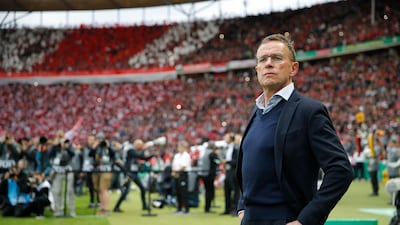
The first time Frank Lampard left Chelsea, it felt an ending marred by ingratitude. News emerged, not in a glowing tribute to their record scorer and Champions League-winning captain, but in the form of the list of released players submitted to the Premier League.
That was in 2014. Jose Mourinho, the manager who had elevated Lampard to the rank of the second-best player in the world, ended up dropping him, discarding him and lining up his successor, Cesc Fabregas. Now Roman Abramovich, the owner who once lent Lampard his yacht, has sacked him. Even with a rare statement from the Russian, containing plenty of praise, it ranks as another undignified departure.
Brutal place, Stamford Bridge. The cast of characters coming and going, often in bloody fashion, lend it the feel of a soap opera. Lampard has gone from favourite son to casualty in the space of seven weeks. He may have overdone the references to Chelsea’s 17-game unbeaten run of late, but it meant they topped the table in early December.
Yet they will be 10th when they kick off against Wolves on Wednesday. Lampard’s past means he, more than anyone else, knows the fundamental rules of Chelsea. Failing to qualify for the Champions League is a sackable offence. The prospect of it tends to prompt a pre-emptive strike.
Lampard’s legendary status, his past as Chelsea’s greatest player, afforded no protection, but neither did the track record of success some of his predecessors boasted. Even Roberto Di Matteo and Avram Grant had more on their managerial CVs than Lampard when appointed; and, indeed, when dismissed.
________________
Other contenders for Chelsea job
________________
But the lack of sentimentality and the swiftness of Lampard’s demise do not render this a surprise sacking. Ole Gunnar Solskjaer and Mikel Arteta have survived worse slumps, but at different clubs.
It is not merely that Chelsea have lost five times in eight league games. It is the manner of the setbacks. Chelsea have had sorry starts, losing the first halves to Arsenal, Manchester City and Leicester by an aggregate score of 8-0. They have looked unprepared and unmotivated.
It is hard to escape the sense that some of the players, with the honourable exception of his protege Mason Mount, gave up on Lampard or that some of his rhetoric consisted of blaming them. He strayed further from his strongest team, with recent odd selections betraying more desperation than inspiration.
He has been tactically outwitted by Pep Guardiola and Brendan Rodgers, two far more experienced managers. But perhaps that always threatened to be the case: Chelsea knew they were appointing a rookie.
Some failings of Lampard’s side – a weakness in transition and a susceptibility to the counter-attack – were recurring themes. Others were addressed: his team became far better at set-pieces this season.
Yet they regressed in defining games as expenditure raised expectations. They have only beaten one top-half team this season, in West Ham, while Abramovich’s nearly £300 million ($409m) outlay in a depressed market was designed to catapult Chelsea back to the summit.
Kai Havertz and Timo Werner became the flagship failures of Lampard’s Chelsea, two budding Galacticos who scarcely ranked in his best side. That, Chelsea seemingly concluded, was more his fault than theirs.
Perhaps he was a better manager with fewer elite players. Last season’s mitigating circumstances – the loss of Eden Hazard and Chelsea’s transfer ban, lumbered with Kepa Arrizabalaga, bequeathed the perpetual problem of Jorginho by Maurizio Sarri – forged a unique campaign in which, despite a poor defensive record, Lampard got more right than wrong.
The underachievement has come this year. But Chelsea’s plight may call for a proven manager. Lampard is not that, but then he never has been. He was an uncharacteristic appointment by Chelsea, but he has suffered a familiar fate.

The specs
Engine: 2.0-litre four-cylinder turbo
Power: 268hp at 5,600rpm
Torque: 380Nm at 4,800rpm
Transmission: CVT auto
Fuel consumption: 9.5L/100km
On sale: now
Price: from Dh195,000
Hidden killer
Sepsis arises when the body tries to fight an infection but damages its own tissue and organs in the process.
The World Health Organisation estimates it affects about 30 million people each year and that about six million die.
Of those about three million are newborns and 1.2 are young children.
Patients with septic shock must often have limbs amputated if clots in their limbs prevent blood flow, causing the limbs to die.
Campaigners say the condition is often diagnosed far too late by medical professionals and that many patients wait too long to seek treatment, confusing the symptoms with flu.
The specs
Engine: 2.0-litre 4cyl turbo
Power: 261hp at 5,500rpm
Torque: 405Nm at 1,750-3,500rpm
Transmission: 9-speed auto
Fuel consumption: 6.9L/100km
On sale: Now
Price: From Dh117,059
The%20specs
%3Cp%3E%3Cstrong%3EEngine%3A%20%3C%2Fstrong%3E4.0-litre%20twin-turbo%20V8%0D%3Cbr%3E%3Cstrong%3EPower%3A%20%3C%2Fstrong%3E640hp%20at%206%2C000rpm%0D%3Cbr%3E%3Cstrong%3ETorque%3A%20%3C%2Fstrong%3E850Nm%20from%202%2C300-4%2C500rpm%0D%3Cbr%3E%3Cstrong%3ETransmission%3A%20%3C%2Fstrong%3E8-speed%20auto%0D%3Cbr%3E%3Cstrong%3EFuel%20consumption%3A%20%3C%2Fstrong%3E11.9L%2F100km%0D%3Cbr%3E%3Cstrong%3EPrice%3A%20%3C%2Fstrong%3EDh749%2C800%0D%3Cbr%3E%3Cstrong%3EOn%20sale%3A%20%3C%2Fstrong%3Enow%3C%2Fp%3E%0A
How to turn your property into a holiday home
- Ensure decoration and styling – and portal photography – quality is high to achieve maximum rates.
- Research equivalent Airbnb homes in your location to ensure competitiveness.
- Post on all relevant platforms to reach the widest audience; whether you let personally or via an agency know your potential guest profile – aiming for the wrong demographic may leave your property empty.
- Factor in costs when working out if holiday letting is beneficial. The annual DCTM fee runs from Dh370 for a one-bedroom flat to Dh1,200. Tourism tax is Dh10-15 per bedroom, per night.
- Check your management company has a physical office, a valid DTCM licence and is licencing your property and paying tourism taxes. For transparency, regularly view your booking calendar.
Mercer, the investment consulting arm of US services company Marsh & McLennan, expects its wealth division to at least double its assets under management (AUM) in the Middle East as wealth in the region continues to grow despite economic headwinds, a company official said.
Mercer Wealth, which globally has $160 billion in AUM, plans to boost its AUM in the region to $2-$3bn in the next 2-3 years from the present $1bn, said Yasir AbuShaban, a Dubai-based principal with Mercer Wealth.
“Within the next two to three years, we are looking at reaching $2 to $3 billion as a conservative estimate and we do see an opportunity to do so,” said Mr AbuShaban.
Mercer does not directly make investments, but allocates clients’ money they have discretion to, to professional asset managers. They also provide advice to clients.
“We have buying power. We can negotiate on their (client’s) behalf with asset managers to provide them lower fees than they otherwise would have to get on their own,” he added.
Mercer Wealth’s clients include sovereign wealth funds, family offices, and insurance companies among others.
From its office in Dubai, Mercer also looks after Africa, India and Turkey, where they also see opportunity for growth.
Wealth creation in Middle East and Africa (MEA) grew 8.5 per cent to $8.1 trillion last year from $7.5tn in 2015, higher than last year’s global average of 6 per cent and the second-highest growth in a region after Asia-Pacific which grew 9.9 per cent, according to consultancy Boston Consulting Group (BCG). In the region, where wealth grew just 1.9 per cent in 2015 compared with 2014, a pickup in oil prices has helped in wealth generation.
BCG is forecasting MEA wealth will rise to $12tn by 2021, growing at an annual average of 8 per cent.
Drivers of wealth generation in the region will be split evenly between new wealth creation and growth of performance of existing assets, according to BCG.
Another general trend in the region is clients’ looking for a comprehensive approach to investing, according to Mr AbuShaban.
“Institutional investors or some of the families are seeing a slowdown in the available capital they have to invest and in that sense they are looking at optimizing the way they manage their portfolios and making sure they are not investing haphazardly and different parts of their investment are working together,” said Mr AbuShaban.
Some clients also have a higher appetite for risk, given the low interest-rate environment that does not provide enough yield for some institutional investors. These clients are keen to invest in illiquid assets, such as private equity and infrastructure.
“What we have seen is a desire for higher returns in what has been a low-return environment specifically in various fixed income or bonds,” he said.
“In this environment, we have seen a de facto increase in the risk that clients are taking in things like illiquid investments, private equity investments, infrastructure and private debt, those kind of investments were higher illiquidity results in incrementally higher returns.”
The Abu Dhabi Investment Authority, one of the largest sovereign wealth funds, said in its 2016 report that has gradually increased its exposure in direct private equity and private credit transactions, mainly in Asian markets and especially in China and India. The authority’s private equity department focused on structured equities owing to “their defensive characteristics.”
Ten tax points to be aware of in 2026
1. Domestic VAT refund amendments: request your refund within five years
If a business does not apply for the refund on time, they lose their credit.
2. E-invoicing in the UAE
Businesses should continue preparing for the implementation of e-invoicing in the UAE, with 2026 a preparation and transition period ahead of phased mandatory adoption.
3. More tax audits
Tax authorities are increasingly using data already available across multiple filings to identify audit risks.
4. More beneficial VAT and excise tax penalty regime
Tax disputes are expected to become more frequent and more structured, with clearer administrative objection and appeal processes. The UAE has adopted a new penalty regime for VAT and excise disputes, which now mirrors the penalty regime for corporate tax.
5. Greater emphasis on statutory audit
There is a greater need for the accuracy of financial statements. The International Financial Reporting Standards standards need to be strictly adhered to and, as a result, the quality of the audits will need to increase.
6. Further transfer pricing enforcement
Transfer pricing enforcement, which refers to the practice of establishing prices for internal transactions between related entities, is expected to broaden in scope. The UAE will shortly open the possibility to negotiate advance pricing agreements, or essentially rulings for transfer pricing purposes.
7. Limited time periods for audits
Recent amendments also introduce a default five-year limitation period for tax audits and assessments, subject to specific statutory exceptions. While the standard audit and assessment period is five years, this may be extended to up to 15 years in cases involving fraud or tax evasion.
8. Pillar 2 implementation
Many multinational groups will begin to feel the practical effect of the Domestic Minimum Top-Up Tax (DMTT), the UAE's implementation of the OECD’s global minimum tax under Pillar 2. While the rules apply for financial years starting on or after January 1, 2025, it is 2026 that marks the transition to an operational phase.
9. Reduced compliance obligations for imported goods and services
Businesses that apply the reverse-charge mechanism for VAT purposes in the UAE may benefit from reduced compliance obligations.
10. Substance and CbC reporting focus
Tax authorities are expected to continue strengthening the enforcement of economic substance and Country-by-Country (CbC) reporting frameworks. In the UAE, these regimes are increasingly being used as risk-assessment tools, providing tax authorities with a comprehensive view of multinational groups’ global footprints and enabling them to assess whether profits are aligned with real economic activity.
Contributed by Thomas Vanhee and Hend Rashwan, Aurifer
Women & Power: A Manifesto
Mary Beard
Profile Books and London Review of Books
SPECS
%3Cp%3E%0D%3Cstrong%3EEngine%3A%3C%2Fstrong%3E%204.0-litre%20twin-turbo%20V8%0D%3Cbr%3E%3Cstrong%3EPower%3A%3C%2Fstrong%3E%20750hp%20at%207%2C500rpm%0D%3Cbr%3E%3Cstrong%3ETorque%3A%3C%2Fstrong%3E%20800Nm%20at%205%2C500rpm%0D%3Cbr%3E%3Cstrong%3ETransmission%3A%3C%2Fstrong%3E%207%20Speed%20dual-clutch%20auto%0D%0D%3Cbr%3E%3Cstrong%3ETop%20speed%3A%3C%2Fstrong%3E%20332kph%0D%3Cbr%3E%3Cstrong%3EFuel%20consumption%3A%3C%2Fstrong%3E%2012.2L%2F100km%0D%3Cbr%3E%3Cstrong%3EOn%20sale%3A%20%3C%2Fstrong%3EYear%20end%0D%3Cbr%3E%3Cstrong%3EPrice%3A%3C%2Fstrong%3E%20From%20Dh1%2C430%2C000%20(coupe)%3B%20From%20Dh1%2C566%2C000%20(Spider)%3C%2Fp%3E%0A
FFP EXPLAINED
What is Financial Fair Play?
Introduced in 2011 by Uefa, European football’s governing body, it demands that clubs live within their means. Chiefly, spend within their income and not make substantial losses.
What the rules dictate?
The second phase of its implementation limits losses to €30 million (Dh136m) over three seasons. Extra expenditure is permitted for investment in sustainable areas (youth academies, stadium development, etc). Money provided by owners is not viewed as income. Revenue from “related parties” to those owners is assessed by Uefa's “financial control body” to be sure it is a fair value, or in line with market prices.
What are the penalties?
There are a number of punishments, including fines, a loss of prize money or having to reduce squad size for European competition – as happened to PSG in 2014. There is even the threat of a competition ban, which could in theory lead to PSG’s suspension from the Uefa Champions League.