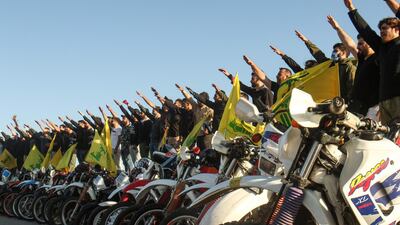
Hezbollah supporters perform a salute as they stand behind motorcycles carrying the group's flags in the southern Lebanese district of Marjayoun on the border with Israel on May 25, 2020. AFP

Hezbollah is much weaker than it seems


  • English
  • Arabic

Some would say that, given the crisis Lebanon is facing today, Hezbollah’s project for the country is dead. Such statements, however, go too far.

With thousands of men under arms, a missile arsenal, Iranian backing and much of the Shiite religious community behind the party, Hezbollah remains a potent force in Lebanese society. Yet it is also true that today its ability to act as Iran’s deterrent has been severely compromised by Lebanon’s domestic situation, and this may not end any time soon.

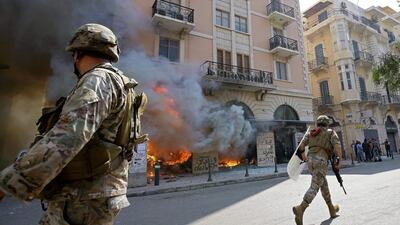
  • Lebanese soldiers clear the road next to a burning bank branch, set ablaze by demonstrators following the funeral of protester Fawaz al-Samman, in the northern port city of Tripoli. AFP
    Lebanese soldiers clear the road next to a burning bank branch, set ablaze by demonstrators following the funeral of protester Fawaz al-Samman, in the northern port city of Tripoli. AFP
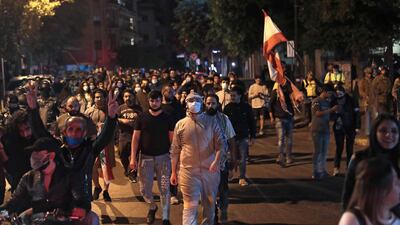
  • Lebanese demonstrators chant anti-government slogans while they walk through the streets of the capital Beirut. AFP
    Lebanese demonstrators chant anti-government slogans while they walk through the streets of the capital Beirut. AFP
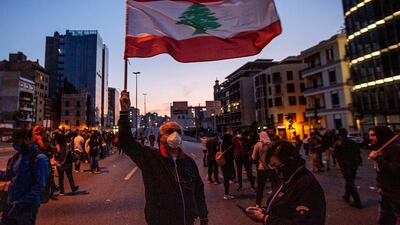
  • Anti-government protesters attend a protest against the collapsing Lebanese pound currency and the price hikes of goods in Beirut. EPA
    Anti-government protesters attend a protest against the collapsing Lebanese pound currency and the price hikes of goods in Beirut. EPA
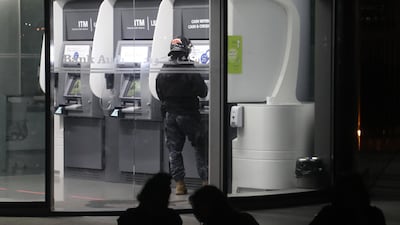
  • Riot police members withdraw money from an ATM at a local Bank Audi SAL bank branch during an anti-government demonstration in Beirut. Bloomberg
    Riot police members withdraw money from an ATM at a local Bank Audi SAL bank branch during an anti-government demonstration in Beirut. Bloomberg
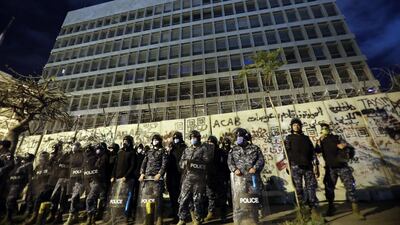
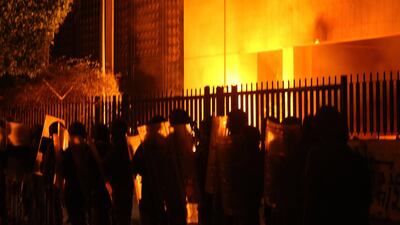
  • Riot police line up outside the headquarters of the Lebanese central bank during an anti-government demonstration in Beirut. Bloomberg
    Riot police line up outside the headquarters of the Lebanese central bank during an anti-government demonstration in Beirut. Bloomberg
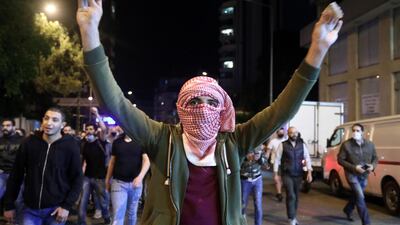
  • A demonstrator gestures during an anti-government demonstration outside the headquarters of the Lebanese central bank in Beirut. Bloomberg
    A demonstrator gestures during an anti-government demonstration outside the headquarters of the Lebanese central bank in Beirut. Bloomberg
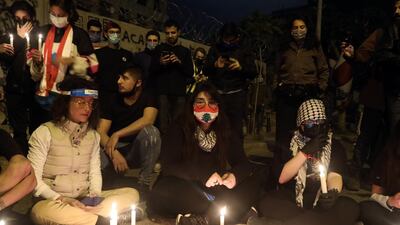
  • Protesters wearing protective face masks light candles during an anti-government demonstration outside the headquarters of the Lebanese central bank in Beirut. Bloomberg
    Protesters wearing protective face masks light candles during an anti-government demonstration outside the headquarters of the Lebanese central bank in Beirut. Bloomberg
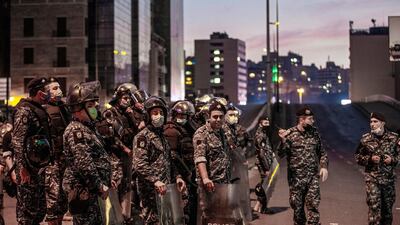
  • Lebanese riot police stand guard during an anti-government protest against the collapsing Lebanese pound currency and the price hikes of goods in Beirut. EPA
    Lebanese riot police stand guard during an anti-government protest against the collapsing Lebanese pound currency and the price hikes of goods in Beirut. EPA
  • Lebanese army soldiers accompany demonstrators as they chant anti-government slogans while they walk through the streets of the capital Beirut. AFP
    Lebanese army soldiers accompany demonstrators as they chant anti-government slogans while they walk through the streets of the capital Beirut. AFP
  • Lebanese police stand guard after demonstrators hurled petrol bombs at the central bank headquarters in the southern city of Sidon (Saida). AFP
    Lebanese police stand guard after demonstrators hurled petrol bombs at the central bank headquarters in the southern city of Sidon (Saida). AFP
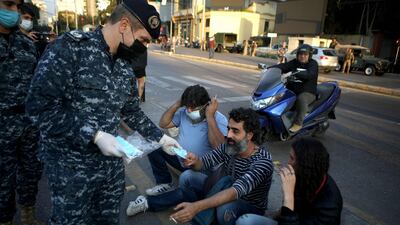
  • A Lebanese policeman, wearing a protective mask, distributes masks to protesters during a demonstration in the capital Beirut. AFP
    A Lebanese policeman, wearing a protective mask, distributes masks to protesters during a demonstration in the capital Beirut. AFP
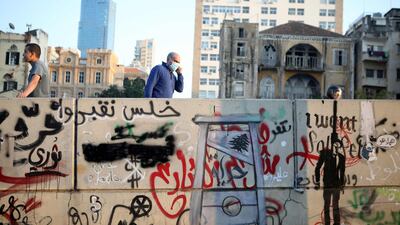
  • Lebanese protesters walk past a wall bearing graffiti of a hanging politician and a guillotine during a demonstration in the capital Beirut. AFP
    Lebanese protesters walk past a wall bearing graffiti of a hanging politician and a guillotine during a demonstration in the capital Beirut. AFP
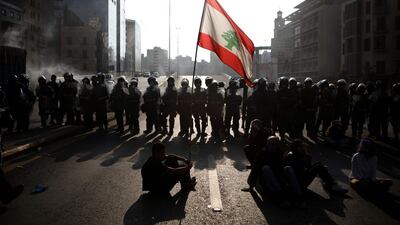
  • Lebanese protesters wave the national flag in front of riot police in the capital Beirut. AFP
    Lebanese protesters wave the national flag in front of riot police in the capital Beirut. AFP
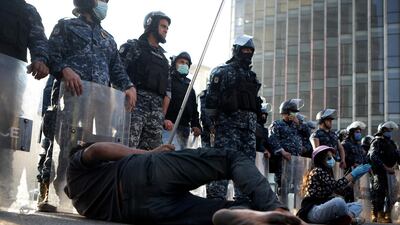
  • A barefoot Lebanese protester lies on the tarmac in front of riot police in the capital Beirut. AFP
    A barefoot Lebanese protester lies on the tarmac in front of riot police in the capital Beirut. AFP
  • A Lebanese protester sits in front of riot police in the capital Beirut. AFP
    A Lebanese protester sits in front of riot police in the capital Beirut. AFP
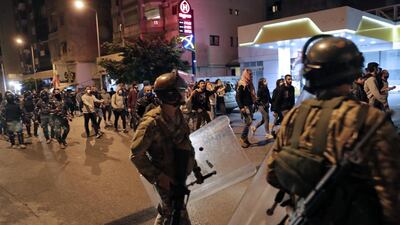
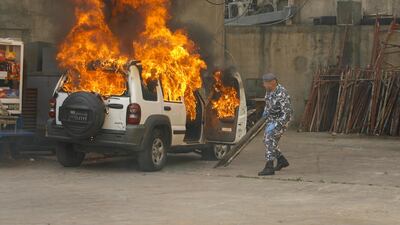
  • A Lebanese policeman reacts as his jeep is engulfed in flames during clashes between protesters and Lebanese soldiers in the northern port city of Tripoli. AFP
    A Lebanese policeman reacts as his jeep is engulfed in flames during clashes between protesters and Lebanese soldiers in the northern port city of Tripoli. AFP
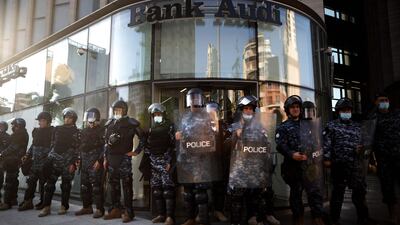
  • Lebanese riot police guard a bank in the capital Beirut. AFP
    Lebanese riot police guard a bank in the capital Beirut. AFP
  • Demonstrators throw pieces of concrete during a protest against growing economic hardship in Beirut, Lebanon. REUTERS
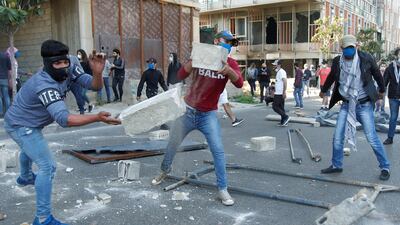
    Demonstrators throw pieces of concrete during a protest against growing economic hardship in Beirut, Lebanon. REUTERS

What is Hezbollah’s plan? Principally, it is to turn the country into a so-called “resistance state” that acts as an outpost for Iranian influence, and another counterweight to Israel and the United States. The common assumption is that the militant party has succeeded in that effort.

But has it?

Hezbollah has power over the Lebanese state, but its sway has also helped to bankrupt and undermine Lebanon, negatively affecting the party’s capacities.

There are several reasons for this. In protecting a corrupt political class and allowing it to pursue its looting of the state, Hezbollah was partly responsible for the collapse last October of Lebanon’s financial order. At the time, the party’s secretary general, Hassan Nasrallah, had understood the risks of popular protests against the ruling class and tried to neutralise public anger. He failed.

For weeks Hezbollah sought to retain some control over a system that had lost all legitimacy, and in January it thought it had succeeded when a government formed by the party and its allies came to power.

But something was definitely broken. Lebanon was insolvent, hundreds of thousands of people were out of work and all of the political parties were forced to recalculate.

This lost Hezbollah two of the essential prerequisites needed to conduct a war against Israel, were Iran to demand it. The first is Lebanon’s ability to absorb Israeli retaliation and rebuild, as happened in 2006. The second is a minimum level of consensus nationally behind Hezbollah’s “resistance” agenda.

A picture taken on May 22, 2020 shows a poster of soldiers carrying a coffin draped in an Israeli flag at the Hezbollah memorial landmark in Mleeta, built in 2010 to commemorate Israel's withdrawal from Lebanon. AFP
Iran leaves countries so debilitated that its proxies end up controlling volatile and vulnerable sandcastles

Lebanon’s bankruptcy means that if there were a war against Israel, the country would be unable to bounce back from the destruction the Israelis would cause. Worse, because of Hezbollah, Lebanon has isolated itself from most of the Arab countries that might once have been willing to finance its reconstruction, so this time the damage would be enduring.

Nor could Beirut call upon Iran, Hezbollah’s economically strangled sponsor, to help, as it simply lacks the means to do so.

The rifts in the political class as a result of the popular protest movement mean that there is no discernible consensus to back Hezbollah in going to war.

Today, the party’s harshest critics come from its erstwhile allies in the Aounist movement, a predominantly Christian faction led by former foreign minister Gebran Bassil. Their criticisms may be linked to domestic disagreements, but when Ziad Aswad, a prominent Aounist, declares that Lebanon “cannot continue to hold a rifle when its people are hungry,” he expresses a widespread view.

Without domestic backing, Hezbollah’s ability to wage war would be greatly hampered. The party would be blamed for sacrificing Lebanon for Iran. Hundreds of thousands of displaced Shiites would have to find refuge in areas hostile to the party, further stoking divisions and potentially leading to strife. This is a nightmare scenario for Hezbollah, as it could plunge the party into a civil conflict that it could not hope to win, nullifying its usefulness to Iran.

Yet that usefulness is questionable even today. Hezbollah has hubristically assumed that Lebanon is solidly in the Iranian camp. Its command of the state may be assured to an extent to an extent, but its command over society is not. And even then, key outposts of the state, such as the army, merely play along with Hezbollah but remain autonomous and would manoeuvre away from the party if the power balance shifted.

Another factor fundamental in determining Hezbollah’s latitude to engage in war with Israel is the situation in Syria. Until the start of Syria’s civil war in 2011, Damascus provided Hezbollah with potential strategic depth in any war. Weapons and men could be moved through Syrian territory to reinforce the party in Lebanon. But today, much of Syria’s airspace is controlled by Russia and Israel, both of whom would oppose, by action or omission, Syria’s transformation into an Iranian forward base.

Iran’s regional strategy involves feeding off the weaknesses of institutions in many Arab countries to advance its own interests. Lebanon, Iraq, Yemen and Syria have all paid a price. In each, Tehran built up autonomous armed groups that counterbalanced state structures, eroding the state. Indeed, Iran gains influence by destroying its host.

Today, Hezbollah’s ability to carry the Lebanese state and society in the direction of its own regional preferences, strong-arm Lebanon’s sects into approving its actions and secure legitimacy from the country’s leaders has been crippled. The party remains powerful, but the foundations on which it built its order in Lebanon have collapsed. Perhaps that’s the problem in Iran’s approach: it leaves countries so debilitated that its proxies end up controlling volatile and vulnerable sandcastles.

As Iran looks at Lebanon, what does it see? It sees its local ally presiding over a state in ruin whose population is angry and refuses to suffer for Tehran. Nor can Hezbollah go to war against Israel without potentially destroying its own domestic standing. All of that won’t make the Iranians alter their strategy, but it does raise real questions about the value of that strategy today.

Michael Young is editor of Diwan, the blog of the Carnegie Middle East programme, in Beirut

UPI facts

More than 2.2 million Indian tourists arrived in UAE in 2023
More than 3.5 million Indians reside in UAE
Indian tourists can make purchases in UAE using rupee accounts in India through QR-code-based UPI real-time payment systems
Indian residents in UAE can use their non-resident NRO and NRE accounts held in Indian banks linked to a UAE mobile number for UPI transactions

The specs

Engine: 3.9-litre twin-turbo V8
Power: 620hp from 5,750-7,500rpm
Torque: 760Nm from 3,000-5,750rpm
Transmission: Eight-speed dual-clutch auto
On sale: Now
Price: From Dh1.05 million ($286,000)

Mercer, the investment consulting arm of US services company Marsh & McLennan, expects its wealth division to at least double its assets under management (AUM) in the Middle East as wealth in the region continues to grow despite economic headwinds, a company official said.

Mercer Wealth, which globally has $160 billion in AUM, plans to boost its AUM in the region to $2-$3bn in the next 2-3 years from the present $1bn, said Yasir AbuShaban, a Dubai-based principal with Mercer Wealth.

Within the next two to three years, we are looking at reaching $2 to $3 billion as a conservative estimate and we do see an opportunity to do so,” said Mr AbuShaban.

Mercer does not directly make investments, but allocates clients’ money they have discretion to, to professional asset managers. They also provide advice to clients.

“We have buying power. We can negotiate on their (client’s) behalf with asset managers to provide them lower fees than they otherwise would have to get on their own,” he added.

Mercer Wealth’s clients include sovereign wealth funds, family offices, and insurance companies among others.

From its office in Dubai, Mercer also looks after Africa, India and Turkey, where they also see opportunity for growth.

Wealth creation in Middle East and Africa (MEA) grew 8.5 per cent to $8.1 trillion last year from $7.5tn in 2015, higher than last year’s global average of 6 per cent and the second-highest growth in a region after Asia-Pacific which grew 9.9 per cent, according to consultancy Boston Consulting Group (BCG). In the region, where wealth grew just 1.9 per cent in 2015 compared with 2014, a pickup in oil prices has helped in wealth generation.

BCG is forecasting MEA wealth will rise to $12tn by 2021, growing at an annual average of 8 per cent.

Drivers of wealth generation in the region will be split evenly between new wealth creation and growth of performance of existing assets, according to BCG.

Another general trend in the region is clients’ looking for a comprehensive approach to investing, according to Mr AbuShaban.

“Institutional investors or some of the families are seeing a slowdown in the available capital they have to invest and in that sense they are looking at optimizing the way they manage their portfolios and making sure they are not investing haphazardly and different parts of their investment are working together,” said Mr AbuShaban.

Some clients also have a higher appetite for risk, given the low interest-rate environment that does not provide enough yield for some institutional investors. These clients are keen to invest in illiquid assets, such as private equity and infrastructure.

“What we have seen is a desire for higher returns in what has been a low-return environment specifically in various fixed income or bonds,” he said.

“In this environment, we have seen a de facto increase in the risk that clients are taking in things like illiquid investments, private equity investments, infrastructure and private debt, those kind of investments were higher illiquidity results in incrementally higher returns.”

The Abu Dhabi Investment Authority, one of the largest sovereign wealth funds, said in its 2016 report that has gradually increased its exposure in direct private equity and private credit transactions, mainly in Asian markets and especially in China and India. The authority’s private equity department focused on structured equities owing to “their defensive characteristics.”

THE%20SWIMMERS
%3Cp%3E%3Cstrong%3EDirector%3A%20%3C%2Fstrong%3ESally%20El-Hosaini%3C%2Fp%3E%0A%3Cp%3E%3Cstrong%3EStars%3A%20%3C%2Fstrong%3ENathalie%20Issa%2C%20Manal%20Issa%2C%20Ahmed%20Malek%20and%20Ali%20Suliman%C2%A0%3C%2Fp%3E%0A%3Cp%3E%3Cstrong%3ERating%3A%20%3C%2Fstrong%3E4%2F5%3C%2Fp%3E%0A
MATCH INFO

Bayern Munich 2 Borussia Monchengladbach 1
Bayern:
 Zirkzee (26'), Goretzka (86')
Gladbach: Pavard (37' og)

Man of the Match: Breel Embolo (Borussia Monchengladbach)

Company profile

Name: Infinite8

Based: Dubai

Launch year: 2017

Number of employees: 90

Sector: Online gaming industry

Funding: $1.2m from a UAE angel investor

Our legal consultant

Name: Hassan Mohsen Elhais

Position: legal consultant with Al Rowaad Advocates and Legal Consultants.

Hamilton profile

Age 32

Country United Kingdom

Grands Prix entered 198

Pole positions 67

Wins 57

Podiums 110

Points 2,423

World Championships 3

How it works

Each player begins with one of the great empires of history, from Julius Caesar's Rome to Ramses of Egypt, spread over Europe and the Middle East.

Round by round, the player expands their empire. The more land they have, the more money they can take from their coffers for each go.

As unruled land and soldiers are acquired, players must feed them. When a player comes up against land held by another army, they can choose to battle for supremacy.

A dice-based battle system is used and players can get the edge on their enemy with by deploying a renowned hero on the battlefield.

Players that lose battles and land will find their coffers dwindle and troops go hungry. The end goal? Global domination of course.

The%20Killer
%3Cp%3E%3Cstrong%3EDirector%3A%C2%A0%3C%2Fstrong%3EDavid%20Fincher%3C%2Fp%3E%0A%3Cp%3E%3Cstrong%3EStars%3A%C2%A0%3C%2Fstrong%3EMichael%20Fassbender%2C%20Tilda%20Swinton%2C%20Charles%20Parnell%3C%2Fp%3E%0A%3Cp%3E%3Cstrong%3ERating%3A%3C%2Fstrong%3E%204%2F5%C2%A0%3C%2Fp%3E%0A
RESULTS

2.30pm Jaguar I-Pace – Conditions (PA) Dh80,000 (Dirt)
1,600m 

Winner Namrood, Antonio Fresu (jockey), Musabah Al Muhairi
(trainer) 

3.05pm Land Rover Defender – Maiden (TB) Dh82,500 (D)
1,400m 

Winner Shadzadi, Tadhg O’Shea, Bhupat Seemar 

3.40pm Jaguar F-Type – Maiden (TB) Dh82,500 (Turf) 1,600m 

Winner Tahdeed, Fernando Jara, Nicholas Bachalard 

4.15pm New Range Rover – Handicap (TB) Dh87,500 (D) 1,400m 

Winner Shanty Star, Richard Mullen, Rashed Bouresly 

4.50pm Land Rover – Handicap (TB) Dh95,000 (T) 2,400m 

Winner Autumn Pride, Bernardo Pinheiro, Helal Al Alawi 

5.25pm Al Tayer Motor – Handicap (TB) Dh95,000  T) 1,000m 

Winner Dahawi, Antonio Fresu, Musabah Al Muhairi 

6pm Jaguar F-Pace SVR – Handicap (TB) Dh87,500 (D) 1,600m 

Winner Scabbard, Sam Hitchcock, Doug Watson  

The stats: 2017 Jaguar XJ

Price, base / as tested Dh326,700 / Dh342,700

Engine 3.0L V6

Transmission Eight-speed automatic

Power 340hp @ 6,000pm

Torque 450Nm @ 3,500rpm

Fuel economy, combined 9.1L / 100km

Three ways to get a gratitude glow

By committing to at least one of these daily, you can bring more gratitude into your life, says Ong.

  • During your morning skincare routine, name five things you are thankful for about yourself.
  • As you finish your skincare routine, look yourself in the eye and speak an affirmation, such as: “I am grateful for every part of me, including my ability to take care of my skin.”
  • In the evening, take some deep breaths, notice how your skin feels, and listen for what your skin is grateful for.
Company%C2%A0profile
%3Cp%3E%3Cstrong%3EDate%20started%3A%20%3C%2Fstrong%3EMay%202022%3Cbr%3E%3Cstrong%3EFounder%3A%20%3C%2Fstrong%3EHusam%20Aboul%20Hosn%3Cbr%3E%3Cstrong%3EBased%3A%20%3C%2Fstrong%3EDIFC%3Cbr%3E%3Cstrong%3ESector%3A%20%3C%2Fstrong%3EFinTech%20%E2%80%94%20Innovation%20Hub%3Cbr%3E%3Cstrong%3EEmployees%3A%20%3C%2Fstrong%3Eeight%3Cbr%3E%3Cstrong%3EStage%3A%20%3C%2Fstrong%3Epre-seed%3Cbr%3E%3Cstrong%3EInvestors%3A%20%3C%2Fstrong%3Epre-seed%20funding%20raised%20from%20family%20and%20friends%20earlier%20this%20year%3C%2Fp%3E%0A
Moving%20Out%202
%3Cp%3E%3Cstrong%3EDeveloper%3A%3C%2Fstrong%3E%20SMG%20Studio%3Cbr%3E%3Cstrong%3EPublisher%3A%3C%2Fstrong%3E%20Team17%3Cbr%3E%3Cstrong%3EConsoles%3A%3C%2Fstrong%3E%20Nintendo%20Switch%2C%20PlayStation%204%26amp%3B5%2C%20PC%20and%20Xbox%20One%3Cbr%3E%3Cstrong%3ERating%3A%3C%2Fstrong%3E%204%2F5%3C%2Fp%3E%0A
Race card

6.30pm: Al Maktoum Challenge Round-3 Group 1 (PA) US$100,000 (Dirt) 2,000m

7.05pm: Meydan Classic Listed (TB) $175,000 (Turf) 1,600m

7.40pm: Handicap (TB) $135,000 (T) 2,000m

8.15pm: Handicap (TB) $135,000 (D) 1,600m

8.50pm: Nad Al Sheba Trophy Group 2 (TB) $300,000 (T) 2,810m

9.25pm: Curlin Stakes Listed (TB) $175,000 (D) 2,000m

10pm: Handicap (TB) $135,000 (T) 2,000m

10.35pm: Handicap (TB) $175,000 (T) 1,400m

The National selections

6.30pm: Shahm, 7.05pm: Well Of Wisdom, 7.40pm: Lucius Tiberius, 8.15pm: Captain Von Trapp, 8.50pm: Secret Advisor, 9.25pm: George Villiers, 10pm: American Graffiti, 10.35pm: On The Warpath

Lexus LX700h specs

Engine: 3.4-litre twin-turbo V6 plus supplementary electric motor

Power: 464hp at 5,200rpm

Torque: 790Nm from 2,000-3,600rpm

Transmission: 10-speed auto

Fuel consumption: 11.7L/100km

On sale: Now

Price: From Dh590,000

Key facilities
  • Olympic-size swimming pool with a split bulkhead for multi-use configurations, including water polo and 50m/25m training lanes
  • Premier League-standard football pitch
  • 400m Olympic running track
  • NBA-spec basketball court with auditorium
  • 600-seat auditorium
  • Spaces for historical and cultural exploration
  • An elevated football field that doubles as a helipad
  • Specialist robotics and science laboratories
  • AR and VR-enabled learning centres
  • Disruption Lab and Research Centre for developing entrepreneurial skills
What is 'Soft Power'?

Soft power was first mentioned in 1990 by former US Defence Secretary Joseph Nye. 
He believed that there were alternative ways of cultivating support from other countries, instead of achieving goals using military strength. 
Soft power is, at its root, the ability to convince other states to do what you want without force. 
This is traditionally achieved by proving that you share morals and values.