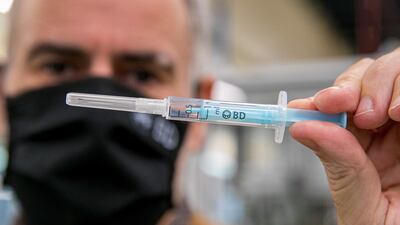
With new Covid-19 vaccines in production, the world must now plan for widespread and equitable distribution. EPA

Vaccine distribution efforts are giving us hope


  • English
  • Arabic

In recent weeks, the world has welcomed the developments around a series of Covid-19 vaccines. Their discovery means the most immediate impediment to global post-pandemic recovery is behind us.

The rush to develop vaccines also generated interest in the human stories of these breakthroughs. Perhaps the most notable example was the German husband and wife “power couple” who were responsible for the Pfizer vaccine.

These individuals now have their place in history. But for those working on the next phase of the fight against Covid-19, fame from individual success is unlikely. Instead, the many thousands involved in the upcoming vaccination programme will be part of a mass, but still heroic global effort.

The next phase is primarily logistical, because achieving mass immunisation does not just rest on a vaccine. It also requires complex and carefully managed strategies on the purchase, storage, allocation and transportation of jabs.

The Hope Consortium is working on strategies to immunise the world as efficiently as possible. AFP
The many thousands involved in the upcoming vaccination programme will be part of a heroic global effort

The Department of Health - Abu Dhabi has recognised this by creating the Hope Consortium. This group pools the wide-ranging expertise needed to address such a global logistical challenge.

Its ambitions are bold. Already, the consortium has this month provided storage and distribution for five million doses. By next year, it aims to store and transport more than six billion.

Members of the new group include Etihad Cargo, Abu Dhabi Ports Company, Rafed – a group purchasing unit created by Abu Dhabi Developmental Holding Company that will oversee vaccine procurement – and SkyCell, a Switzerland-based specialist in temperature-controlled containers, which keep vaccines safe as they are transported around the world.

The consortium will involve many hundreds, if not thousands, of people. It represents the importance of multilateralism in the next stage of the fight against Covid-19. It is also a good example of what public-private partnerships can achieve when they work together, in this instance, the major task of immunising as large a share of the population as possible, as quickly as possible.

This is important because true immunisation is reached only when vaccination programmes span the globe. When they are concentrated in individual nations, recovery is unnecessarily delayed.

Unfortunately, many wealthy nations are going against this advice. Canada, for example, has acquired enough jabs to immunise each citizen five times over.

It also brings no social or economic benefits. “Vaccine nationalism” ignores the fact that economies, especially those of the richest nations, are globally connected. Quashing the virus worldwide, through well-orchestrated programmes, is the only way to revive markets. In contrast, patchy immunisation risks prolonging the immense damage the pandemic has inflicted on our economies.

It would also prevent our societies returning to normal. All over the world, people shoulder social burdens, particularly those with physical and mental health conditions, the young, who have had their education and job prospects curtailed, and the elderly, many of whom are forced into isolation.

The work, therefore, of those involved in organisations such as the Hope Consortium is of enormous value and will create a much needed dynamic to get through this pandemic.

It will not be possible to thank individually those undertaking such crucial tasks. There are simply too many involved. Instead, we can thank the vision of organisations like Hope Consortium, to which these people contribute.

Isaac Newton famously observed that every scientist who advances their field is “standing on the shoulders of giants”. In this instance, the many giants across all industries and nations who work to immunise the world, will remain nameless. But they are united, and deserve our gratitude, for their determination to overcome the trauma of the pandemic.


Mia Man’s tips for fermentation

- Start with a simple recipe such as yogurt or sauerkraut

- Keep your hands and kitchen tools clean. Sanitize knives, cutting boards, tongs and storage jars with boiling water before you start.

- Mold is bad: the colour pink is a sign of mold. If yogurt turns pink as it ferments, you need to discard it and start again. For kraut, if you remove the top leaves and see any sign of mold, you should discard the batch.

- Always use clean, closed, airtight lids and containers such as mason jars when fermenting yogurt and kraut. Keep the lid closed to prevent insects and contaminants from getting in.


History's medical milestones

1799 - First small pox vaccine administered

1846 - First public demonstration of anaesthesia in surgery

1861 - Louis Pasteur published his germ theory which proved that bacteria caused diseases

1895 - Discovery of x-rays

1923 - Heart valve surgery performed successfully for first time

1928 - Alexander Fleming discovers penicillin

1953 - Structure of DNA discovered

1952 - First organ transplant - a kidney - takes place 

1954 - Clinical trials of birth control pill

1979 - MRI, or magnetic resonance imaging, scanned used to diagnose illness and injury.

1998 - The first adult live-donor liver transplant is carried out

The specs

Engine: 2.0-litre 4-cyl turbo

Power: 247hp at 6,500rpm

Torque: 370Nm from 1,500-3,500rpm

Transmission: 10-speed auto

Fuel consumption: 7.8L/100km

Price: from Dh94,900

On sale: now

The National's picks

4.35pm: Tilal Al Khalediah
5.10pm: Continous
5.45pm: Raging Torrent
6.20pm: West Acre
7pm: Flood Zone
7.40pm: Straight No Chaser
8.15pm: Romantic Warrior
8.50pm: Calandogan
9.30pm: Forever Young

Brief scores:

Toss: South Africa, chose to field

Pakistan: 177 & 294

South Africa: 431 & 43-1

Man of the Match: Faf du Plessis (South Africa)

Series: South Africa lead three-match series 2-0

Emergency

Director: Kangana Ranaut

Stars: Kangana Ranaut, Anupam Kher, Shreyas Talpade, Milind Soman, Mahima Chaudhry 

Rating: 2/5

Racecard

6.35pm: The Madjani Stakes – Group 2 (PA) Dh97,500 (Dirt) 1,900m 

7.10pm: Evidenza – Handicap (TB) Dh87,500 (D) 1,200m 

7.45pm: The Longines Conquest – Maiden (TB) Dh82,500 (D) 2,000m 

8.20: The Longines Elegant – Conditions (TB) Dh82,500 (D) 

8.35pm: The Dubai Creek Mile – Listed (TB) Dh132,500 (D) 1,600m 

9.30pm: Mirdif Stakes – Conditions (TB) Dh120,000 (D) 1,400m 

10.05pm: The Longines Record – Handicap (TB) Dh87,500 (D) 1,900m  

'Jurassic%20World%20Dominion'
%3Cp%3EDirector%3A%20Colin%20Trevorrow%3C%2Fp%3E%0A%3Cp%3EStars%3A%20Sam%20Neill%2C%20Laura%20Dern%2C%20Jeff%20Goldblum%2C%20Bryce%20Dallas%20Howard%2C%20Chris%20Pratt%3C%2Fp%3E%0A%3Cp%3ERating%3A%204%2F5%3C%2Fp%3E%0A
The years Ramadan fell in May

1987

1954

1921

1888

Brown/Black belt finals

3pm: 49kg female: Mayssa Bastos (BRA) v Thamires Aquino (BRA)
3.07pm: 56kg male: Hiago George (BRA) v Carlos Alberto da Silva (BRA)
3.14pm: 55kg female: Amal Amjahid (BEL) v Bianca Basilio (BRA)
3.21pm: 62kg male: Gabriel de Sousa (BRA) v Joao Miyao (BRA)
3.28pm: 62kg female: Beatriz Mesquita (BRA) v Ffion Davies (GBR)
3.35pm: 69kg male: Isaac Doederlein (BRA) v Paulo Miyao (BRA)
3.42pm: 70kg female: Thamara Silva (BRA) v Alessandra Moss (AUS)
3.49pm: 77kg male: Oliver Lovell (GBR) v Tommy Langarkar (NOR)
3.56pm: 85kg male: Faisal Al Ketbi (UAE) v Rudson Mateus Teles (BRA)
4.03pm: 90kg female: Claire-France Thevenon (FRA) v Gabreili Passanha (BRA)
4.10pm: 94kg male: Adam Wardzinski (POL) v Kaynan Duarte (BRA)
4.17pm: 110kg male: Yahia Mansoor Al Hammadi (UAE) v Joao Rocha (BRA

Who's who in Yemen conflict

Houthis: Iran-backed rebels who occupy Sanaa and run unrecognised government

Yemeni government: Exiled government in Aden led by eight-member Presidential Leadership Council

Southern Transitional Council: Faction in Yemeni government that seeks autonomy for the south

Habrish 'rebels': Tribal-backed forces feuding with STC over control of oil in government territory

Mercer, the investment consulting arm of US services company Marsh & McLennan, expects its wealth division to at least double its assets under management (AUM) in the Middle East as wealth in the region continues to grow despite economic headwinds, a company official said.

Mercer Wealth, which globally has $160 billion in AUM, plans to boost its AUM in the region to $2-$3bn in the next 2-3 years from the present $1bn, said Yasir AbuShaban, a Dubai-based principal with Mercer Wealth.

Within the next two to three years, we are looking at reaching $2 to $3 billion as a conservative estimate and we do see an opportunity to do so,” said Mr AbuShaban.

Mercer does not directly make investments, but allocates clients’ money they have discretion to, to professional asset managers. They also provide advice to clients.

“We have buying power. We can negotiate on their (client’s) behalf with asset managers to provide them lower fees than they otherwise would have to get on their own,” he added.

Mercer Wealth’s clients include sovereign wealth funds, family offices, and insurance companies among others.

From its office in Dubai, Mercer also looks after Africa, India and Turkey, where they also see opportunity for growth.

Wealth creation in Middle East and Africa (MEA) grew 8.5 per cent to $8.1 trillion last year from $7.5tn in 2015, higher than last year’s global average of 6 per cent and the second-highest growth in a region after Asia-Pacific which grew 9.9 per cent, according to consultancy Boston Consulting Group (BCG). In the region, where wealth grew just 1.9 per cent in 2015 compared with 2014, a pickup in oil prices has helped in wealth generation.

BCG is forecasting MEA wealth will rise to $12tn by 2021, growing at an annual average of 8 per cent.

Drivers of wealth generation in the region will be split evenly between new wealth creation and growth of performance of existing assets, according to BCG.

Another general trend in the region is clients’ looking for a comprehensive approach to investing, according to Mr AbuShaban.

“Institutional investors or some of the families are seeing a slowdown in the available capital they have to invest and in that sense they are looking at optimizing the way they manage their portfolios and making sure they are not investing haphazardly and different parts of their investment are working together,” said Mr AbuShaban.

Some clients also have a higher appetite for risk, given the low interest-rate environment that does not provide enough yield for some institutional investors. These clients are keen to invest in illiquid assets, such as private equity and infrastructure.

“What we have seen is a desire for higher returns in what has been a low-return environment specifically in various fixed income or bonds,” he said.

“In this environment, we have seen a de facto increase in the risk that clients are taking in things like illiquid investments, private equity investments, infrastructure and private debt, those kind of investments were higher illiquidity results in incrementally higher returns.”

The Abu Dhabi Investment Authority, one of the largest sovereign wealth funds, said in its 2016 report that has gradually increased its exposure in direct private equity and private credit transactions, mainly in Asian markets and especially in China and India. The authority’s private equity department focused on structured equities owing to “their defensive characteristics.”