
Over the past few weeks, tensions have flared once again in many parts of the Middle East. Fighting in Libya is still ongoing despite Egyptian attempts to broker a ceasefire. The nosedive taken by the Syrian and Lebanese pounds have prompted protests. In Iran, society is witnessing a second wave of coronavirus infections, leading to popular outcry.
Other tensions have simmered under the surface of international headlines, only now coming to an unexpected boil. One of these is an escalation in the long-time rivalry between Turkey and Greece, with Greek Defense Minister Nikolaos Panagiotopoulos recently going so far as to declare that Athens is ready "for military conflict with Turkey”.
Renewed agitation between the two Nato allies is linked to Turkey's ongoing belligerence in Libya and its attempts to dominate the eastern Mediterranean Sea. Last November, Ankara struck a maritime deal with the Libya’s Islamist-aligned Government of National Accord, granting Turkey drilling rights in gas-rich areas of the Mediterranean that are also claimed by Greece, Egypt and Cyprus.
In exchange, Turkey has propped up the GNA’s firepower on the ground against the latter’s competitor for control over Libya, the Libyan National Army. The arrangement has rallied at least half a dozen nations – notably, Greece, Cyprus, Egypt and France – against Turkey’s aspirations for regional hegemony.
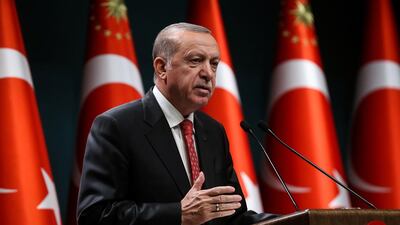
Ankara’s designs in Libya make up only one part of Turkish President Recep Tayyip Erdogan's expansionist agenda. Far away from the shores of Tripoli, Mr Erdogan has secured a de facto Turkish enclave in north-western Syria, defended in part by Ankara’s local surrogates. Last October, the Turkish military launched an offensive on the mostly Kurdish-inhabited and Kurdish-run border region of Syria’s north-east, manipulating the demographics of the area to their advantage. And now Turkey is trying to solidify its influence by enforcing the use of the Turkish Lira, instead of the Syrian pound, in north-western Syria.
Ankara’s battle with Kurdish groups is also an excuse for routine encroachment on the Kurdistan Region of Iraq. Turkey regularly carries out airstrikes across the border, in Iraqi territory, under the pretence of weeding out targets it claims are associated with the Kurdistan Workers’ Party, which Ankara and Washington consider to be a terrorist group. On Sunday, Turkey announced hitting more than 50 "PKK sites" inside Iraq, once more undermining the sovereignty of the country.
Even Lebanon, where Turkey has no military presence or shared borders, is not immune to Ankara's interference. Last week, an online campaign targeting Neshan Der Haroutiounian, a Lebanese-Armenian television presenter, was launched with supporters of the Turkish president hurling racist insults and using a defamatory hashtag on Twitter in response to his criticism of Mr Erdogan.
Within Turkey, Mr Erdogan has consolidated his power even further. A controversial bill passed last week empowers the “nightwatchmen” – a group of Turkish vigilantes – to carry guns, conduct searches and make arrests. It is no coincidence that most nightwatchmen today are young men linked to Mr Erdogan’s own political party.
Ankara’s continued doubling-down of its external operations is an effort to project strength at a time of increased hardships at home. The Turkish economy has long been in a state of financial crisis, and Turkish society has become increasingly divided over the President’s ongoing attempts to erode civil liberties. And although Turkish health officials have dealt with the country’s ongoing coronavirus outbreak relatively well, the country still suffers the second-most infections in the region and spent weeks denying it had any cases.
Turkey's expansionist views, which for many in the Arab world resurface painful memories of Ottoman rule, are incompatible with the country’s commitments to Nato and, ultimately, international law. A decade ago, when discussions on Turkey in the Middle East still revolved around soft power, Ankara’s diplomatic corps vaunted a policy of “zero problems with neighbours”. That mission now seems dead in the water.

