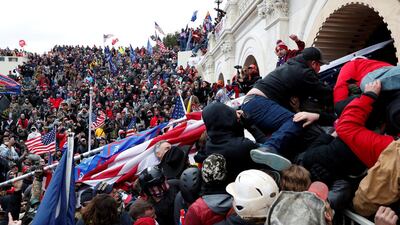
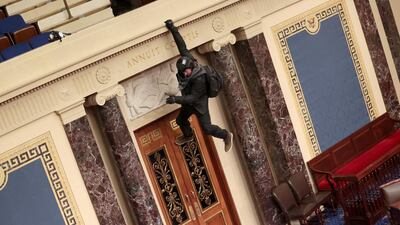
epa08923404 Supporters of US President Donald J. Trump outside the senate chambers after breaching Capitol security in Washington, DC, USA, 06 January 2021. Protesters entered the US Capitol where the Electoral College vote certification for President-elect Joe Biden took place. EPA/JIM LO SCALZO
Leigh Ann Luck dressed up as Statue of Liberty shouts as supporters of U.S. President Donald Trump gather near U.S. Capitol building in Washington, U.S., January 6, 2021. REUTERS/Leah Millis TPX IMAGES OF THE DAY
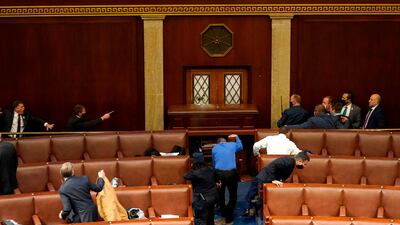
People are seen in the House gallery as protesters try to break into the House Chamber at the U.S. Capitol on Wednesday, Jan. 6, 2021, in Washington. (AP Photo/Andrew Harnik)
Protesters enter the U.S. Capitol Building. AFP
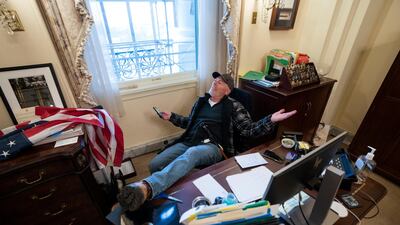
epa08923440 A supporter of US President Donald J. Trump sits on the desk of US House Speaker Nancy Pelosi, after supporters of US President Donald J. Trump breached the US Capitol security in Washington, DC, USA, 06 January 2021. Protesters stormed the US Capitol where the Electoral College vote certification for President-elect Joe Biden took place. EPA/JIM LO SCALZO
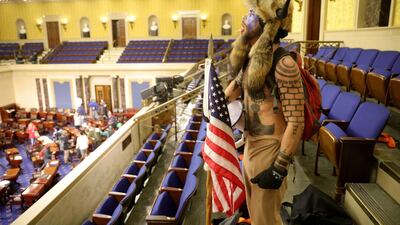
TOPSHOT - A supporter of US President Donald Trump wears a gas mask as he protests after storming the US Capitol on January 6, 2021, in Washington, DC. Demonstrators breeched security and entered the Capitol as Congress debated the a 2020 presidential election Electoral Vote Certification. President-elect Joe Biden denounced the storming of the US Capitol as an "insurrection" and demanded President Donald Trump go on television to call an end to the violent "siege." / AFP / Brendan SMIALOWSKI
TOPSHOT - Supporters of US President Donald Trump enter the US Capitol's Rotunda on January 6, 2021, in Washington, DC. Demonstrators breeched security and entered the Capitol as Congress debated the a 2020 presidential election Electoral Vote Certification. / AFP / Saul LOEB
TOPSHOT - Supporters of US President Donald Trump enter the US Capitol on January 6, 2021, in Washington, DC. Demonstrators breeched security and entered the Capitol as Congress debated the a 2020 presidential election Electoral Vote Certification. / AFP / Saul LOEB
TOPSHOT - A supporter of US President Donald Trump sits at a desk after invading the Capitol Building on January 6, 2021, in Washington, DC. Demonstrators breeched security and entered the Capitol as Congress debated the a 2020 presidential election Electoral Vote Certification. / AFP / Saul LOEB
TOPSHOT - A man calls on people to raid the building as Trump supporters clash with police and security forces as they try to storm the US Capitol in Washington D.C on January 6, 2021. Demonstrators breeched security and entered the Capitol as Congress debated the a 2020 presidential election Electoral Vote Certification. / AFP / Joseph Prezioso
Trump supporters gesture to U.S. Capitol Police in the hallway outside of the Senate chamber at the Capitol in Washington, Wednesday, Jan. 6, 2021. (AP Photo/Manuel Balce Ceneta)
Wherever in the world it may happen, the storming of a government building by an angry mob often results in the same, familiar scenes. Security services, overwhelmed or unwilling to use force, have to make way for rioters who proceed to parade through the offices, gawk at the furnishings in the corridors of power and send legislators scurrying for safety. The atmosphere among the intruders is jubilant – they feel justified in openly disrespecting a political class that they believe has disrespected them – but also menacing, as though the national order itself is under threat.
These scenes played out in Washington on Wednesday, when hundreds of supporters of US President Donald Trump, including many who were armed, overran the Capitol, America's legislative assembly building, while the Senate was in session to confirm the election of his successor, Joe Biden.
But what happened in Washington was not an attack on the political class. Encouraged by the President himself as well as several of his political allies in order to impede the peaceful transition of power, it was an attack on the institutions fundamental to America's democratic political system. It was the attempted subjugation of good government to mob rule by an extremist fringe.
Pro-Trump protesters storm into the U.S. Capitol during clashes with police, during a rally to contest the certification of the 2020 U.S. presidential election results by the U.S. Congress, in Washington, U.S. Reuters
A protester yells inside the Senate Chamber. AFP
Pro-Trump protesters clash with police at a rally to contest the certification of the 2020 U.S. presidential election results by the U.S. Congress, at the U.S. Capitol Building. Reuters
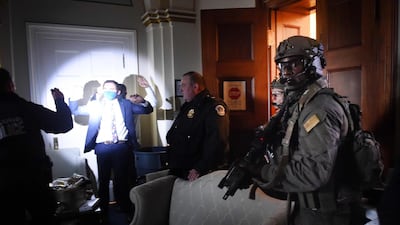
Congress staffers hold up their hands while Capitol Police Swat teams check everyone in the room as they secure the floor of Trump supporters. AFP
U.S. Capitol police officers point their guns at a door that was vandalized in the House Chamber during a joint session of Congress. AFP
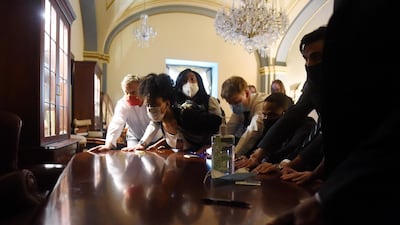
Congress staffers barricade themselves after Trump supporters stormed inside the US Capitol. AFP
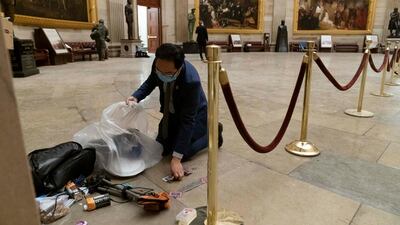
Rep. Andy Kim, D-N.J., cleans up debris and personal belongings strewn across the floor of the Rotunda in the early morning hours of the morning, after protesters stormed the Capitol in Washington. AP Photo
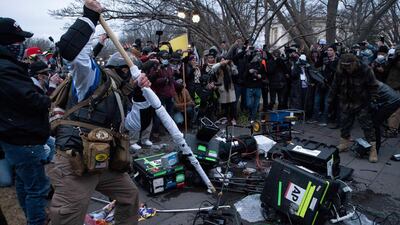
Demonstrators break TV equipment outside the the U.S. Capitol, in Washington. AP Photo
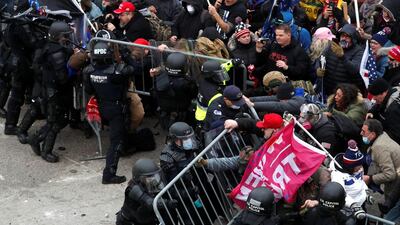
Pro-Trump protesters attempt to tear down a police barricade during a rally to contest the certification of the 2020 U.S. presidential election results by the U.S. Congress, at the U.S. Capitol Building. Reuters
A protester is seen hanging from the balcony in the Senate Chamber. AFP
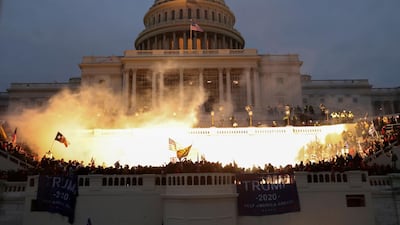
An explosion caused by a police munition is seen while supporters of U.S. President Donald Trump gather in front of the U.S. Capitol Building. Reuters
A supporter of US President Donald J. Trump sits on the desk of US House Speaker Nancy Pelosi, after supporters of US President Donald J. Trump breached the US Capitol security in Washington, DC. EPA
Yesterday's events demonstrated that courts and elections alone are not enough to safeguard American democracy. Stability and progress depend on the responsible stewardship of leaders, who can uphold a sense of reverence for institutions even when they produce a result contrary to their wishes.
Seemingly unprepared for the incursion on the Capitol, building security and Washington police were quickly overcome. The ineffectiveness of law enforcement was galling to many; a largely peaceful assembly in Washington led by activists from the Black Lives Matter movement in June was met with an immense show of force. This time, the federal government opted not to deploy the National Guard, a reserve branch of the military, to restore order until long after politicians in the building were forced to evacuate and many of the legislative offices had been vandalised. Whatever subjective morality drives the mob to invade such hallowed institutional walls, once they are breached, some of the reverence is lost for good.
As the rioters continued their occupation of the building, Mr Biden addressed the nation, calling the events "an assault on the citadel of liberty". His remarks evoked the longstanding self-image of America as a "city on a hill", an elevated fortress from which to defend a certain set of values while projecting them elsewhere in the world, either actively or by example.
Congress staffers barricade themselves after Trump supporters stormed the US Capitol in Washington on January 6, 2021. AFP
It was the attempted subjugation of government to mob rule by an extremist fringe
Whatever foreign policy Mr Biden's incoming administration chooses to adopt over the next four years, its priority will necessarily be to project, in its affairs at home, America's example. People around the world watched Wednesday's scene at the Capitol less with respect than with disbelief, alarm and even ridicule.
Mr Biden's chief task after his inauguration on January 20 will be to unite a country shaken by deep divisions. This will be a delicate and arduous mission that involves, in part, seeking accountability for these displays of violence without escalating tensions further on either side. If he can manage it, America may see its citadel restored.

Houthis: Iran-backed rebels who occupy Sanaa and run unrecognised government
Yemeni government: Exiled government in Aden led by eight-member Presidential Leadership Council
Southern Transitional Council: Faction in Yemeni government that seeks autonomy for the south
Habrish 'rebels': Tribal-backed forces feuding with STC over control of oil in government territory
What the law says
Micro-retirement is not a recognised concept or employment status under Federal Decree Law No. 33 of 2021 on the Regulation of Labour Relations (as amended) (UAE Labour Law). As such, it reflects a voluntary work-life balance practice, rather than a recognised legal employment category, according to Dilini Loku, senior associate for law firm Gateley Middle East.
“Some companies may offer formal sabbatical policies or career break programmes; however, beyond such arrangements, there is no automatic right or statutory entitlement to extended breaks,” she explains.
“Any leave taken beyond statutory entitlements, such as annual leave, is typically regarded as unpaid leave in accordance with Article 33 of the UAE Labour Law. While employees may legally take unpaid leave, such requests are subject to the employer’s discretion and require approval.”
If an employee resigns to pursue micro-retirement, the employment contract is terminated, and the employer is under no legal obligation to rehire the employee in the future unless specific contractual agreements are in place (such as return-to-work arrangements), which are generally uncommon, Ms Loku adds.
Gifts exchanged
King Charles - replica of President Eisenhower Sword
Queen Camilla - Tiffany & Co vintage 18-carat gold, diamond and ruby flower brooch
Donald Trump - hand-bound leather book with Declaration of Independence
1. Domestic VAT refund amendments: request your refund within five years
If a business does not apply for the refund on time, they lose their credit.
2. E-invoicing in the UAE
Businesses should continue preparing for the implementation of e-invoicing in the UAE, with 2026 a preparation and transition period ahead of phased mandatory adoption.
3. More tax audits
Tax authorities are increasingly using data already available across multiple filings to identify audit risks.
4. More beneficial VAT and excise tax penalty regime
Tax disputes are expected to become more frequent and more structured, with clearer administrative objection and appeal processes. The UAE has adopted a new penalty regime for VAT and excise disputes, which now mirrors the penalty regime for corporate tax.
5. Greater emphasis on statutory audit
There is a greater need for the accuracy of financial statements. The International Financial Reporting Standards standards need to be strictly adhered to and, as a result, the quality of the audits will need to increase.
6. Further transfer pricing enforcement
Transfer pricing enforcement, which refers to the practice of establishing prices for internal transactions between related entities, is expected to broaden in scope. The UAE will shortly open the possibility to negotiate advance pricing agreements, or essentially rulings for transfer pricing purposes.
7. Limited time periods for audits
Recent amendments also introduce a default five-year limitation period for tax audits and assessments, subject to specific statutory exceptions. While the standard audit and assessment period is five years, this may be extended to up to 15 years in cases involving fraud or tax evasion.
8. Pillar 2 implementation
Many multinational groups will begin to feel the practical effect of the Domestic Minimum Top-Up Tax (DMTT), the UAE's implementation of the OECD’s global minimum tax under Pillar 2. While the rules apply for financial years starting on or after January 1, 2025, it is 2026 that marks the transition to an operational phase.
9. Reduced compliance obligations for imported goods and services
Businesses that apply the reverse-charge mechanism for VAT purposes in the UAE may benefit from reduced compliance obligations.
10. Substance and CbC reporting focus
Tax authorities are expected to continue strengthening the enforcement of economic substance and Country-by-Country (CbC) reporting frameworks. In the UAE, these regimes are increasingly being used as risk-assessment tools, providing tax authorities with a comprehensive view of multinational groups’ global footprints and enabling them to assess whether profits are aligned with real economic activity.
Contributed by Thomas Vanhee and Hend Rashwan, Aurifer
Favourite book: Peter Rabbit. I used to read it to my three children and still read it myself. If I am feeling down it brings back good memories.
Best thing about your job: Getting to help people. My mum always told me never to pass up an opportunity to do a good deed.
Best part of life in the UAE: The weather. The constant sunshine is amazing and there is always something to do, you have so many options when it comes to how to spend your day.
Favourite holiday destination: Malaysia. I went there for my honeymoon and ended up volunteering to teach local children for a few hours each day. It is such a special place and I plan to retire there one day.
National Bonds unveiled a Golden Pension Scheme in 2022 to help private-sector foreign employees with their financial planning.
In April 2021, Hayah Insurance unveiled a workplace savings plan to help UAE employees save for their retirement.
Lunate, an Abu Dhabi-based investment manager, has launched a fund that will allow UAE private companies to offer employees investment returns on end-of-service benefits.