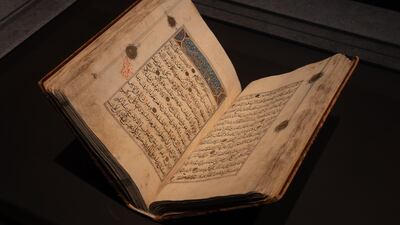
Today is Arabic Language Day, marking the date Arabic was adopted as the sixth official language of the United Nations, in 1973. The occasion reminds those in the Middle East and the wider world of Arabic's fundamental importance, not just on a practical level – it has 290 million speakers – but also in terms of how it shapes people in a deeper way, underpinning the very idea of who they are.
The language is still going strong, despite the ascension of English to global primacy and the continued dominance of French in many parts of the Middle East and North Africa. An enthusiasm for Arabic sustains among the region's youth, even while they take up English in school, business and much of day-to-day life.
The most effective way to keep Arabic thriving is securing its place in the minds of children. That is not without its challenges. Mastery of literary Arabic’s complex grammar, also known as Modern Standard Arabic, can take years. But achieving it imparts on young minds the value of their heritage. No one, for example, is left poorer after reading the works of Egyptian novelist Naguib Mahfouz, the first writer to win the Nobel Prize for Literature for a work penned in Arabic. Mahfouz harnessed the language's power, adding to the canon of world literature and giving Arabic speakers pride in the ideas and emotions that can be captured best in the language.
On Wednesday, the UN body Unesco announced that it is putting various traditions from the Arab world on its cultural heritage list. These include the "aflaj" irrigation system and camel racing. Nowadays, it is particularly important for people in the region to understand the value of what they ought to protect. Terrorist groups consistently threaten Arab cultural heritage, as we have seen in Iraq, Syria and the Sahel, among other places, targeting anything they interpret to be outside their twisted worldviews. Other threats include the proliferation of criminals in the antiques trade, climate change, a lack of education among conservationists leading to botched restorations, deregulated urban development and even litter, which too often diminishes our most beloved cultural destinations.
A young Omani boy dressed in traditional clothing posing next to his camel. Camel racing has been added to Unesco's cultural heritage list. Alamy
The most effective way to keep Arabic thriving is securing its place in the minds of children
But on the occasion of Arabic Day, people across the Mena region might pay special attention to the dangers confronting the language that, for centuries, has documented their homeland’s wonders and given birth to entire schools of calligraphy with which to communicate them. It has played an important role in Western civilisation, too. Detailed Arabic scholarship during the Abbasid era safeguarded many works of the Hellenic world, particularly between the eighth and ninth centuries. Without Arabic, we might not have preserved many of the texts of Plato and Aristotle, or the work of the classical scientists, playwrights and mathematicians.
Naguib Mahfouz described his Nobel Prize as one "the Arab world also won with me". Celebrating Arabic Language Day will remind us of its important position in world culture. It will also inspire future generations to follow in the footsteps of the many figures like Mahfouz, who continue to show the world the beauty of Arabic.

Badr Organisation: Seen as the most militarily capable faction in the Hashd. Iraqi Shiite exiles opposed to Saddam Hussein set up the group in Tehran in the early 1980s as the Badr Corps under the supervision of the Iran Revolutionary Guards Corps (IRGC). The militia exalts Iran’s Supreme Leader Ali Khamenei but intermittently cooperated with the US military.
Saraya Al Salam (Peace Brigade): Comprised of former members of the officially defunct Mahdi Army, a militia that was commanded by Iraqi cleric Moqtada Al Sadr and fought US and Iraqi government and other forces between 2004 and 2008. As part of a political overhaul aimed as casting Mr Al Sadr as a more nationalist and less sectarian figure, the cleric formed Saraya Al Salam in 2014. The group’s relations with Iran has been volatile.
Kataeb Hezbollah: The group, which is fighting on behalf of the Bashar Al Assad government in Syria, traces its origins to attacks on US forces in Iraq in 2004 and adopts a tough stance against Washington, calling the United States “the enemy of humanity”.
Asaeb Ahl Al Haq: An offshoot of the Mahdi Army active in Syria. Asaeb Ahl Al Haq’s leader Qais al Khazali was a student of Mr Al Moqtada’s late father Mohammed Sadeq Al Sadr, a prominent Shiite cleric who was killed during Saddam Hussein’s rule.
Harakat Hezbollah Al Nujaba: Formed in 2013 to fight alongside Mr Al Assad’s loyalists in Syria before joining the Hashd. The group is seen as among the most ideological and sectarian-driven Hashd militias in Syria and is the major recruiter of foreign fighters to Syria.
Saraya Al Khorasani: The ICRG formed Saraya Al Khorasani in the mid-1990s and the group is seen as the most ideologically attached to Iran among Tehran’s satellites in Iraq.
(Source: The Wilson Centre, the International Centre for the Study of Radicalisation)
Dubai Bling season three
Cast: Loujain Adada, Zeina Khoury, Farhana Bodi, Ebraheem Al Samadi, Mona Kattan, and couples Safa & Fahad Siddiqui and DJ Bliss & Danya Mohammed
Mercer, the investment consulting arm of US services company Marsh & McLennan, expects its wealth division to at least double its assets under management (AUM) in the Middle East as wealth in the region continues to grow despite economic headwinds, a company official said.
Mercer Wealth, which globally has $160 billion in AUM, plans to boost its AUM in the region to $2-$3bn in the next 2-3 years from the present $1bn, said Yasir AbuShaban, a Dubai-based principal with Mercer Wealth.
“Within the next two to three years, we are looking at reaching $2 to $3 billion as a conservative estimate and we do see an opportunity to do so,” said Mr AbuShaban.
Mercer does not directly make investments, but allocates clients’ money they have discretion to, to professional asset managers. They also provide advice to clients.
“We have buying power. We can negotiate on their (client’s) behalf with asset managers to provide them lower fees than they otherwise would have to get on their own,” he added.
Mercer Wealth’s clients include sovereign wealth funds, family offices, and insurance companies among others.
From its office in Dubai, Mercer also looks after Africa, India and Turkey, where they also see opportunity for growth.
Wealth creation in Middle East and Africa (MEA) grew 8.5 per cent to $8.1 trillion last year from $7.5tn in 2015, higher than last year’s global average of 6 per cent and the second-highest growth in a region after Asia-Pacific which grew 9.9 per cent, according to consultancy Boston Consulting Group (BCG). In the region, where wealth grew just 1.9 per cent in 2015 compared with 2014, a pickup in oil prices has helped in wealth generation.
BCG is forecasting MEA wealth will rise to $12tn by 2021, growing at an annual average of 8 per cent.
Drivers of wealth generation in the region will be split evenly between new wealth creation and growth of performance of existing assets, according to BCG.
Another general trend in the region is clients’ looking for a comprehensive approach to investing, according to Mr AbuShaban.
“Institutional investors or some of the families are seeing a slowdown in the available capital they have to invest and in that sense they are looking at optimizing the way they manage their portfolios and making sure they are not investing haphazardly and different parts of their investment are working together,” said Mr AbuShaban.
Some clients also have a higher appetite for risk, given the low interest-rate environment that does not provide enough yield for some institutional investors. These clients are keen to invest in illiquid assets, such as private equity and infrastructure.
“What we have seen is a desire for higher returns in what has been a low-return environment specifically in various fixed income or bonds,” he said.
“In this environment, we have seen a de facto increase in the risk that clients are taking in things like illiquid investments, private equity investments, infrastructure and private debt, those kind of investments were higher illiquidity results in incrementally higher returns.”
The Abu Dhabi Investment Authority, one of the largest sovereign wealth funds, said in its 2016 report that has gradually increased its exposure in direct private equity and private credit transactions, mainly in Asian markets and especially in China and India. The authority’s private equity department focused on structured equities owing to “their defensive characteristics.”
Under ‘snapback’, measures imposed on Iran by the UN Security Council in six resolutions would be restored, including:
An arms embargo
A ban on uranium enrichment and reprocessing
A ban on launches and other activities with ballistic missiles capable of delivering nuclear weapons, as well as ballistic missile technology transfer and technical assistance
A targeted global asset freeze and travel ban on Iranian individuals and entities
Authorisation for countries to inspect Iran Air Cargo and Islamic Republic of Iran Shipping Lines cargoes for banned goods
This article is part of a guide on where to live in the UAE. Our reporters will profile some of the country’s most desirable districts, provide an estimate of rental prices and introduce you to some of the residents who call each area home.
