The 2020 G20 summit concluded yesterday, bringing to a close one of the organisation’s most important meetings since its inception in 1999.
The mandate of the organisation is to promote global economic co-operation. With its members totalling 80 per cent of the world’s economic output, what it discusses in its annual, two-day summits matters.
It is no surprise that this year’s meeting focused on the pandemic and post-Covid-19 global economic recovery. But what does such a recovery really mean?
It not only entails scientific and medical progress, but the regeneration of economies, too. And not just high-income economies – the world will not be healed fully until all nations, rich or poor, are back on track.
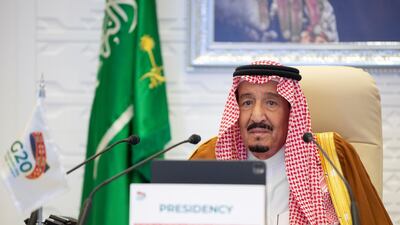
For all of the club’s lofty ideals, however, even G20 member states are not immune to the cut-throat atmosphere brought about by the pandemic, in which nations jockey to protect their own citizens first. In response to this phenomenon, King Salman of Saudi Arabia stressed the urgent need to ensure vaccine distribution is “affordable and equitable for all people.”
A primary focus for Saudi Arabia’s G20 presidency this year has been a comprehensive plan to support lower-income countries, ensuring the fair distribution of vaccines worldwide. Saudi Arabia is right to seek pledges from member states. Not doing so risks a free-for-all in which large economies hoard at the expense of smaller ones.
King Salman also said that the subject areas of the this year’s G20, Empowering People, Safeguarding the Planet, and Shaping New Frontiers, all play a role in overcoming the challenge posed by the virus.
These areas are particularly relevant when it comes to vaccines. Researchers at Duke University in the US have estimated that high and middle-income countries have already secured almost 4 billion vaccine doses. Canada has reportedly purchased enough stocks to immunise each of its citizens five times over.
Experts estimate this unequal concentration of stocks could prolong the virus’s grip on the global economy until 2024. According to the Rand Corporation, a think tank, unequal distribution of vaccine doses could cost the global economy $1.2 trillion a year.
Antonio Guterres, Secretary-General of the UN, was right to call for more nations to join the COVAX programme started by Gavi, the global vaccine alliance. COVAX was conceived early in the pandemic with a specific focused on the just distribution of future Covid-19 jabs.
Even when much of the world is immunised, the legacy of mass unemployment may be slower to fade. Technology’s role in keeping the economy’s engines running during Covid-19 has accelerated the effects of a broader phenomenon, which is the growing tension between technological development and employment.
Without the internet, automation and artificial intelligence, the pandemic may have wrought a much heavier toll on us this year. They were saving graces at a time when everyone was shielding in their homes. But when millions of people return to daily life, they must not find that the tools that helped them at home have now replaced them entirely at the workplace.
Rather than the usual G20 leaders photo, Covid-19 restrictions required a digitally created image. AP
The complexity of the task ahead reminds us that we need the spirit of multilateralism embodied by the G20
G20 leaders, and those of other nations, can avoid such a scenario by embracing the ideals of early tech, which sought to empower people and information sharing. By increasing skills and tech literacy, and extending opportunities to a greater share of the global workforce, a G20 blueprint for recovery can protect the human aspect of the global economy.
The complexity of the task ahead reminds us that we need the spirit of multilateralism embodied by the G20 and other such organisations. It also reminds us that going it alone is rarely a winning strategy for any nation in meeting today’s challenges. After all, a prosperous economy cannot maintain its health if it does not engage with smaller ones.
Over the months and years ahead, what ought to emerge from the discussions had at this year’s summit is a renewed vigour in the G20’s core ideal: powerful nations pursuing economic development for the interests of all.

Pakistan v Sri Lanka:
28 Sep-2 Oct, 1st Test, Abu Dhabi
6-10 Oct, 2nd Test (day-night), Dubai
13 Oct, 1st ODI, Dubai
16 Oct, 2nd ODI, Abu Dhabi
18 Oct, 3rd ODI, Abu Dhabi
20 Oct, 4th ODI, Sharjah
23 Oct, 5th ODI, Sharjah
26 Oct, 1st T20I, Abu Dhabi
27 Oct, 2nd T20I, Abu Dhabi
29 Oct, 3rd T20I, Lahore
How to watch Ireland v Pakistan in UAE
When: The one-off Test starts on Friday, May 11 What time: Each day’s play is scheduled to start at 2pm UAE time. TV: The match will be broadcast on OSN Sports Cricket HD. Subscribers to the channel can also stream the action live on OSN Play.
UAE results Lost to Oman by eight runs Beat Namibia by three wickets Lost to Oman by 12 runs Beat Namibia by 43 runs
UAE fixtures Free admission. All fixtures broadcast live on icc.tv
Tuesday March 15, v PNG at Sharjah Cricket Stadium Friday March 18, v Nepal at Dubai International Stadium Saturday March 19, v PNG at Dubai International Stadium Monday March 21, v Nepal at Dubai International Stadium
Starring: Tom Cruise, Val Kilmer, Jennifer Connelly, Jon Hamm, Miles Teller, Glen Powell, Ed Harris
SANCTIONED
Kirill Shamalov, Russia's youngest billionaire and previously married to Putin's daughter Katarina
Petr Fradkov, head of recently sanctioned Promsvyazbank and son of former head of Russian Foreign Intelligence, the FSB.
Denis Bortnikov, Deputy President of Russia's largest bank VTB. He is the son of Alexander Bortnikov, head of the FSB which was responsible for the poisoning of political activist Alexey Navalny in August 2020 with banned chemical agent novichok.
Yury Slyusar, director of United Aircraft Corporation, a major aircraft manufacturer for the Russian military.
Elena Aleksandrovna Georgieva, chair of the board of Novikombank, a state-owned defence conglomerate.
The flightsFly Dubai, Air Arabia, Emirates, Etihad, and Royal Jordanian all offer direct, three-and-a-half-hour flights from the UAE to the Jordanian capital Amman. Alternatively, from June Fly Dubai will offer a new direct service from Dubai to Aqaba in the south of the country. See the airlines’ respective sites for varying prices or search on reliable price-comparison site Skyscanner.
The trip
Jamie Lafferty was a guest of the Jordan Tourist Board. For more information on adventure tourism in Jordan see Visit Jordan. A number of new and established tour companies offer the chance to go caving, rock-climbing, canyoning, and mountaineering in Jordan. Prices vary depending on how many activities you want to do and how many days you plan to stay in the country. Among the leaders are Terhaal, who offer a two-day canyoning trip from Dh845 per person. If you really want to push your limits, contact the Stronger Team. For a more trek-focused trip, KE Adventure offers an eight-day trip from Dh5,300 per person.
- Carbonated drinks, sweet or savoury packaged snacks, confectionery, mass-produced packaged breads and buns
- margarines and spreads; cookies, biscuits, pastries, cakes, and cake mixes, breakfast cereals, cereal and energy bars;
- energy drinks, milk drinks, fruit yoghurts and fruit drinks, cocoa drinks, meat and chicken extracts and instant sauces
- infant formulas and follow-on milks, health and slimming products such as powdered or fortified meal and dish substitutes,
- many ready-to-heat products including pre-prepared pies and pasta and pizza dishes, poultry and fish nuggets and sticks, sausages, burgers, hot dogs, and other reconstituted meat products, powdered and packaged instant soups, noodles and desserts.
Engine: 3.9-litre twin-turbo V8 Power: 620hp from 5,750-7,500rpm Torque: 760Nm from 3,000-5,750rpm Transmission: Eight-speed dual-clutch auto On sale: Now Price: From Dh1.05 million ($286,000)
Cyber crime - This includes fraud, impersonation, scams and deepfake technology, tactics that are increasingly targeting infrastructure and exploiting human vulnerabilities. Cyber terrorism - Social media platforms are used to spread radical ideologies, misinformation and disinformation, often with the aim of disrupting critical infrastructure such as power grids. Cyber warfare - Shaped by geopolitical tension, hostile actors seek to infiltrate and compromise national infrastructure, using one country’s systems as a springboard to launch attacks on others.
