
The international community has rallied around Lebanon in the immediate aftermath of the explosions at Beirut's port that rocked the city on Tuesday, killing over a hundred people and injuring thousands more.
On Wednesday, a plane flew out of Dubai carrying 43 tonnes of medical equipment worth Dh2 million, supplied by the World Health Organisation and International Federation of Red Cross and Red Crescent Societies in co-ordination with Ministry of Health and Prevention. The UAE also sent tens of millions of dirhams worth of aid on Thursday, as President Sheikh Khalifa donated 12 tonnes of protective equipment to protect against Covid-19. The equipment, which was sent on the orders of Sheikh Mohamed bin Zayed, Crown Prince of Abu Dhabi and Deputy Supreme Commander of the Armed Forces, will support more than 10,000 front-line medical staff. Aircraft carrying emergency aid and rescue personnel arrived from Jordan, France and the US as well, with French President Emmanuel Macron himself having landed in Beirut less than 48 hours after the tragedy.
Meanwhile, offers of from fuel and rescue workers have come from several nations, including the UK and the European Union. Even Iraq, which is experiencing its own political and economic crises, has pledged aid in the form of oil.
-
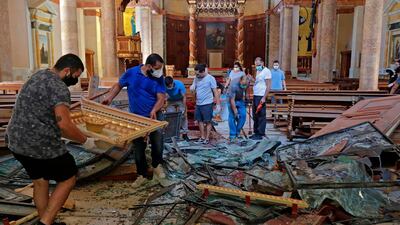
Destruction inside a church in the aftermath of the massive explosion. AFP -
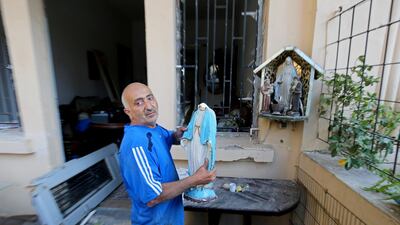
A man holds a damaged sculpture depicting Mary in his house near the site of Tuesday's blast in Beirut's port area. Reuters -
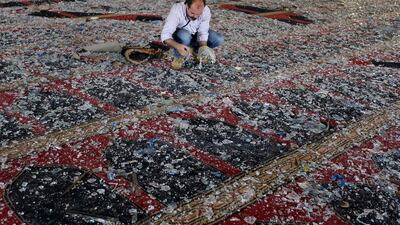
A man removes broken glass scattered on the carpet of a mosque damaged in Tuesday's blast in Beirut. Reuters -
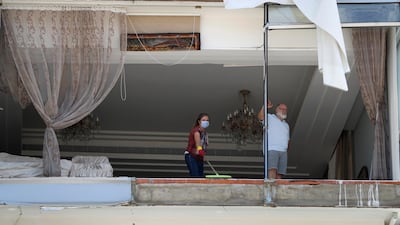
A woman cleans debris from her damaged apartment a day after an explosion hit the seaport of Beirut. AP Photo -
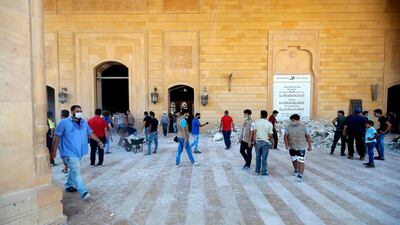
People clean debris at Mohammed Al Amin mosque in the centre of Beirut. AFP -
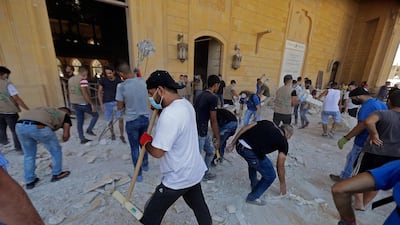
People clean debris at Mohammed Al Amin mosque in the centre of Beirut. AFP -
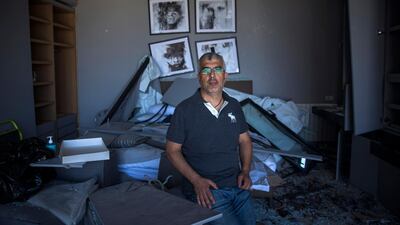
Karim Corbani, 45, poses for a portrait inside his bedroom in Beirut. Getty Images -
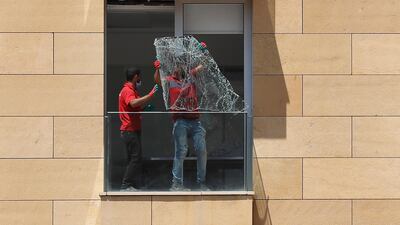
Workers throw a broken window from a damaged apartment a day after an explosion hit the seaport of Beirut. AP Photo -
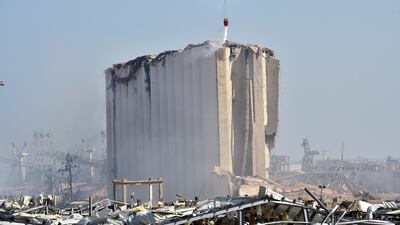
A helicopter trying to put out the fire a day after the explosion rocked Beirut. EPA -
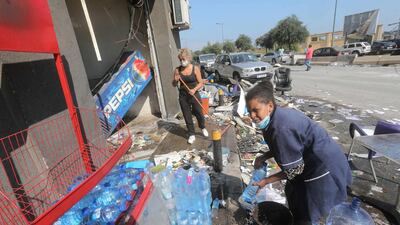
Women clear the damage outside a sideroad kiosk in Beirut. AFP -

People help clear rubble and debris from the driveway of a residential building in Beirut. Bloomberg -
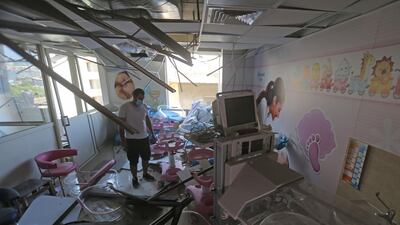
The damaged Wardieh hospital is pictured in the aftermath of the blast that tore through Lebanon's capital. AFP -
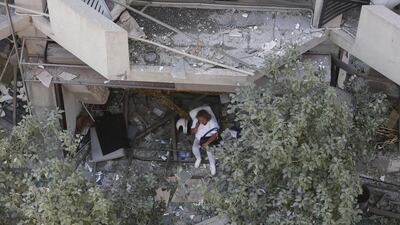
A woman sits in front of a building, damaged by the explosion a day earlier. Getty Images -
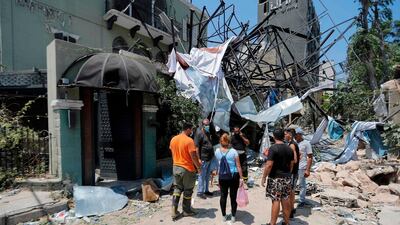
Lebanese inspect the damage in the aftermath of yesterday's blast that tore through Lebanon's capital. AFP -

A woman looks out of the collapsed facade of an apartment. Getty Images -

A woman looks down from a balcony. Getty Images -
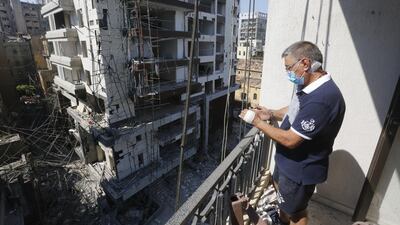
A man looks from the balcony of a building. Getty Images -
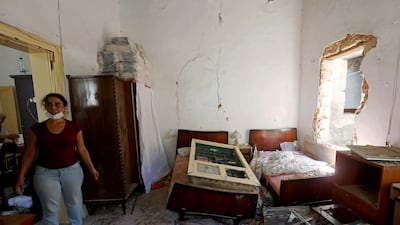
A woman stands inside her damaged home. Reuters


The show of force and grace is inspiring at a time when the Covid-19 pandemic has plunged the global economy into a deep recession. It ought to give Beirut's ruling class pause, as they weigh their options on the path forward for a country brought to its knees by corruption and administrative incompetence, even before the port tragedy and the pandemic.
The complex mess in which Lebanon is caught is so wide and so deep that since October the public has been out on the streets demanding wholesale changes to the country’s political and economic systems. Protesters’ anger is directed squarely at the country’s ruling class.
The fury is justified, given that Lebanese people must deal with daily, hours-long power cuts , garbage left uncollected on the streets, the collapse of the their currency, massive inflation and the evaporation of their life savings. Tuesday's blast has also added food insecurity to their worries; the country's main grain silo is destroyed, leaving Lebanon with less than a month's reserves before it sees a food crisis. It also rendered 300,000 Beirutis homeless in mere minutes. Lebanon, according to one government adviser, will need to spend at least $15 billion to complete repairs.
While the aid deliveries now under way will be critical for a city trying to get back on its feet, it is not a bail-out for the political system, and it will not be nearly enough for the country as a whole to sustain itself in the long run. Immediate relief funds will not be able to subsidise an economic recovery in a country facing endemic crises.
For Lebanon to make a complete economic recovery, its so-called unity government – with all of its disparate factions – will need to enact sweeping and painful reforms. It has so far resisted doing so, even though those reforms are a condition for it to receive economic assistance from the International Monetary Fund, because that would mean putting an end to its decades-long systems of nepotism.
The government’s inability to bring about change is also attributable to the domination within its ranks of the Iranian-backed militant party Hezbollah. For its part, Hezbollah views the IMF proposal, which has been on the table for months, with suspicion, as the proposed reforms not only undermine its own interests and standing in the country but those of its backers in Tehran.
Tuesday’s tragedy, however, should serve as a wake-up call to Beirut’s leaders. They must now see who their people’s real allies are, and what the path to genuine, national prosperity looks like.
“Lebanon is not alone,” the French President said upon his arrival in Beirut. It is a much-needed reminder for a country that been adrift and whose people have suffered far too much.

