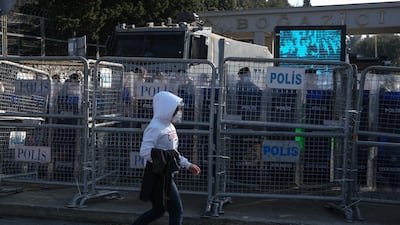

The overreach of President Recep Tayyip Erdogan is creeping into Turkey's university sector. In response, students from one of the country's elite institutions are pushing back.
Protests began in response to the appointment of Melih Bulu as rector at Istanbul’s Bogazici University. The institution was founded in 1863 and has a reputation for being among the most meritocratic in the country. It often recruits talented students from disadvantaged backgrounds, offering them a world-class education. It has a proud democratic approach to electing senior staff.
Mr Bulu breaks from this tradition. He ran for local office in 2015 for President Erdogan's Justice and Development Party (AKP). Many argue that a state-appointed rector – with a questionable academic record, having been accused of plagiarising parts of his doctoral thesis – insults the spirit of academic freedom. Graduates of the university are so angry that protests have taken place across the globe, in cities such as Paris, Berlin, Eindhoven, Sydney and Toronto.
This will not deter Mr Bulu and his backers. Corrupt leaders always consider independent universities as a threat to their rule. And students are often among the first citizens in a nation to identify problems in a country's governance. In Lebanon, for example, recent protests highlighted Lebanon's crumbling and corrupt state, which deteriorates by the day at the expense of Lebanese young people and their futures.
Those at universities like Bogazici graduate from their studies schooled in liberal social, political and cultural ideas. They are often firm defenders of Turkey's secular identity. Crucially, they also emerge with a knowledge of English – foreign language skills are limited in the nation – exposing them to counter-arguments in the international media against Mr Erdogan.
Turkey's president has already weakened universities by firing thousands, possibly tens of thousands of academics, citing vague accusations that they were involved in an attempted coup against him in 2016. While weakening universities at home, he has strengthened a new generation of religious higher education institutions, in what has been described as a neo-Ottoman bid to de-secularise degrees, often encouraging under-privileged young people from Muslim Balkan states to study his new brand of Turkish education.

Mr Erdogan is pursuing this campaign to quash bastions of opposition to his rule, and strengthen his populist base. Those who care about Turkey's future should take note. Students are the canary in the coalmine, warning us of a bleak future, in which the country drifts away from its secular, liberal roots. Universities will die if political favouritism becomes the norm. Mr Erdogan's government has a record in this regard. In 2018, Mr Erdogan appointed his son-in-law, Berat Albayrak, as the country's finance minister – only to remove him in recent weeks as the economy went into repeated crises. This could squander the futures of the brightest among the country's youth, an orchestrated tragedy just to secure his position.
A key feature of populism is the contempt it holds for academic elites, exactly the sort of people at Bogazici University. In normal times, graduates would have been future leaders of the country. They are, therefore, not just a threat to Mr Erdogan's current position, but also his legacy, which seeks to permanently steer Turkey down a different path than the liberal one intended by its founders.

