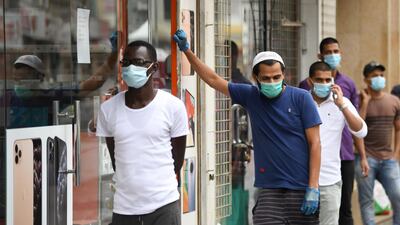
The coronavirus pandemic has kept nearly half of all of humanity indoors, while essential workers continue to go outside to keep society on its feet. Among them are healthcare workers tending to patients. While medical staff have been praised for their life-saving efforts, the work of other professionals who are just as vital to our pandemic-struck societies has been overlooked.
Blue-collar workers, including labourers working on construction sites, grocery clerks, security and cleaning personnel, food delivery drivers and many more deserve a great deal of attention and care as the pandemic continues.
Their contributions to society and the economy are invaluable. In some countries, they are foreigners who seek better employment and income to care for their families, as is the case in parts of the Arab world. Here in the UAE, they are an integral part of our society. They have built Dubai’s world-famous skyscrapers, contributing in turning the city from a modest port in the vast Arabian desert into a glamourous, cosmopolitan financial hub. They have also constructed Abu Dhabi and Sharjah’s most iconic sites. Now that the pandemic has struck all sections of society and as we witness economic pressures around the world, these workers are also getting protection from its impacts. The UAE government has put in place important measures to try to shield the most vulnerable from this virus. Regardless of their nationality, people in need can apply for a stipend from the UAE government to support their families.
UAE-based charities are doing a spectacular job at helping low-income workers who have been laid off or whose salaries have been cut.
Foreign workers who have tested positive to the novel coronavirus at a testing centre in Dubai are transported to a specialised centre for isolation and treatment. AFP
In addition to financial help, authorities have launched a mass-testing programme aimed specifically at low-income workers. In Ras Al Khaimah, authorities aim to carry out 20,000 tests on labourers by next month. In Abu Dhabi’s industrial district, 10,000 labourers are tested every day without charge. Food rations, water and juice are distributed to those waiting for hours in long queues. Those who test positive for the coronavirus are treated for free, and if other underlying conditions are discovered during the screenings, they are referred for treatment. In fact, anyone who contracts the virus in the UAE receives free treatment, and the government has also announced that it will look after the families of those who die from Covid-19, the disease caused by coronavirus, regardless of nationality or social status.
Other Gulf nations have taken similar action to support their most vulnerable workers. Labourer accommodation sites are being sterilised, and many of their occupants rehoused in larger accommodation units where they can more easily self-isolate. The UAE and Saudi Arabia provide free testing and treatment even for people who are residing in these countries without clear legal status.
Blue-collar workers deserve a great deal of attention and care as the pandemic continues
Other residents of the UAE also have a role to play in providing relief and recognition to low-income workers. Thanking the cashier at one’s local supermarket or giving a hefty tip to food delivery drivers can go a long way in showing the most valuable and the most vulnerable workers that society is grateful for their work.
More than 8,000 UAE residents and citizens have thus far volunteered to help stop the pandemic and to provide relief for those who are quarantined or in need.
Proactive and preventative measures are crucial to keeping the most vulnerable members of society safe and healthy, and so is moral support and recognition from wider society. People who have contributed to the UAE’s success story deserve every possible support, both material and moral.

Priority access to new homes from participating developers
Discounts on sales price of off-plan units
Flexible payment plans from developers
Mortgages with better interest rates, faster approval times and reduced fees
DLD registration fee can be paid through banks or credit cards at zero interest rates
Dubai works towards better air quality by 2021
Dubai is on a mission to record good air quality for 90 per cent of the year – up from 86 per cent annually today – by 2021.
The municipality plans to have seven mobile air-monitoring stations by 2020 to capture more accurate data in hourly and daily trends of pollution.
These will be on the Palm Jumeirah, Al Qusais, Muhaisnah, Rashidiyah, Al Wasl, Al Quoz and Dubai Investment Park.
“It will allow real-time responding for emergency cases,” said Khaldoon Al Daraji, first environment safety officer at the municipality.
“We’re in a good position except for the cases that are out of our hands, such as sandstorms.
“Sandstorms are our main concern because the UAE is just a receiver.
“The hotspots are Iran, Saudi Arabia and southern Iraq, but we’re working hard with the region to reduce the cycle of sandstorm generation.”
Mr Al Daraji said monitoring as it stood covered 47 per cent of Dubai.
There are 12 fixed stations in the emirate, but Dubai also receives information from monitors belonging to other entities.
“There are 25 stations in total,” Mr Al Daraji said.
“We added new technology and equipment used for the first time for the detection of heavy metals.
“A hundred parameters can be detected but we want to expand it to make sure that the data captured can allow a baseline study in some areas to ensure they are well positioned.”
Abu Dhabi World Pro 2019 remaining schedule:
Wednesday April 24: Abu Dhabi World Professional Jiu-Jitsu Championship, 11am-6pm
Thursday April 25: Abu Dhabi World Professional Jiu-Jitsu Championship, 11am-5pm
Individuals must register on UAE Drone app or website using their UAE Pass
Add all their personal details, including name, nationality, passport number, Emiratis ID, email and phone number
Upload the training certificate from a centre accredited by the GCAA
Submit their request
What are the regulations?
Fly it within visual line of sight
Never over populated areas
Ensure maximum flying height of 400 feet (122 metres) above ground level is not crossed
Users must avoid flying over restricted areas listed on the UAE Drone app
Only fly the drone during the day, and never at night
Should have a live feed of the drone flight
Drones must weigh 5 kg or less
Day 3, Dubai Test: At a glance
Moment of the day Lahiru Gamage, the Sri Lanka pace bowler, has had to play a lot of cricket to earn a shot at the top level. The 29-year-old debutant first played a first-class game 11 years ago. His first Test wicket was one to savour, bowling Pakistan opener Shan Masood through the gate. It set the rot in motion for Pakistan’s batting.
Stat of the day – 73 Haris Sohail took 73 balls to hit a boundary. Which is a peculiar quirk, given the aggressive intent he showed from the off. Pakistan’s batsmen were implored to attack Rangana Herath after their implosion against his left-arm spin in Abu Dhabi. Haris did his best to oblige, smacking the second ball he faced for a huge straight six.
The verdict One year ago, when Pakistan played their first day-night Test at this ground, they held a 222-run lead over West Indies on first innings. The away side still pushed their hosts relatively close on the final night. With the opposite almost exactly the case this time around, Pakistan still have to hope they can salvage a win from somewhere.
