

The World Food Programme, received this year's Nobel Peace Prize in a welcome move that highlights the importance of this United Nations' organisation. The honour is well-deserved and especially appropriate in 2020 given that due to Covid-19, the forecast for global hunger is even graver than before: an additional 130 million people could starve. Figures like these represent the enormity of the challenge WFP faces in giving assistance to the 88 countries they have aided in just the past year.
While Covid-19 has claimed over 1 million lives in 10 months, the threat of global hunger is more dire still. The ambition to eradicate global hunger by 2030 is now uncertain as the world continues to assess the gravity of this year's crisis.
Tens of millions of people already do not get enough to eat. It is this desperate plight that aid organisations strive to alleviate. The Nobel committee rightfully lauded WFP "for its contribution to bettering conditions for peace in conflict-affected areas and for acting as a driving force in efforts to prevent the use of hunger as a weapon of war and conflict."
The number of hungry people might shoot up to 165m at the end of 2020, from the 135m it was last year. Just five years ago it was 85m.
In this globally crippling year, food security has been an especially pressing issue. Several countries have stepped up to join relief efforts. Take the UAE, for instance. In this past year, the UAE has delivered food and medical aid to some of the worst-afflicted countries. The Emirates has dispatched more than 1,485 tonnes of aid to 118 countries. This is the spirit of helping each other that Berit Reiss-Andersen, Chair of the Norwegian Nobel Committee spoke of when she stressed the need for multilateralism and co-operation as a tool to solve global problems such as hunger.
It is then fitting that the Nobel Prize was awarded not to any one individual this year but to an organisation. This is not the first time that has happened. In 2012, for example, the European Union won the award. Twice, in the 1950s and 80s, it went to UNHCR.
In the history of the Nobel, the Middle East has seen some prominent names top the list but not nearly enough. As our columnist Janine di Giovanni has pointed out, there is also not nearly enough recognition for women pioneers in the field of science.
The region has in the past seen winners from across fields. The Prime Minister of Ethiopia Abiy Ahmed won the award last year for making peace with Eritrea. Yazidi activist Nadia Murad won in 2018 for her efforts to end the use of sexual violence as a weapon of war.
When the Egyptian writer Naguib Mahfouz accepted the 1988 Nobel Prize for Literature, he spoke of the great hopes he had for writers of his nation to sit with full merit among international writers "in this grief-ridden world of ours."
-
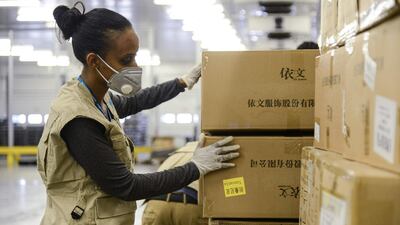
A staff member of the World Food Programme checks boxes that arrived, mostly personal protective equipment (PPE), at Ethiopian Airlines' cargo facility at the Bole International Airport in Addis Ababa, Ethiopia, on April 14. Samuel Habtab / AFP -
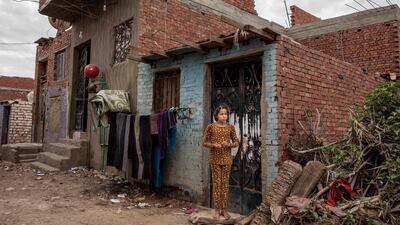
A girl waits outside her home in Cairo to see if she and her family will get a carton filled with food from the non-governmental organisation Resala Nour Ala Nour. Nariman El-Mofty / AFP -
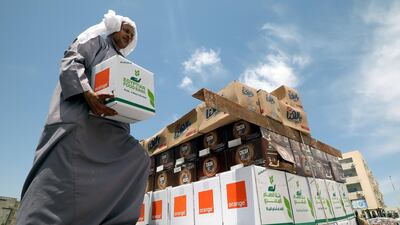
An Egyptian worker distributes food boxes by the Egyptian Food Bank to people who have lost their jobs due to the pandemic, in New Cairo, Egypt. Khaled Elfiqi / EPA -
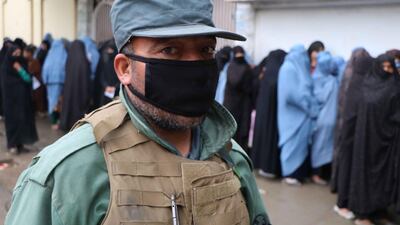
A security force member stands guard as women line up to receive rations distributed by the World Food Programme in Herat, Afghanistan, 31 March. Jalil Rezayee / EPA -
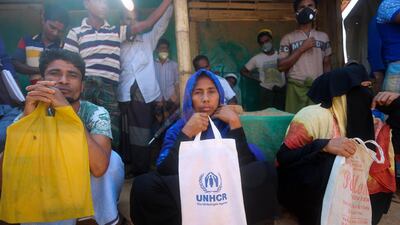
Rohingya refugees at the Kutupalong refugee camp in Cox’s Bazar, Bangladesh. Aid workers are bracing for a possible outbreak of coronavirus in one of the world's largest refugee camps in Bangladesh. Officials warn that containing the disease among more than one million tightly packed Rohingya Muslims will be a daunting task. Suzauddin Rubel / AP -
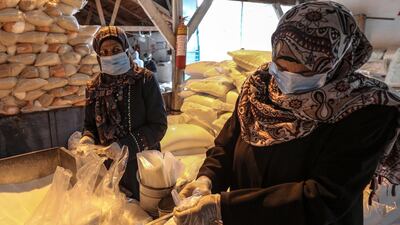
Palestinian workers at the United Nation Relief and Works Agency prepare rations for refugee families at Al Shatea refugee camp, Gaza City. Mohammed Saber / EPA -
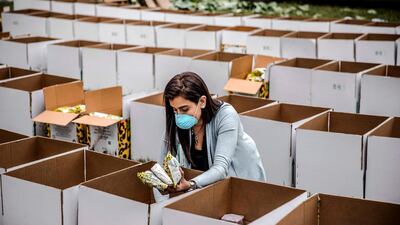
A volunteer prepares boxes with food and other basic goods at the Montessori School grounds in Nairobi, Kenya. The boxes will be delivered in the slums to people affected by the measures adopted by the Kenyan Government to stop the spread of Covid-19. Luis Tato / AFP -

Boxes with food and other basic goods that are delivered to people in Nairobi's slums affected by the measures adopted by the Kenyan Government to stop the spread of Covid-19, March 28. Luis Tato / AFP -
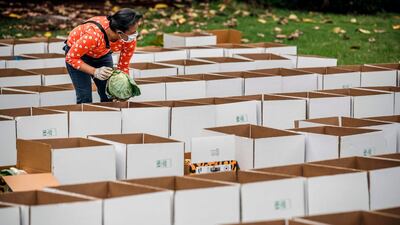
Aid boxes prepared by a volunteer to be delivered in the slums in Nairobi, Kenya on March 28. Luis Tato / AFP


Today, in a year as critical and demanding as 2020, it is the turn of an organisation, not an individual, whose urgent work must be applauded.
David Beasley, the WFP chief referencing the “family” of aid workers – the 17,000 employees of WFP said: "They're out there in the most difficult, complex places in the world. Whether it's war, conflict, climate extremes... it doesn't matter, they're out there. And they deserve this award."

