

On Thursday, Germany joined the US, UK and a number of other countries, including members of the Arab League, in designating Hezbollah a terrorist entity. This decision means banning all activities carried out by the group on German soil. The Interior Ministry in Berlin also confirmed that police had conducted early morning raids to detain suspected Hezbollah operatives.
Germany's decision is a welcome one. It comes five months after the Bundestag – Germany's legislature – approved a motion calling on the country's authorities to put a stop to Hezbollah's local activities. It also represents a significant step within the international community towards curbing the influence of a rogue operator that has for years window-dressed itself as a responsible political actor in Lebanon. In reality, Hezbollah has been little else but an armed proxy for Tehran's wider geopolitical interests, holding Lebanese politics – and the Lebanese state – hostage. It has also succeeded in spreading its tentacles across the Middle East and elsewhere in the world, including within the European Union and even Latin America.
-
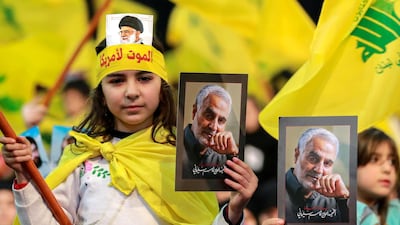
Supporters of Hezbollah hold photos of slain Iranian general Qassem Suleimani as they listen to a televised speech by Hezbollah leader Hassan Nasrallah in a southern suburb of the Lebanese capital Beirut. EPA -
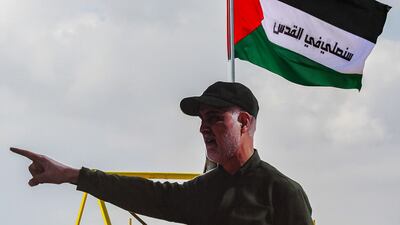
A giant cutout of Qassem Suleimani set up in the Garden of Iran park built by the Iranian government in the southern Lebanese village of Maroun Al Ras near the border with Israel. AFP -
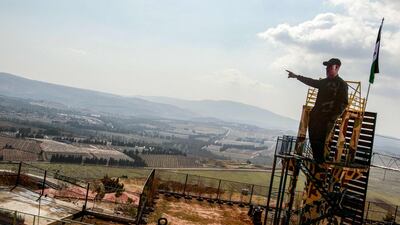
A view of a giant cutout depicting Iran's late top general Qasem Soleimani, who was killed in a US drone strike near Baghdad airport on January 3, 2020. AFP -
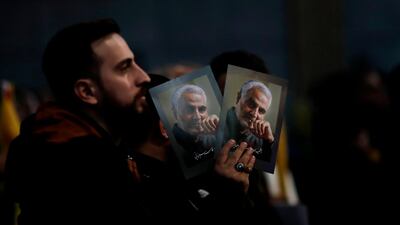
A Hezbollah supporter holds pictures of Qassem Suleimani during a ceremony marking the the end of a 40-day Muslim mourning period for the Iranian general and the anniversary of the assassination of Hezbollah leaders Abbas Al Moussawi, Ragheb Harb and Imad Mughniyeh. AP Photo -

Hezbollah supporters hold pictures of Qassem Suleimani in the southern suburb of Beirut. AP Photo -
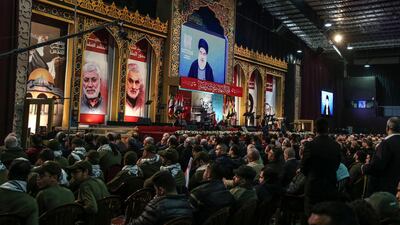
Hezbollah leader Hassan Nasrallah addresses supporters via a video link. EPA -
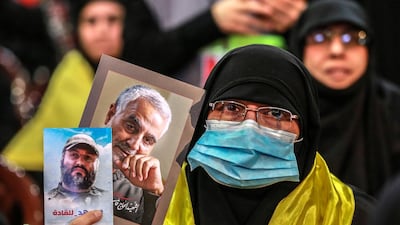
A Hezbollah supporter holds a photo of Qassem Suleimani during a rally to mark the group's Martyrs Day. EPA -
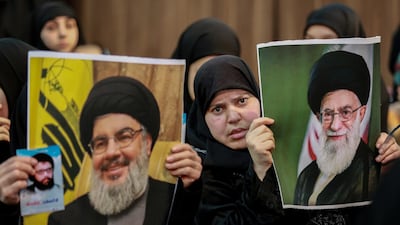
Supporters of Hezbollah hold photos of Hassan Nasrallah and Iran's supreme leader Ali Khamenei in southern Beirut. EPA -
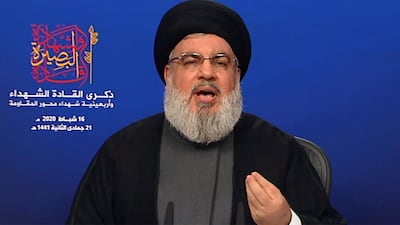
An screen grab from Hezbollah's Al Manar TV shows Hassan Nasrallah delivering a televised address from an undisclosed location in Lebanon. AFP -
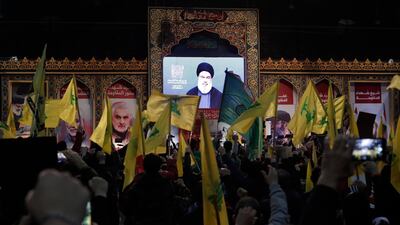
Hezbollah supporters wave the group's flag as they listen to Hassan Nasrallah speak. AP Photo -
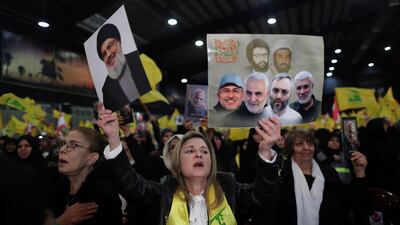
Hezbollah supporters sing the Lebanese and Hezbollah anthems during a ceremony marking the deaths of slain commanders and the Iranian general Qassem Suleimani in the southern suburb of Beirut. AP Photo


These new developments then amount to yet another setback for Iran, which is already saddled with an economy battered by US-led sanctions in response to its illegal nuclear and ballistic programmes, as well as its military adventurism in the region. The regime has often relied upon on the EU to act as an interlocutor between itself and Washington in its bid to get sanctions relief. Now, the largest EU member state has sent an extraordinary signal that there is a limit to European patience with Iran's broader extremist agenda.
Perhaps the most immediate hit to Hezbollah will be financial. Already set to lose 40 per cent of its income from Iran after the dramatic fall in oil prices as a result of coronavirus, Hezbollah's ability to raise funds from its activities in Europe, including its running of fake orphanages, will be significantly hampered.
There is also a renewed spotlight on Hezbollah's decades-long cloak-and-dagger operations, which include terror plots across the Middle East and the world, and a range of illegal activities from money-laundering to drug-smuggling. It has become an integral part of a global nexus between rogue states and organised crime. In Venezuela, for instance, Hezbollah has been linked to Caracas's newly appointed oil minister, Tareck El Aissami, a man accused of a host of illicit activities by the US State Department.

Worryingly, despite its transgressions, Hezbollah has been able to use its status as the dominant political party within the Lebanese parliament to garner some political legitimacy abroad. Its status in Beirut, where it is a significant backer of the government of Prime Minister Hassan Diab, gives it the look of one among many parties operating within the confines of a national political system. But Hezbollah runs its own militias, who not only enforce its power in certain parts of Lebanon, but also conduct independent operations in neighbouring Syria, where they support President Bashar Al Assad, and further afield in Iraq. These units often answer directly to senior commanders of the Iran's Islamic Revolutionary Guard Corps.
Berlin had previously made a distinction between Hezbollah’s political arm and its military units. But the two are by no means cleanly separated, and the sooner more countries recognise this, the better the outcome will be for the victims of Hezbollah’s activities. It would also present a victory for proponents of the rule of law; states should have a monopoly on the use of force, not individual political parties. If this is well understood now in Berlin, perhaps someday it will be understood just as well in Beirut.

