

As he sets out priorities for his administration, US President Joe Biden has made it clear that he seeks to dissociate himself entirely from his predecessor Donald Trump.
While Mr Trump left Mr Biden few plans on how to deal with major domestic crises, he did leave behind a smart blueprint for America’s relations in the Arabian Peninsula. Embedded within it was a useful tool for helping to resolve the seemingly intractable conflict in Yemen, which has plagued Yemen and the region for nearly six years.
As a parting shot for the administration, Mike Pompeo, Mr Trump's secretary of state, announced in January that the Houthi rebel group controlling most of Yemen would be formally designated a terrorist organisation by the US. The designation, according to Mr Pompeo, was "intended to hold them accountable for terrorist acts, including cross-border attacks threatening civilian populations". But it was also, he noted, "intended to advance efforts to achieve a peaceful, sovereign and united Yemen that is both free from Iranian interference and at peace with its neighbours".
It is difficult to argue with any of those intentions, or the facts underwriting them. Since overthrowing Yemen's government in 2014, the Houthis have imposed a brutal regime. They have hardened further an already-extremist ideology ("Death to Jews" is a popular Houthi cry) and preached propaganda to the population, glorifying violence and promoting false conspiracy theories, including about coronavirus. The Houthis have conscripted child soldiers into their forces, murdered dissenters and sought to destroy much of Yemen's critical infrastructure. On December 30, the group attacked Aden's airport, injuring one of The National's reporters, among others.
The Houthis have also cultivated a dangerous relationship with Iran, which has supplied them with strategic advice, money and weapons. By entering the Iranian tent, they hope to join a regional network of proxies that subvert peace and promote sectarianism in the name of a supposed revolution. But there is no revolutionary vision – only a naked attempt by Tehran to accrue power for power's sake. It is telling that when the UN's Yemen envoy Martin Griffiths embarked on a diplomatic mission yesterday to seek an end to the Yemen crisis, his plane took him to Tehran.
-
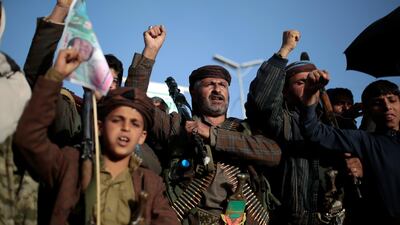
Houthi supporters chant slogans as they attend a demonstration against the United States over its decision to designate the Houthis a foreign terrorist organization in Sanaa, Yemen. AP Photo -
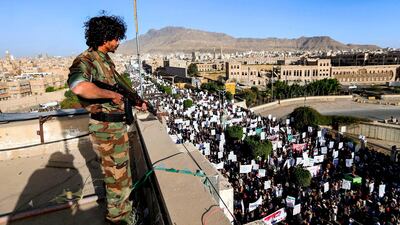
A member of security forces loyal to Yemen's Houthi rebels stands guard as supporters attend a rally denouncing the United States and the Trump administration's decision to apply the "terrorist" designation to the Iran-backed movement. AFP -

A Houthi supporter holds his weapon during a demonstration against the United States over its decision to designate the Houthis a foreign terrorist organization in Sanaa, Yemen. AP -

Opposers of Yemen's Houthi rebels shout slogans during a rally in support of the United States and the Trump administration's decision to apply the "terrorist" designation to the Iran-backed movement, in Yemen's third city of Taez. AFP -

Opposers of Yemen's Houthi rebels shout slogans during a rally in support of the United States and the outgoing Trump administration's decision to apply the "terrorist" designation to the Iran-backed movement, in Yemen's third city of Taez. AFP -
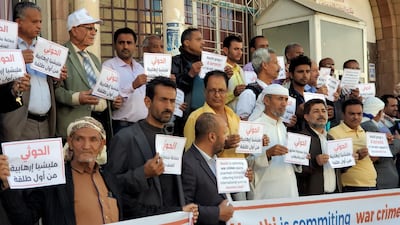
Yemenis opposed to the country's Houthi rebels take part in a rally in support of a recent decision by the United States' outgoing administration blacklisting the Houthi group as a "terrorist" organisation in Yemen's third city of Taez. AFP -

A joint Saudi-backed Sudanese-Yemeni force removes landmines, which they said were planted by the Iran-aligned Houthi rebels in Yemen's northern coastal town of Midi, in the Hajjah governorate. AFP -
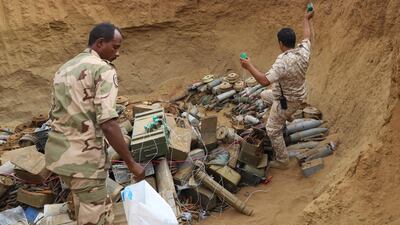
The Saudi-backed Sudanese-Yemeni force removes and de-activates landmines in the Hajjah governorate near the border with Saudi Arabia on the Red Sea. AFP -
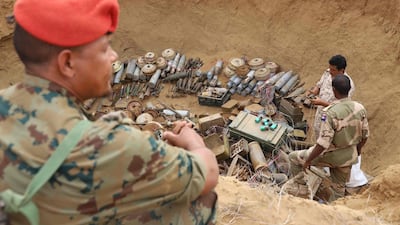
The force collected some 5,000 landmines. AFP -
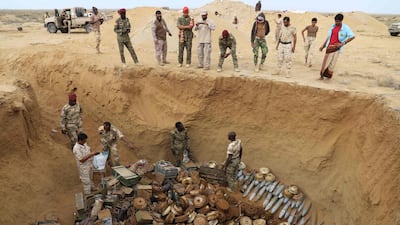
A shot shows landmines collected by the Sudanese-Yemeni force. AFP -
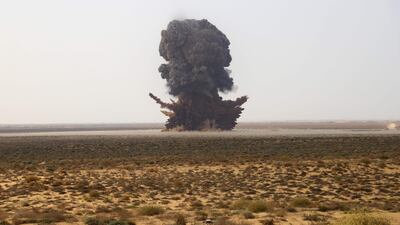
An expAFP


Designating the Houthis terrorists seemed, at the very least, an exercise in stating the obvious. But it also provided the Biden administration with leverage to use in the much-needed peace negotiations that will prove the only way to solve Yemen’s crisis. Last week, however, Mr Biden reversed Mr Pompeo’s move, under pressure from critics in Washington who feared that the designation, which sanctioned entities that deal with the Houthis, would obstruct the flow of aid to the Yemeni people. This is despite the fact that the work of relief agencies have been affected by the actions of the Houthis, who have taxed aid and extorted aid workers, in addition to occasionally blocking their activities altogether.
The war in Yemen has come at a significant humanitarian cost. The UAE withdrew its own forces last October and has continued to push for diplomatic solutions since. But the foremost obstacle to these solutions is the Houthis – who have enthusiastically exploited the humanitarian disaster and the presence of UN agencies for their own profit.
The consolation is that as Mr Biden cast aside one valuable tool, he replaced it with another. He has chosen for his Yemen envoy Timothy Lenderking, a foreign policy veteran with strong relationships with Gulf allies and a deep knowledge of Yemen. These are excellent qualities of which Mr Lenderking can avail himself as he works in the service of peace. But with the Houthis only digging in and Washington’s leverage fading, he will need also need some luck.

