

Mark Lowcock, the top UN official in charge of humanitarian affairs and emergency relief, had a stark assessment of the coronavirus situation in Syria during a Security Council briefing on Monday. The Syrian government had already reported 10 cases in the country. Two had died by Tuesday.
“That is the tip of the iceberg,” he said. “The virus has the potential to have a devastating impact on vulnerable communities across the country.”

Syria has now entered the 10th year of its civil war. More than half a million people have been killed, more than 10 million were displaced, countless civilians have been maimed or wounded in the violence and tens of thousands have been disappeared into Syrian regime dungeons. The cost of reconstruction is in the hundreds of billions of dollars. Ordinary civilians in government-controlled areas are suffering from abject poverty, unable to buy even basic food staples or fuel for their homes.
Those in the remaining pockets of rebel-held territory, also destitute, have been forced to flee their homes due to recent government offensives in the province of Idlib near Turkey. A million people were displaced from December to February alone, forced to live in overcrowded and flimsy tents or out in the open. Many remain there despite a temporary ceasefire.
A deadly pandemic is the last thing they need.
-
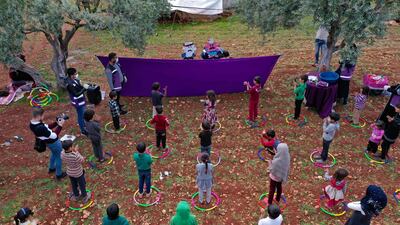
Volunteers from the Violet organisation perform a puppet show for children in a camp for displaced Syrians to inform them about coronavirus and the methods used to limit its spread, in the village of Kafr Yahmul, Idlib, Syria, on April 7, 2020. AFP -
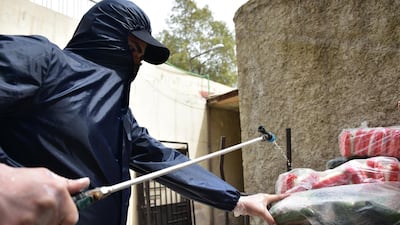
A member of an NGO in a protective suit disinfects bags containing foods in Damascus, Syria, on 6, April 2020. EPA -
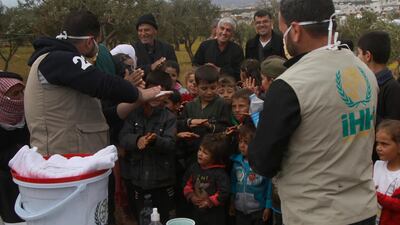
Aid workers from Turkish humanitarian group IHH show Syrian children how to properly wash their hands, at a camp for internally displaced persons in norther Syria, on Monday, April 6, 2020. IHH via AP -
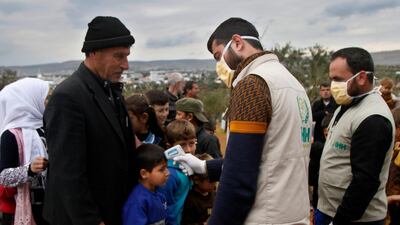
In this undated photo released by the Turkish humanitarian group IHH on Monday, April 6, 2020, aid workers of the group check the temperature of Syrian children at a camp for internally displaced persons in northern Syria. IHH via AP -
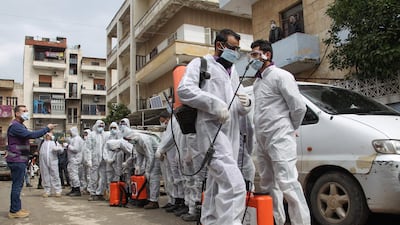
Members of the Syrian Violet NGO prepare to disinfect the Ibn Sina Hospital in Idlib on March 19, 2020. AFP -
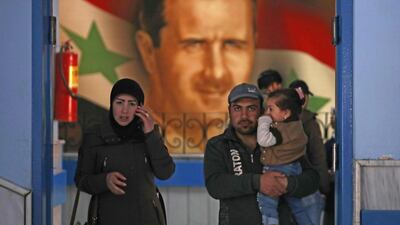
A family stand in the doorway of a ward at a hospital in the Syrian capital Damascus on March 19, 2020, as it is being prepared to quarantine possible cases of coronavirus, on March 19, 2020. AFP -
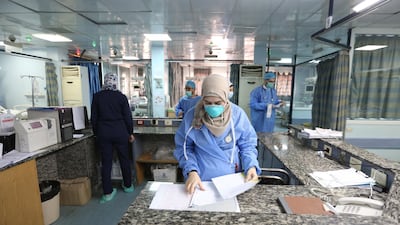
Health personnel prepare quarantine rooms at the government-run Al Mojtahed hospital in Damascus, Syria, on March 19, 2020. EPA -
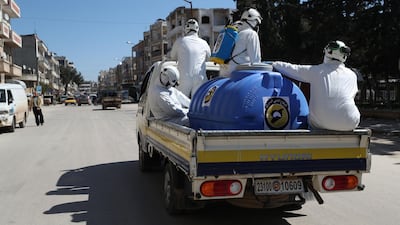
Members of the Syrian Civil Defence, also known as the "White Helmets", prepare their equipment before sterilising a hospital in Idlib on March 22, 2020. AFP -
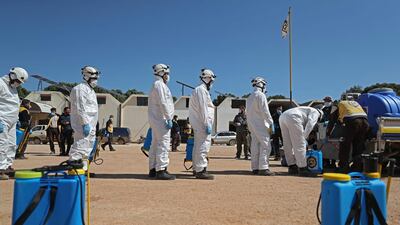
Members of the Syrian Civil Defence, also known as the "White Helmets", prepare their equipment before sterilising a hospital in Idlib on March 22, 2020. AFP -
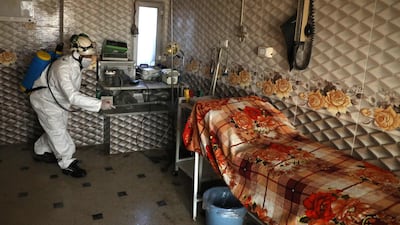
A member of the Syrian Civil Defence known as the "White Helmets" disinfects a hospital room in Dana, Syria, on March 22, 2020. AFP -
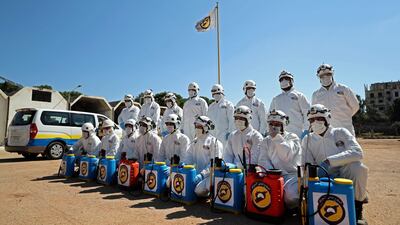
Members of the Syrian Civil Defence, also known as the "White Helmets", prepare their equipment before sterilising a hospital in Idlib on March 22, 2020. AFP -
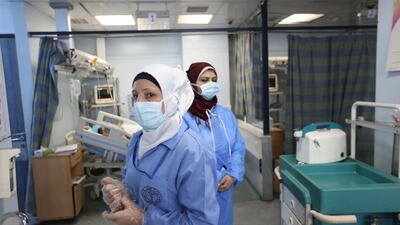
Nurses work in the intensive care unit at the government-run Al Mojtahed hospital in Damascus, Syria, on March 19, 2020. EPA


In the past few weeks, rumours were already circulating of possible coronavirus infections in Syria, due to the regular movement of fighters and commanders from Iran-backed militias into and within the country. The rumours were impossible to verify, given the degree of control by the government in the territories it holds.
Over the past few days, however, the government reported that cases had been detected and hospitalised in the country and announced a range of measures, including a ban on civilians traveling between provinces and a partial curfew.
It may not be enough. The potential for the virus’s rapid spread is horrifying, even more so because Syrians have already endured years of grave destruction and displacement – including extreme damage to its health system.
According to the UN, health services in Syria are extremely fragile, with only around half of its hospitals and primary healthcare centres still operational after nine years of war. Physicians for Human Rights, an organisation that tracks and verifies attacks on health care in Syria, has recorded nearly 600 separate attacks on medical facilities in the country throughout the war.
Of these attacks, nearly 300 were carried out by Assad regime forces, 240 by either Syrian or Russian forces, and 24 by rebel groups. ISIS carried out ten attacks.
In addition, the organisation tracks the targeting of doctors, paramedics, nurses and other health workers – those on the front lines battling the pandemic all over the world. But in Syria, more than 900 have been killed from 2011 through March 2020. Of those, 91 per cent were killed by the Syrian government or its foreign allies. Some of them were killed during so-called “double tap” strikes, in which planes that target an area circle back to bomb it a second time after rescue workers have arrived.
The devastation of the healthcare system in Syria was part of a systematic campaign, after medical facilities in rebel-controlled areas were designated as de facto military targets by a Syrian government counter-terrorism law in 2012.
The destruction and prolonged warfare have left Syria woefully under-prepared to handle a pandemic. Few hospitals have the spare capacity or medical personnel to treat coronavirus infections, nor are there enough intensive care beds or equipment, particularly in cities like Aleppo that bore the brunt of the conflict, to treat serious cases.
In addition, the economic crisis in the country means that few people can afford to stay at home. The state does not have the capacity to provide for their needs. In prisons, the potential for contagion spreading like wildfire among detainees is enormous. In rebel-held communities, few citizens can take measures like social distancing or even find clean water to wash their hands regularly in order to prevent the spread of infection, and the virus can easily spread through crowded, displaced communities already suffering from violence and dispossession.
The World Health Organisation must be given access to conduct tests among vulnerable communities in the country – those living in towns hammered by conflict and camps for the displaced, those fleeing rebel-held communities and detainees in regime prisons rendered vulnerable by years of mistreatment and torture. It must ensure that humanitarian supplies, testing kits and other equipment are available to track any infections and isolate cases, as well as to provide medical expertise, help rebuild destroyed hospital wards and prepare ventilators to treat potential cases.
Most importantly, the ongoing ceasefire must hold and allow communities to prepare for and contain the pandemic. Syrians cannot fight two wars – an invisible one against the virus, and another against their fellow citizens – at the same time.
Kareem Shaheen is a former Middle East correspondent based in Canada

