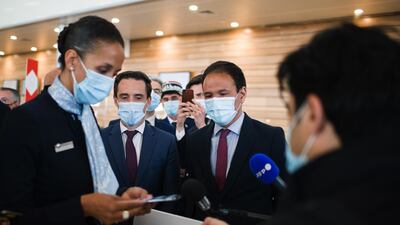
Air France-KLM check-in staff demonstrate the 'TousAntiCovid' smartphone tracing app at Orly Airport in Paris last week. France is moving towards a rollout of digital health certificates. Bloomberg
The prospect of vaccine passports or certifications in order to be allowed to travel is gathering pace in the West as vaccinations become more widespread in North America and parts of western Europe.
This week, Canadian Health Minister Patty Hajdu said the government was in favour of vaccine passports and would probably seek to adapt an existing safe travel app to allow prospective vacationers to go on holidays if they have been vaccinated. I'm particularly excited about this because I should be able to finally book my vaccine appointment when Montreal, where I live, opens the door for appointments for the general population on Friday.
Similar measures are likely to be introduced elsewhere – the EU has said it will introduce digital certificates that certify that a person has been vaccinated, received a recent negative Covid-19 test result, or recovered from the disease, with the aim of making check-in procedures and verification of health measures easier at airports. The US is divided on the question of vaccine passports because it is the US and everything has to be a political statement and be polarised.
Countries are scrambling to have these measures in place ahead of the summer tourism season, hoping to revive their economies in time to revel in the wanderlust and hunger for novelty after a year of lockdowns, fear, and asceticism.
Vaccine passports are a sensible public health measure, of course, and surveys generally find widespread support for their adoption. I personally don't think they go far enough, and believe vaccine passports or certificates ought to be required for most activities that bring you in close contact with a lot of people. Imposing such restrictions will resolve the problems of vaccine hesitancy by making it untenable for people to avoid them in the long run. This will allow countries to overcome the challenge of achieving herd immunity more quickly, and allow us to get back to normal as soon as possible, and to finally take off these masks.
The problem with this approach, however, is that it risks entrenching global inequality because not all countries have equal access to coronavirus vaccines. Wealthier countries such as the US and Canada and other G20 nations secured an outsized proportion of the global vaccine supply because they could afford to pay extravagantly for pre-orders such that they would be at the front of the line, and have the cold chain supply and manufacturing capabilities to obtain and store them. Poorer countries have to rely either on vaccines without the same proven efficacy or on international procurement and distribution mechanisms like the UN-backed Covax initiative, which will take a long time to vaccinate people around the world sufficiently for herd immunity to be achieved.
This will, of course, limit the ability of talented people who want to travel or emigrate to the West from doing so in the medium term. The way out of this conundrum is for wealthier countries to invest more heavily in vaccine distribution through Covax and other initiatives. This is not only the right thing to do, but it is also the practical, wise thing to do, because global herd immunity is what will ultimately defeat the pandemic. No country is safe until all countries are safe.
AstraZeneca Covid-19 vaccine doses provided by the Covax initiative arrive in Mogadishu, Somalia. AP
None of these complex factors are what first came to my mind though when I was contemplating the news. Rather, the first thing I thought of was that vaccine passports were going to be yet another hoop for most Arabs to jump through when applying for unlikely visas to the West.
I am lucky that I managed to be able to emigrate to Canada on account of being sponsored by my wife, who was a permanent resident. Even then my first visa application got rejected. I was once rejected for a British visa despite working for the UK newspaper The Guardian. As an Egyptian, I missed out on plenty of reporting assignments because I could not obtain visas on time, and when I did I was often questioned in airports whenever I travelled. When my wife and I tried to apply for visas to the EU for our honeymoon, the clerk at the application centre essentially told us not to bother. We found a destination that didn't require a visa. And I'm one of the lucky ones.
As a reporter, I covered stories of families that had been kept apart because of visa restrictions and heard countless stories of rejection, an often humiliating experience because you essentially gather every errant piece of paperwork from your life for a chance at the promised land and are even then usually found wanting.
When talking to a friend about the vaccination rule, it occurred to me that at least those failed visa applications will have one benefit – more people will get vaccinated in pursuit of visas that in all likelihood will never happen. Maybe, inadvertently, the new rules will be precisely what is needed to overcome vaccine hesitancy and conspiracy theories in our part of the world, even if it is in pursuit of a futile goal.
Kareem Shaheen is a veteran Middle East correspondent in Canada and a columnist for The National

Eoin Morgan (capt), Moeen Ali, Jofra Archer, Jonny Bairstow, Jos Buttler (wkt), Tom Curran, Liam Dawson, Liam Plunkett, Adil Rashid, Joe Root, Jason Roy, Ben Stokes, James Vince, Chris Woakes, Mark Wood
THE NEW BATCH'S FOCUS SECTORS
AiFlux – renewables, oil and gas
DevisionX – manufacturing
Event Gates – security and manufacturing
Farmdar – agriculture
Farmin – smart cities
Greener Crop – agriculture
Ipera.ai – space digitisation
Lune Technologies – fibre-optics
Monak – delivery
NutzenTech – environment
Nybl – machine learning
Occicor – shelf management
Olymon Solutions – smart automation
Pivony – user-generated data
PowerDev – energy big data
Sav – finance
Searover – renewables
Swftbox – delivery
Trade Capital Partners – FinTech
Valorafutbol – sports and entertainment
Workfam – employee engagement
INVESTMENT PLEDGES
Cartlow: $13.4m
Rabbitmart: $14m
Smileneo: $5.8m
Soum: $4m
imVentures: $100m
Plug and Play: $25m
TO A LAND UNKNOWN
Director: Mahdi Fleifel
Starring: Mahmoud Bakri, Aram Sabbah, Mohammad Alsurafa
It was discovered in 2004, when Russian-born Manchester scientists Andrei Geim and Kostya Novoselov were experimenting with sticky tape and graphite, the material used as lead in pencils.
Placing the tape on the graphite and peeling it, they managed to rip off thin flakes of carbon. In the beginning they got flakes consisting of many layers of graphene. But when they repeated the process many times, the flakes got thinner.
By separating the graphite fragments repeatedly, they managed to create flakes that were just one atom thick. Their experiment led to graphene being isolated for the very first time.
In 2010, Geim and Novoselov were awarded the Nobel Prize for Physics.
1. Sebastian Vettel, Ferrari 1:39:46.713
2. Kimi Raikkonen, Ferrari 00:00.908
3. Valtteri Bottas, Mercedes-GP 00:12.462
4. Lewis Hamilton, Mercedes-GP 00:12.885
5. Max Verstappen, Red Bull Racing 00:13.276
6. Fernando Alonso, McLaren 01:11.223
7. Carlos Sainz Jr, Toro Rosso 1 lap
8. Sergio Perez, Force India 1 lap
9. Esteban Ocon, Force India 1 lap
10. Stoffel Vandoorne, McLaren 1 lap
11. Daniil Kvyat, Toro Rosso 1 lap
12. Jolyon Palmer, Renault 1 lap
13. Kevin Magnussen, Haas 1 lap
14. Lance Stroll, Williams 1 lap
15. Pascal Wehrlein, Sauber 2 laps
16. Marcus Ericsson, Sauber 2 laps
17r. Nico Huelkenberg, Renault 3 laps
r. Paul Di Resta, Williams 10 laps
r. Romain Grosjean, Haas 50 laps
r. Daniel Ricciardo, Red Bull Racing 70 laps
Super Bowl LIII schedule
What Super Bowl LIII
Who is playing New England Patriots v Los Angeles Rams
Where Mercedes-Benz Stadium in Atlanta, United States
When Sunday (start time is 3.30am on Monday UAE time)
• Increase defence spending to 2.5% of GDP by 2027 but given “turbulent times it may be necessary to go faster”
• Prioritise a shift towards working with AI and autonomous systems
• Invest in the resilience of military space systems.
• Number of active reserves should be increased by 20%
• More F-35 fighter jets required in the next decade
• New “hybrid Navy” with AUKUS submarines and autonomous vessels
COMPANY PROFILE
Name: ARDH Collective
Based:Dubai
Founders:Alhaan Ahmed, Alyina Ahmed and Maximo Tettamanzi
Sector:Sustainability
Total funding: Self funded
Number of employees:4
White hydrogen: Naturally occurring hydrogen Chromite: Hard, metallic mineral containing iron oxide and chromium oxide Ultramafic rocks: Dark-coloured rocks rich in magnesium or iron with very low silica content Ophiolite: A section of the earth’s crust, which is oceanic in nature that has since been uplifted and exposed on land Olivine: A commonly occurring magnesium iron silicate mineral that derives its name for its olive-green yellow-green colour
Price, base Dh485,000 (GranTurismo) and Dh575,000 (GranCabrio)
Engine 4.7L V8
Transmission Six-speed automatic
Power 460hp @ 7,000rpm
Torque 520Nm @ 4,750rpm
Fuel economy, combined 14.3L (GranTurismo) and 14.5L (GranCabrio) / 100km
Mercer, the investment consulting arm of US services company Marsh & McLennan, expects its wealth division to at least double its assets under management (AUM) in the Middle East as wealth in the region continues to grow despite economic headwinds, a company official said.
Mercer Wealth, which globally has $160 billion in AUM, plans to boost its AUM in the region to $2-$3bn in the next 2-3 years from the present $1bn, said Yasir AbuShaban, a Dubai-based principal with Mercer Wealth.
“Within the next two to three years, we are looking at reaching $2 to $3 billion as a conservative estimate and we do see an opportunity to do so,” said Mr AbuShaban.
Mercer does not directly make investments, but allocates clients’ money they have discretion to, to professional asset managers. They also provide advice to clients.
“We have buying power. We can negotiate on their (client’s) behalf with asset managers to provide them lower fees than they otherwise would have to get on their own,” he added.
Mercer Wealth’s clients include sovereign wealth funds, family offices, and insurance companies among others.
From its office in Dubai, Mercer also looks after Africa, India and Turkey, where they also see opportunity for growth.
Wealth creation in Middle East and Africa (MEA) grew 8.5 per cent to $8.1 trillion last year from $7.5tn in 2015, higher than last year’s global average of 6 per cent and the second-highest growth in a region after Asia-Pacific which grew 9.9 per cent, according to consultancy Boston Consulting Group (BCG). In the region, where wealth grew just 1.9 per cent in 2015 compared with 2014, a pickup in oil prices has helped in wealth generation.
BCG is forecasting MEA wealth will rise to $12tn by 2021, growing at an annual average of 8 per cent.
Drivers of wealth generation in the region will be split evenly between new wealth creation and growth of performance of existing assets, according to BCG.
Another general trend in the region is clients’ looking for a comprehensive approach to investing, according to Mr AbuShaban.
“Institutional investors or some of the families are seeing a slowdown in the available capital they have to invest and in that sense they are looking at optimizing the way they manage their portfolios and making sure they are not investing haphazardly and different parts of their investment are working together,” said Mr AbuShaban.
Some clients also have a higher appetite for risk, given the low interest-rate environment that does not provide enough yield for some institutional investors. These clients are keen to invest in illiquid assets, such as private equity and infrastructure.
“What we have seen is a desire for higher returns in what has been a low-return environment specifically in various fixed income or bonds,” he said.
“In this environment, we have seen a de facto increase in the risk that clients are taking in things like illiquid investments, private equity investments, infrastructure and private debt, those kind of investments were higher illiquidity results in incrementally higher returns.”
The Abu Dhabi Investment Authority, one of the largest sovereign wealth funds, said in its 2016 report that has gradually increased its exposure in direct private equity and private credit transactions, mainly in Asian markets and especially in China and India. The authority’s private equity department focused on structured equities owing to “their defensive characteristics.”
Company Fact Box
Company name/date started: Abwaab Technologies / September 2019
Founders: Hamdi Tabbaa, co-founder and CEO. Hussein Alsarabi, co-founder and CTO
Based: Amman, Jordan
Sector: Education Technology
Size (employees/revenue): Total team size: 65. Full-time employees: 25. Revenue undisclosed
Stage: early-stage startup
Investors: Adam Tech Ventures, Endure Capital, Equitrust, the World Bank-backed Innovative Startups SMEs Fund, a London investment fund, a number of former and current executives from Uber and Netflix, among others.
The specs
Engine: 3.0-litre six-cylinder turbo
Power: 398hp from 5,250rpm
Torque: 580Nm at 1,900-4,800rpm
Transmission: Eight-speed auto
Fuel economy, combined: 6.5L/100km
On sale: December
Price: From Dh330,000 (estimate)
FFP EXPLAINED
What is Financial Fair Play?
Introduced in 2011 by Uefa, European football’s governing body, it demands that clubs live within their means. Chiefly, spend within their income and not make substantial losses.
What the rules dictate?
The second phase of its implementation limits losses to €30 million (Dh136m) over three seasons. Extra expenditure is permitted for investment in sustainable areas (youth academies, stadium development, etc). Money provided by owners is not viewed as income. Revenue from “related parties” to those owners is assessed by Uefa's “financial control body” to be sure it is a fair value, or in line with market prices.
What are the penalties?
There are a number of punishments, including fines, a loss of prize money or having to reduce squad size for European competition – as happened to PSG in 2014. There is even the threat of a competition ban, which could in theory lead to PSG’s suspension from the Uefa Champions League.
UAE squad
Men's draw: Victor Scvortov and Khalifa Al Hosani, (both 73 kilograms), Sergiu Toma and Mihail Marchitan (90kg), Ivan Remarenco (100kg), Ahmed Al Naqbi (60kg), Musabah Al Shamsi and Ahmed Al Hosani (66kg)
Occupation: Specialised chief medical laboratory technologist
Age: 78
Favourite destination: Always Al Ain “Dar Al Zain”
Hobbies: his work - “ the thing which I am most passionate for and which occupied all my time in the morning and evening from 1963 to 2019”
Other hobbies: football
Favorite football club: Al Ain Sports Club
INDIA V SOUTH AFRICA
First Test: October 2-6, at Visakhapatnam
Second Test: October 10-14, at Maharashtra
Third Test: October 19-23, at Ranchi
Essentials
The flights Etihad and Emirates fly direct from the UAE to Delhi from about Dh950 return including taxes. The hotels
Double rooms at Tijara Fort-Palace cost from 6,670 rupees (Dh377), including breakfast.
Doubles at Fort Bishangarh cost from 29,030 rupees (Dh1,641), including breakfast. Doubles at Narendra Bhawan cost from 15,360 rupees (Dh869). Doubles at Chanoud Garh cost from 19,840 rupees (Dh1,122), full board. Doubles at Fort Begu cost from 10,000 rupees (Dh565), including breakfast. The tours
Amar Grover travelled with Wild Frontiers. A tailor-made, nine-day itinerary via New Delhi, with one night in Tijara and two nights in each of the remaining properties, including car/driver, costs from £1,445 (Dh6,968) per person.
Match info
Australia 580 Pakistan 240 and 335
Result: Australia win by an innings and five runs
THE BIO:
Favourite holiday destination: Thailand. I go every year and I’m obsessed with the fitness camps there.
Favourite book: Born to Run by Christopher McDougall. It’s an amazing story about barefoot running.
Favourite film: A League of their Own. I used to love watching it in my granny’s house when I was seven.
Personal motto: Believe it and you can achieve it.
Abu Dhabi GP Saturday schedule
12.30pm GP3 race (18 laps)
2pm Formula One final practice
5pm Formula One qualifying
6.40pm Formula 2 race (31 laps)
Our legal columnist
Name: Yousef Al Bahar
Advocate at Al Bahar & Associate Advocates and Legal Consultants, established in 1994
Education: Mr Al Bahar was born in 1979 and graduated in 2008 from the Judicial Institute. He took after his father, who was one of the first Emirati lawyers
A 2019 United Nations special analysis on Aids reveals 37 per cent of new HIV infections in the Mena region are from people injecting drugs.
New HIV infections have also risen by 29 per cent in western Europe and Asia, and by 7 per cent in Latin America, but declined elsewhere.
Egypt has shown the highest increase in recorded cases of HIV since 2010, up by 196 per cent.
Access to HIV testing, treatment and care in the region is well below the global average.
Few statistics have been published on the number of cases in the UAE, although a UNAIDS report said 1.5 per cent of the prison population has the virus.
October 26: Bahrain withdraws from a proposal to create a federation of nine with the seven Trucial States and Qatar.
December: Ahmed Al Suwaidi visits New York to discuss potential UN membership.
1971
March 1: Alex Douglas Hume, Conservative foreign secretary confirms that Britain will leave the Gulf and “strongly supports” the creation of a Union of Arab Emirates.
July 12: Historic meeting at which Sheikh Zayed and Sheikh Rashid make a binding agreement to create what will become the UAE.
July 18: It is announced that the UAE will be formed from six emirates, with a proposed constitution signed. RAK is not yet part of the agreement.
August 6: The fifth anniversary of Sheikh Zayed becoming Ruler of Abu Dhabi, with official celebrations deferred until later in the year.
August 15: Bahrain becomes independent.
September 3: Qatar becomes independent.
November 23-25: Meeting with Sheikh Zayed and Sheikh Rashid and senior British officials to fix December 2 as date of creation of the UAE.
November 29: At 5.30pm Iranian forces seize the Greater and Lesser Tunbs by force.
November 30: Despite a power sharing agreement, Tehran takes full control of Abu Musa.
November 31: UK officials visit all six participating Emirates to formally end the Trucial States treaties
December 2: 11am, Dubai. New Supreme Council formally elects Sheikh Zayed as President. Treaty of Friendship signed with the UK. 11.30am. Flag raising ceremony at Union House and Al Manhal Palace in Abu Dhabi witnessed by Sheikh Khalifa, then Crown Prince of Abu Dhabi.
December 6: Arab League formally admits the UAE. The first British Ambassador presents his credentials to Sheikh Zayed.
December 9: UAE joins the United Nations.
Electric scooters: some rules to remember
Riders must be 14-years-old or over
Wear a protective helmet
Park the electric scooter in designated parking lots (if any)
Do not leave electric scooter in locations that obstruct traffic or pedestrians
Zakat: an Arabic word meaning ‘to cleanse’ or ‘purification’.
Nisab: the minimum amount that a Muslim must have before being obliged to pay zakat. Traditionally, the nisab threshold was 87.48 grams of gold, or 612.36 grams of silver. The monetary value of the nisab therefore varies by current prices and currencies.
Zakat Al Mal: the ‘cleansing’ of wealth, as one of the five pillars of Islam; a spiritual duty for all Muslims meeting the ‘nisab’ wealth criteria in a lunar year, to pay 2.5 per cent of their wealth in alms to the deserving and needy.
Zakat Al Fitr: a donation to charity given during Ramadan, before Eid Al Fitr, in the form of food. Every adult Muslim who possesses food in excess of the needs of themselves and their family must pay two qadahs (an old measure just over 2 kilograms) of flour, wheat, barley or rice from each person in a household, as a minimum.
