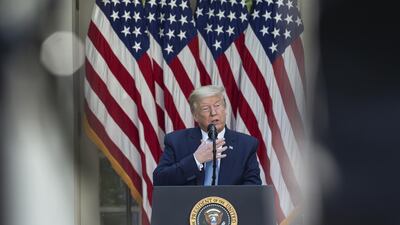

American democracy has been in big trouble for a long time, and it is rapidly deteriorating. Donald Trump, with his authoritarian tendencies, is certainly part of the problem. But he is even more a symptom of deeper weaknesses. Structural distortions ensured that although his opponent, Hillary Clinton, got almost three million more votes in the 2016 elections, he became the President. He could well be re-elected in November but has almost no path to winning the most votes this time either.
And there are more serious problems than the presidency going to the losing candidate. Accountability, rule of law and constitutional checks and balances are atrophying alarmingly. Several pending court rulings will strongly indicate how deep the rot now runs.
Let us start with the electoral college. Americans do not directly vote for the president but for a committee of electors who meet three weeks after the popular vote and formally elect the president. States try to control these electors’ votes, usually to enforce support for whichever candidate won a majority in that state.

Losing candidates like Mr Trump in 2016 can nonetheless become president because most states adopt a winner-take-all approach whereby whoever gets the most votes in a state wins all the electoral college votes of that state (which are apportioned according to population) regardless of how narrow that victory was. This formula meant that Mrs Clinton's national three million-vote victory at the polls translated into a clear defeat in the electoral college.
And it gets worse. This year, the Supreme Court will rule on states’ legal authority over "faithless electors” who vote for whoever they like regardless of the popular vote.
The trouble is that the Supreme Court’s conservative majority all claim to be either "originalists" or "textualists", supposedly guided by a law’s “original” meaning. Faithless electors are a perfect test of such supposed principles since no reading of constitutional history or texts leave any doubt that the founders of the US Constitution intended electors to vote according to their own judgments.
The Supreme Court majority may, and should, rule against "faithless electors", but when they do they will yet again reveal that their "originalist" rhetoric is a disingenuous proxy for a Republican Party-driven political agenda. An actual originalist ruling would force the country to reform these antiquated systems, which is the last thing Republicans would want.

That partisan stance will be even more clearly tested in several crucial cases that will do much to define the astounding immunity and impunity of the presidency that Mr Trump is brazenly claiming.
Several test the total immunity that Mr Trump is demanding for all of his subordinates from constitutional subpoenas. Former White House counsel Don McGahn has been subpoenaed by the Democratic-controlled House of Representatives but refuses to testify. The White House claims all executive branch staff, past and present, are entitled to ignore such subpoenas and effectively quash congressional fact-finding.
They concede that the House can impeach a president. But this would render that function meaningless by making most oversight practically impossible. Congress will not be able to discover whether impeachment is warranted or not.
The Supreme Court has returned this case to a lower court, but they will ultimately decide it one way or another, even by inaction.

And the Supreme Court is directly examining a second new privilege Mr Trump is claiming as President that is even more expansive and terrifying. New York state prosecutors are seeking, as part of a grand jury proceeding, to secure financial records involving Mr Trump, his associates and relatives, and his New York-based businesses from the accountants Mazars USA.
It is a fairly straightforward request, but Mr Trump asserts that, because the Justice Department argues that a sitting president cannot be charged with a crime while he is in office (although this has never been decided by a court), he therefore also cannot be investigated by any law enforcement officials either.
Such "absolute immunity" would apparently extend to a president’s past and present associates and businesses. They would all be beyond the reach of the most basic kind of legal investigation, including – as White House lawyers insisted in court – if a president were seen murdering someone in public.

In both of these cases, the Republican-appointed Supreme Court majority will instinctively want to protect Mr Trump. But they will have to also be concerned about the near-total impunity they would be handing any future president, free from all congressional and law enforcement investigation, inclusive of associates and former businesses.
Chief Justice John Roberts claims to be an "institutionalist" interested in the court's reputation, as well as an "originalist". These two cases will be the greatest test of those pretensions in his career thus far.
The court may try to split the difference by ruling against the Congress on subpoenas but against the President regarding his financial records.
In doing so, they would be gutting Congress' ability to check and balance a president through oversight, and delivering yet another hammer blow to basic structures of democracy.

But rulings from the administrations of Richard Nixon and Bill Clinton seem to clearly establish that presidents are indeed subject to some forms of investigation and litigation. If the court does not uphold the right of New York officials to access the financial information from Mazars, then the presidency will truly be above the law – and entirely and absolutely monarchical.
That is probably a step too far even for this court, at least for now.
The cynicism of such a ruling would be almost overwhelming, because should it be guided entirely by partisan politics and not constitutional law, these same justices would certainly be prepared to casually but completely reverse themselves if a Democratic president tried to assert any such ridiculously expansive privileges.

The Roberts court could rise above partisan politics by rejecting both of Mr Trump's outrageous claims. Sadly, a more likely scenario is that the court's conservative majority will hypocritically (but correctly) rule against "faithless electors", and defend the White House from congressional oversight while reiterating that a sitting president is not totally above the law.
Such a cynical compromise between creeping authoritarianism and lingering accountability would leave American democracy even more badly, but perhaps not yet mortally, wounded. Alas that is probably the best we can hope for at the moment.
Hussein Ibish is a senior resident scholar at the Arab Gulf States Institute in Washington

