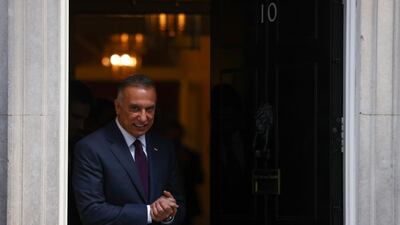

Iraq's Prime Minister Mustafa Al Kadhimi was in Europe last week with a simple but fiendishly difficult mission to accomplish.
Mr Al Kadhimi is a former spymaster with an acute sense of the challenges, expectations and resources in his command. He put it well himself in a briefing held on London’s Park Lane. “I dance on a daily basis with snakes but I am looking for a flute to control them,” he said with a knowing smile.
In the 15 years since Iraqi leaders began visiting London following the Saddam Hussein era, a long shadow has been cast by wars and conflict. What Mr Al Kadhimi represented this time round was someone Europeans could understand at a moment of reset.
-

Britain's Prime Minister Boris Johnson, left, welcomes the Prime Minister of Iraq, Mustafa Al Kadhimi to Downing Street in London. AP Photo -
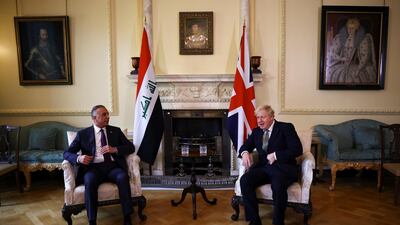
Boris Johnson meets with Mustafa Al Kadhimi at Downing Street. Reuters -

Mustafa Al Kadhimi leaves Downing Street after a meeting with Boris Johnson. Getty Images -
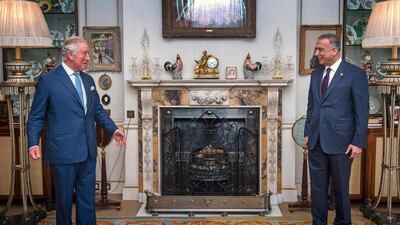
Britain's Prince Charles meets with Mustafa Al Kadhimi at Clarence House in central London. AFP -
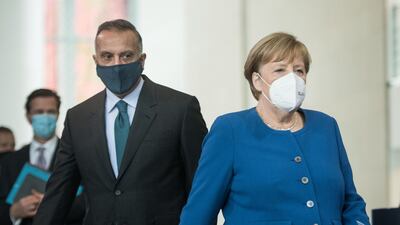
German Chancellor Angela Merkel and Mustafa Al Kadhimi arrive for a news conference at the Chancellery in Berlin, Germany. Reuters -
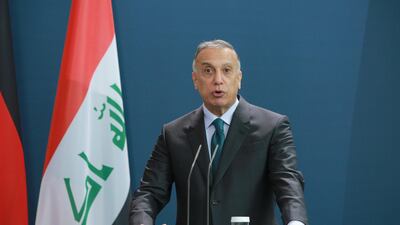
Mustafa Al Kadhimi speaks during a joint press conference with Angela Merkel in Berlin. EPA -
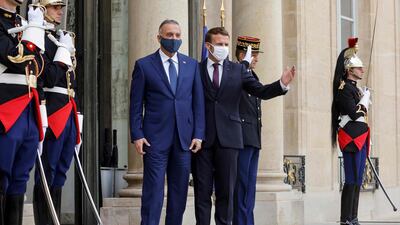
Mustafa Al Kadhimi is welcomed by France's President Emmanuel Macron ahead of a working lunch at the Elysee Palace in Paris. AFP -

French Prime Minister Jean Castex and look on as CEO of Alstom Henri Poupart-Lafarge and Iraqi Transport Minister Nasser Hussain Al Bandar sign documents during a signing ceremony at the Hotel de Matignon in Paris. AFP


Previous Iraqi prime ministers could travel abroad to have crisis talks and not much else. In the past decade, real business was done during Nouri Al Maliki’s talks about the deployment and exit of British forces – as there was with Haider Al Abadi discussing the anti-ISIS coalition.
This time round, Mr Al Kadhimi offered something new for Europeans to seek engagement on neglected strategic and economic issues. The Prime Minister was open about a “very high threshold of expectation” from Iraq’s youthful population as his government responds to popular demands.
He was candid that protests in Baghdad did not only stem from anger at economic issues and corruption. A strong stand against sectarian interests and overweening Iranian infiltration also powered the demonstrations.
The coffers were bare in May 2020 when he took over and he has given himself a June 2021 deadline to enact reforms before new elections. The backdrop is deep and prolonged shock to the world economy from Covid-19.
Iraq has powerful cards to play in the regional matrix. Baghdad is the only regional capital that can talk to all its neighbours in the framework of friendship. As Mr Al Kadhimi put it, Baghdad can mediate the “clandestine points of view” of all the countries around it. He added that Iraq can do so without preconceptions and fear of the other side. That offer could sound opaque but it is also a valuable skill set for the country.
Mr Al Kadhimi's perspective on the changing threat from ISIS is something that resonates strongly in European capitals.
On his first stop in Paris, talks with French President Emmanuel Macron came in the wake of the murder of teacher Samuel Paty by an extremist. The incident underlined the universality of ISIS extremism and Mr Al Kadhimi was able to make that point to Mr Macron.
The Iraqi Prime Minister is determined not to see his country pushed into choices against its will. The US and Iran wage a rivalry. But while Iraq is a key arena, it is not a pawn.
-

President Donald Trump speaks as he meets with Iraqi Prime Minister Mustafa al-Kadhimi in the Oval Office of the White House, Thursday, Aug. 20, 2020, in Washington. AP Photo -

US President Donald J. Trump (L) welcomes Iraqi Prime Minister Mustafa al-Kadhimi to the White House in Washington, DC, USA, 20 August 2020. EPA -

US President Donald J. Trump (R) waits to welcome Iraqi Prime Minister Mustafa al-Kadhimi (not pictured) to the White House in Washington, DC, USA, 20 August 2020. EPA -

US President Donald J. Trump (L) welcomes Iraqi Prime Minister Mustafa al-Kadhimi to the White House in Washington, DC, USA, 20 August 2020. EPA -

President Donald Trump meets with Iraqi Prime Minister Mustafa al-Kadhimi in the Oval Office of the White House, Thursday, Aug. 20, 2020, in Washington. Vice President Mike Pence, second from right, and Secretary of State Mike Pompeo, right, listen. AP Photo -

U.S. President Donald Trump speaks with Iraq's Prime Minister Mustafa al-Kadhimi as a translator listens in the Oval Office at the White House in Washington, U.S., August 20, 2020. REUTERS -

US President Donald Trump(R) meets with Iraqi Prime Minister Mustafa al-Kadhemi in the Oval Office of the White House in Washington, DC, August 20, 2020. AFP -

Mustafa al-Kadhimi, Iraq's prime minister, listens during a meeting with U.S. President Donald Trump, not pictured, in the Oval Office at the White House in Washington, D.C., U.S., on Thursday, Aug. 20, 2020. The U.S. is focused on working with Iraq to ensure it has enough resources to establish security forces that can protect the Iraqi people and are under sovereign control of Iraq, a senior administration official told reporters. Bloomberg


Support for Mr Al Kadhimi in Europe was strong. During his meeting with Angela Merkel, the leaders discussed how to support the Iraqi security forces. The ideas that Mr Al Kadhimi has around the primacy of the state under democratic control is fully supported by the European establishment.
One point that Mr Al Kadhimi makes is that issues of infiltration go far beyond armed groups to political parties, associations, community groups and actors. So a fresh start means a broad agenda that is in need of outside backing.
The appeal that Mr Al Kadhimi makes to the younger Iraqi demographic comes down to economics. Mrs Merkel made the point that she supported his efforts to build the people's confidence in state institutions through his reform agenda. She outlined measures to provide backing for Iraq in the areas of migration to address what compels people to leave their homeland.
-
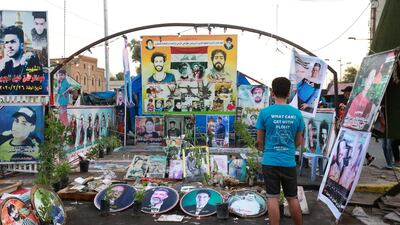
A protester stands next to the pictures of protesters who were killed in clashes with security forces during the anti-government protests at Tahrir Square in central Baghdad. EPA -
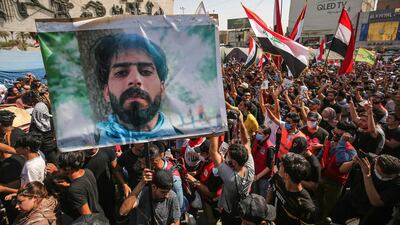
People hold up a picture of a slain protester as they gather with national flags for a demonstration in Tahrir Square in the centre of Iraq's capital Baghdad. AFP -
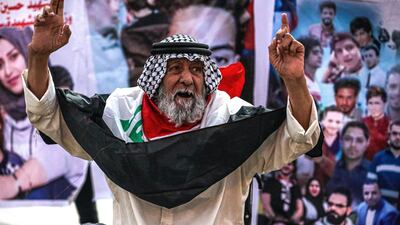
A demonstrator gestures during a protest to mark the first anniversary of the anti-government protests in Basra, Iraq on October 1, 2020. AP Photo -
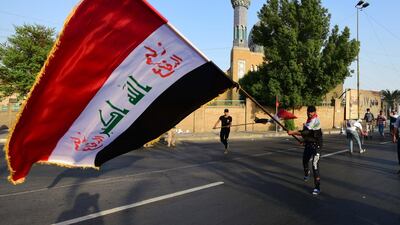
A protester waves the Iraqi national flag during a demonstration at the Al-Firdus square in central Baghdad. EPA -
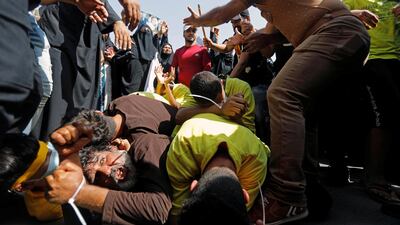
Demonstrators play the role of detainees as they gather to mark the first anniversary of the anti-government protests at Tahrir Square in Baghdad. Reuters -
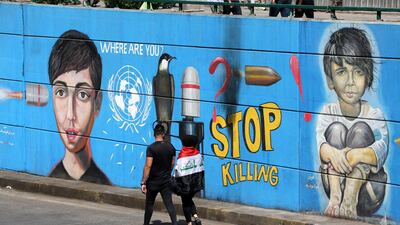
Protesters walk next to a wall with graffiti near Tahrir square in central Baghdad. EPA -
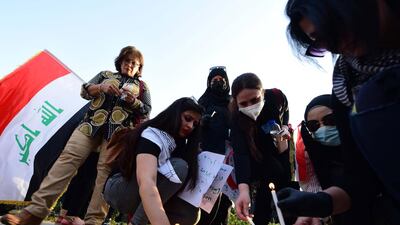
Women light candles and pray for the victims of protests at Tahrir Square in central Baghdad. EPA -
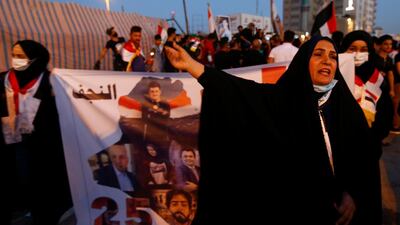
Demonstrators gather to mark the first anniversary of the anti-government protests, in Najaf, Iraq. Reuters -
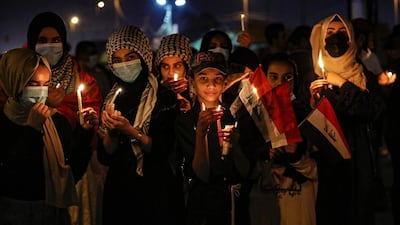
Demonstrators light candles to mark the first anniversary of the anti-government protests in Basra, Iraq. AP Photo -

A protester lights candles and prays for the victims of protests at Tahrir Square in central Baghdad. EPA -
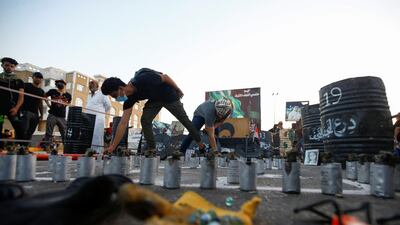
Men prepare torches as Iraqi demonstrators gather to mark the first anniversary of the anti-government protests, in Najaf. Reuters -
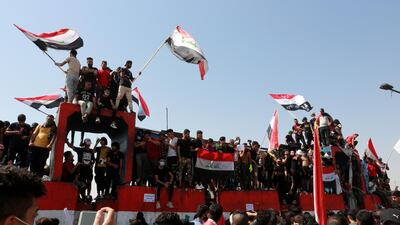
Protesters carry the Iraqi national flag as they stand on concrete blocks which are used by security forces to block the Al-Jumhuriya bridge, close to Tahrir square in central Baghdad. EPA -
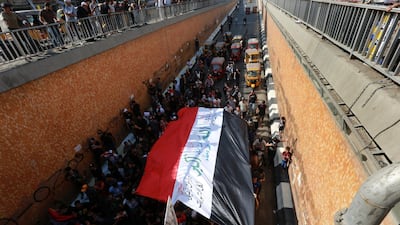
Iraqis carry the Iraqi national flag and chant slogans during a demonstration at Tahrir square in central Baghdad. EPA -
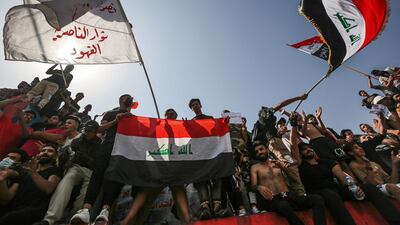
Protesters wave Iraqi national flags as they gather for a demonstration in Tahrir Square in the centre of Iraq's capital Baghdad. AFP -
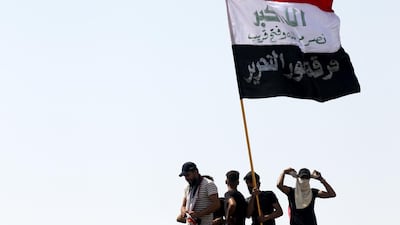
Iraqi protesters wave the national flag as they gather for a demonstration in Tahrir Square in the centre of Iraq's capital Baghdad. AFP


The German parliament is due to decide before the end of the month on the country’s military logistics support and training mission in Iraq. Germany’s long-serving Chancellor acknowledged that ISIS is not only a threat to Iraq but to her own country as well.
There was a strong message in favour of the economic reform ambitions presented by the Iraqi delegation in Berlin with political and business leaders.
Meanwhile in London, there was the first meeting of the Iraqi Economic Contact Group to push permanent initiatives. It is an effort to regularise how Iraq deals with big economies.
Baghdad has established financial institutions to leverage with counterparts in London. To have Mr Al Kadhimi as a chief executive capable of co-ordinating the country’s approach is an advantage.
The Prime Minister also met with Prince Charles and made new accords with the British Museum on the cultural heritage exchanges between both nations.
Looking at his own country, Mr Al Kadhimi saw the obvious mismatch between reliance on rents from the oil industry and ambitions of people in their 20s and 30s. The hunger for change is palpable. Mr Al Kadhimi has a strong vision of his country’s need to change. This is both a diplomatic and a political challenge.
Perhaps the last words should remain with the man himself. Mr Al Kadhimi recognised that he did not have tall pillars of political party support. Instead, he was a man on a tight rope between buildings. “I am not only on the wire but riding a bicycle to do it,” he said.
Europe’s job is to give him the tyres.
Damien McElroy is the London bureau chief of The National

