
Sometimes a tiny act of protest can make ripples that become big waves. In 1955 in Montgomery, Alabama, an African-American woman named Rosa Parks refused to give up her seat on a bus to a white man. This was in defiance of racist segregation laws. The result was a boycott of the buses organised by a young Christian minister called Martin Luther King Jr. One act of civil disobedience by one woman captured the imagination of millions, and helped end racial segregation in the US.
In Scotland another apparently tiny act of civil disobedience may – possibly – have profound consequences for the UK. In the southside of Glasgow a few local people objected when British Home Office enforcement officers arrived at a house in Kenmure Street to arrest two asylum seekers for deportation. It was just another day's work in an immigration crackdown by the hardline British Home Secretary, Priti Patel. Arrests and deportations usually proceed without fuss. But not in Glasgow. Not this week.
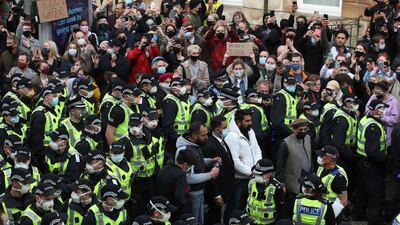
At first five or six people gathered around the enforcement officers’ detention van and stopped it leaving. A man crawled under the van and lay there for eight hours. He was wearing a light T-shirt and the weather was cold, so neighbours brought out blankets and hot water bottles. Then the chanting started: “Leave our neighbours. Let them go.”

The Scottish government does not control immigration policy and has been welcoming to migrants and refugees. But the Westminster government, which does control immigration, promised – in their words – a “hostile environment” to those considered illegal migrants. In Glasgow that resulted in a clash of political cultures.
The arrests took place on Eid Al Fitr in an ethnically mixed area. The two arrested men are Sikhs, but Muslims, Christians and those of no particular faith took part in the protest in an area that happens to be in the parliamentary constituency of Nicola Sturgeon, Scotland's First Minister. Her Scottish National Party (SNP) has just won a very toughly contested election on a programme that demands Scottish independence from precisely the kind of Westminster authorities behind the immigration raid.
Now, I should also declare an interest. I was born in Glasgow. I love Glasgow. Glaswegians call each other “Weegees", and part of this strong local pride meant that when the English politician Nigel Farage tried to stir up anti-migrant feeling in Glasgow a couple of years ago, he was very rudely rebuffed. Signs appeared ridiculing Mr Farage and welcoming refugees, many of them from Syria, Afghanistan and other majority Muslim countries. One popular sign said that Glasgow welcomes “Refu-Weegees", with a tagline in the Scottish dialect saying “We’re All Fae Somewhere” (“We are all from somewhere.”)
In Kenmure Street journalists appeared and were told that the immigration officials had “messed with the wrong city” and that the two arrested men were “part of the community". The Scottish police arrived too, but officers were quick to say that they were there only to keep things calm and peaceful. Their statement read: “Police Scotland does not assist in the removal of asylum seekers. Officers are at the scene to police the protest and to ensure public safety.”
Meanwhile, Scottish government ministers in Edinburgh tried to intervene but reported that they were ignored by Mrs Patel and other politicians in London. All this comes as relations between the Scottish government and Boris Johnson’s government are – to put it mildly – as chilly as lying in a Glasgow street in a T-shirt. Mr Johnson repeatedly disparages the SNP. They feel the same about him.
Back in Kenmure Street crowd members produced home-made banners that read "No One Is Illegal". And then, suddenly, the Scottish police decided to release the two detained men, with a senior police officer saying the decision was taken "to protect the safety, public health and well-being of those involved in the detention and subsequent protest".
In a world of horrors elsewhere, why should anyone care about a small, peaceful act of protest? Well, why did anyone care when an African-American woman refused to leave her bus seat back in 1955? We care because sometimes a tiny symbolic act reminds us that obeying the rules, obeying the law may be the mark of a civilised society – but not if the law itself is cruel or racist or imposed without consent and without common sense.
Ms Sturgeon tweeted her pride in leading “a country that welcomes and shows support to asylum seekers and refugees". Of course, we may find out that there is some important reason why the two men in the van should be deported from Britain. Alternatively, the events in Kenmure Street may have been a badly judged powerplay by a geographically remote government in London – a government remote from empathy too.
Yes, people should respect the law. But laws should respect people’s rights. I am cheered that in the place of my birth there are priorities beyond politics, beyond race, beyond religion – the common humanity of people standing up for their neighbours.
Gavin Esler is a broadcaster and UK columnist for The National

