What coronavirus numbers tell us about UK's social contract
A decade of Conservative-led government policies has produced nothing but inequalities across the country. This is being brutally exposed by the pandemic
Back in 2009, Britain was a different country. True, we were facing the problems of the financial crisis. But in the words of the then opposition leader David Cameron at his party conference, “we are all in this together". He promised that “if we pull together, come together, work together – we will get through this together". Mr Cameron claimed Britain’s economy, politics and society were “broken”.
A year later, he became prime minister. Despite being a decent and likeable fellow, he led the UK into a series of unforced errors – grave mistakes that have come to mean that in many ways, we are worse off than we were. We have not "come together". Quite the opposite.
David Cameron made mistakes that in many ways have made the country worse off than before he took over in 2010. Reuters
Competing nationalisms in Scotland and England mean that the future for the UK will be very tricky to navigate. Scotland's First Minister Nicola Sturgeon says that Prime Minister Boris Johnson has a mandate to take England out of the EU – but no mandate to do the same for Scotland. She wants another vote on Scottish independence.
Then there is Westminster politics. The new Labour leader Keir Starmer is off to a good start after the years of division within the opposition party under his predecessor, Jeremy Corbyn. But you might expect when faced with the common threat of coronavirus, while everyone wants Mr Johnson's government to keep people safe, help the sick and stop the deaths, the "coming together" is again coming apart.
Coronavirus is not an equal-opportunity killer.
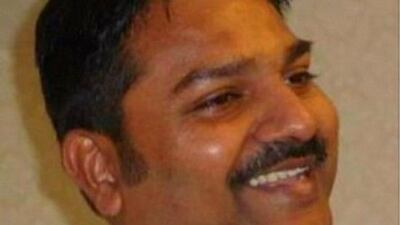
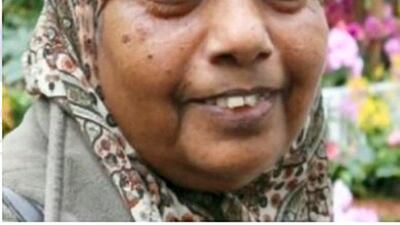
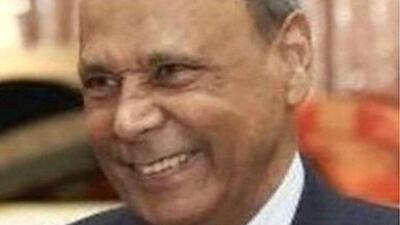
After 10 years of Conservative-led governments under Mr Cameron, Theresa May and now Mr Johnson, people with coronavirus in the country's poorest areas are dying at twice the rate of people in the richest areas. People of colour, most notably among our extraordinarily brave health workers, are dying at a much greater rate than white people in the same jobs.
BAME health workers who sacrificed their lives
Areema Nasreen
Amarante Dias
Ate Wilma Banaag
Rahima Bibi Sidhanee
Syed Zishan Haider
Alfa Saadu
Habib Zaidi
Adil el Tayar
The Office for National Statistics, or ONS – Britain's most trusted source of facts and figures – reckons there are about 55.1 deaths per 100,000 citizens in the most deprived tenth of England, whereas the figures in the least deprived tenth are 25.3 deaths in 100,000.
Those from BAME (Black, Asian, Minority Ethnic) backgrounds are significantly over-represented in the mortality figures. Newham – a less well-off area of London with a large BAME population – has reported 144.3 deaths per 100,000. The cities of Liverpool, Birmingham, Wolverhampton and Middlesbrough also have a high death rate with the virus. Of course, people in these cities are living more closely together.
Artwork thanking the NHS sits on a tree stump in Brighton, England. The NHS has been under-resourced for years. Getty Images
While similar Scottish and Welsh figures are not yet available, it is certainly true that living in the relatively under-populated Scottish highlands or North Wales makes it much less easy for the virus to spread. The ONS data is age-standardised, so age differences are taken into account.
There is nothing new in the idea that poorer people might not live as long as richer people. Some of the areas with a high death rate are very deprived. Poor nutrition, obesity, heart disease, smoking and other factors are undeniably involved. But it is also undeniable that the National Health Service has been under-resourced for years.
In a recent column, I wrote of a report by Professor Michael Marmot – one of Britain's leading experts on health inequalities – who said that over the past decade life expectancy in England has stalled for the first time in 100 years, and among English women living in the poorest communities life expectancy has declined since 2011.
Professor Marmot called it “shocking” that England had “lost a decade” in health care, which – you may think – coincidentally is the decade of Conservative-led governments. The rich-poor life expectancy gap in Britain is a difference of 9.5 years for men and 7.7 years for women.
For the immediate future, Britain needs to bring the death rate down and move towards reinvigorating the economy.
People sit in front of their home in Westminster, as the spread of the coronavirus continues, in London, UK on April 5, 2020. Reuters
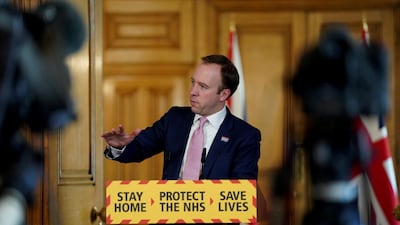
Britain's Health Secretary Matt Hancock holds a Covid-19 Digital Press Conference at 10 Downing Street in London, UK on April 5, 2020. 10 Downing Street handout via Reuters
A man exercises in Burgess Park, as the spread of the coronavirus continues, in London, UK on April 5, 2020. Reuters
People sunbathing on their balconies , as the spread of the coronavirus continues, in London, UK on April 5, 2020. Reuters
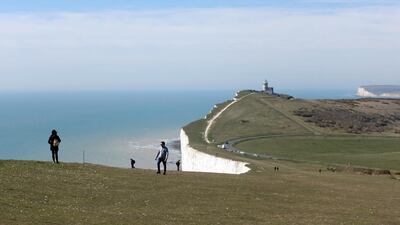
People walk along Beachy Head, as the spread of the coronavirus continues, near Eastbourne, East Sussex, UK on April 5, 2020. Reuters
Residents of Prospect Quay socially distance as they watch Pete Martelle perform an impromptu gig to his apartment block in Putney, as the spread of the coronavirus continues, in London, UK on April 5, 2020. Reuters
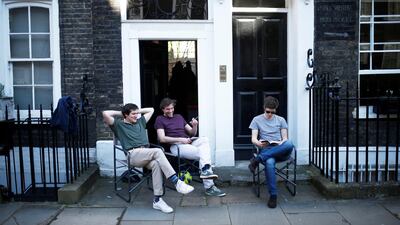
Jane, Ellie and Mason sit out the front of their house in Enfield, London, UK, on April 5, 2020. Reuters
The police talk to people in Clapham Common, London, UK on April 5, 2020. Reuters
People are tested at an NHS testing centre in Glasgow airport, as the spread of the coronavirus continues, in Glasgow, Scotland, UK on April 5, 2020. Reuters
A bus driver wearing a face mask is seen in London, UK on April 5, 2020. Reuters
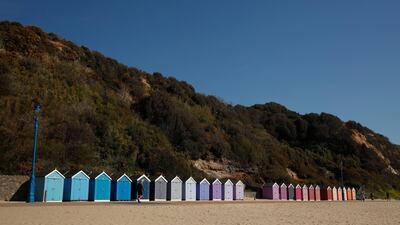
General view of beach huts on Bournemouth beach, in Bournemouth, UK on April 5, 2020. Reuters
Police are seen on Bournemouth beach, Bournemouth, UK on April 5, 2020. Reuters
Some in government, overburdened by the many pressures they face, seem to be disturbed by the idea that their efforts are being criticised. They are wrong. An honest debate is essential right now.
Scotland, Wales and Northern Ireland have all made it clear that they are not following entirely in lockstep behind Mr Johnson’s government, which many commentators and medical experts say was complacent, under-prepared and slow to understand the nature of the coronavirus threat.
For the medium term, we need to get back to something we might call “normal” – although what that will be, no one can say. And for the longer term, we as a nation need to take a long hard look in the mirror.
The rhetoric of being “all in this together” has been a convenient piece of political nonsense. Some of us are more “in it” than others. Death is a great leveller. Maybe our opportunities should be more level too. Rich, poor, white, people of colour, are all equally irreplaceable.
What we need is a new social contract involving governments, businesses and people to recognise in reality – and not just in glib political phrases – that we are all truly in this together.
Gavin Esler is a journalist, author and presenter

Race card
6.30pm: Al Maktoum Challenge Round-3 Group 1 (PA) US$100,000 (Dirt) 2,000m
6.30pm: Shahm, 7.05pm: Well Of Wisdom, 7.40pm: Lucius Tiberius, 8.15pm: Captain Von Trapp, 8.50pm: Secret Advisor, 9.25pm: George Villiers, 10pm: American Graffiti, 10.35pm: On The Warpath
The Uefa Nations League, introduced last year, has reached its final stage, to be played over five days in northern Portugal. The format of its closing tournament is compact, spread over two semi-finals, with the first, Portugal versus Switzerland in Porto on Wednesday evening, and the second, England against the Netherlands, in Guimaraes, on Thursday.
The winners of each semi will then meet at Porto’s Dragao stadium on Sunday, with the losing semi-finalists contesting a third-place play-off in Guimaraes earlier that day.
Qualifying for the final stage was via League A of the inaugural Nations League, in which the top 12 European countries according to Uefa's co-efficient seeding system were divided into four groups, the teams playing each other twice between September and November. Portugal, who finished above Italy and Poland, successfully bid to host the finals.
5pm: Maiden (PA) Dh80,000 1,200m
Winner: Ferdous, Szczepan Mazur (jockey), Ibrahim Al Hadhrami (trainer)
5.30pm: Arabian Triple Crown Round-3 Group 3 (PA) Dh300,000 2,400m
Winner: Basmah, Fabrice Veron, Eric Lemartinel
6pm: UAE Arabian Derby Prestige (PA) Dh150,000 2,200m
Winner: Ihtesham, Szczepan Mazur, Ibrahim Al Hadhrami
6.30pm: Emirates Championship Group 1 (PA) Dh1,000,000 2,200m
Winner: Somoud, Patrick Cosgrave, Ahmed Al Mehairbi
7pm: Abu Dhabi Championship Group 3 (TB) Dh380,000 2,200m
Winner: GM Hopkins, Patrick Cosgrave, Jaber Ramadhan
7.30pm: Wathba Stallions Cup Conditions (PA) Dh70,000 1,600m
Winner: AF Al Bairaq, Tadhg O’Shea, Ernst Oertel
Phishing: Fraudsters send an unsolicited email that appears to be from a financial institution or online retailer. The hoax email requests that you provide sensitive information, often by clicking on to a link leading to a fake website.
Smishing: The SMS equivalent of phishing. Fraudsters falsify the telephone number through “text spoofing,” so that it appears to be a genuine text from the bank.
Vishing: The telephone equivalent of phishing and smishing. Fraudsters may pose as bank staff, police or government officials. They may persuade the consumer to transfer money or divulge personal information.
SIM swap: Fraudsters duplicate the SIM of your mobile number without your knowledge or authorisation, allowing them to conduct financial transactions with your bank.
Identity theft: Someone illegally obtains your confidential information, through various ways, such as theft of your wallet, bank and utility bill statements, computer intrusion and social networks.
Prize scams: Fraudsters claiming to be authorised representatives from well-known organisations (such as Etisalat, du, Dubai Shopping Festival, Expo2020, Lulu Hypermarket etc) contact victims to tell them they have won a cash prize and request them to share confidential banking details to transfer the prize money.
Mercer, the investment consulting arm of US services company Marsh & McLennan, expects its wealth division to at least double its assets under management (AUM) in the Middle East as wealth in the region continues to grow despite economic headwinds, a company official said.
Mercer Wealth, which globally has $160 billion in AUM, plans to boost its AUM in the region to $2-$3bn in the next 2-3 years from the present $1bn, said Yasir AbuShaban, a Dubai-based principal with Mercer Wealth.
“Within the next two to three years, we are looking at reaching $2 to $3 billion as a conservative estimate and we do see an opportunity to do so,” said Mr AbuShaban.
Mercer does not directly make investments, but allocates clients’ money they have discretion to, to professional asset managers. They also provide advice to clients.
“We have buying power. We can negotiate on their (client’s) behalf with asset managers to provide them lower fees than they otherwise would have to get on their own,” he added.
Mercer Wealth’s clients include sovereign wealth funds, family offices, and insurance companies among others.
From its office in Dubai, Mercer also looks after Africa, India and Turkey, where they also see opportunity for growth.
Wealth creation in Middle East and Africa (MEA) grew 8.5 per cent to $8.1 trillion last year from $7.5tn in 2015, higher than last year’s global average of 6 per cent and the second-highest growth in a region after Asia-Pacific which grew 9.9 per cent, according to consultancy Boston Consulting Group (BCG). In the region, where wealth grew just 1.9 per cent in 2015 compared with 2014, a pickup in oil prices has helped in wealth generation.
BCG is forecasting MEA wealth will rise to $12tn by 2021, growing at an annual average of 8 per cent.
Drivers of wealth generation in the region will be split evenly between new wealth creation and growth of performance of existing assets, according to BCG.
Another general trend in the region is clients’ looking for a comprehensive approach to investing, according to Mr AbuShaban.
“Institutional investors or some of the families are seeing a slowdown in the available capital they have to invest and in that sense they are looking at optimizing the way they manage their portfolios and making sure they are not investing haphazardly and different parts of their investment are working together,” said Mr AbuShaban.
Some clients also have a higher appetite for risk, given the low interest-rate environment that does not provide enough yield for some institutional investors. These clients are keen to invest in illiquid assets, such as private equity and infrastructure.
“What we have seen is a desire for higher returns in what has been a low-return environment specifically in various fixed income or bonds,” he said.
“In this environment, we have seen a de facto increase in the risk that clients are taking in things like illiquid investments, private equity investments, infrastructure and private debt, those kind of investments were higher illiquidity results in incrementally higher returns.”
The Abu Dhabi Investment Authority, one of the largest sovereign wealth funds, said in its 2016 report that has gradually increased its exposure in direct private equity and private credit transactions, mainly in Asian markets and especially in China and India. The authority’s private equity department focused on structured equities owing to “their defensive characteristics.”
Public Service
Anchorage Daily News in collaboration with ProPublica
Breaking News Reporting
Staff of The Courier-Journal, Louisville, Ky.
Investigative Reporting
Brian M. Rosenthal of The New York Times
Explanatory Reporting
Staff of The Washington Post
Local Reporting
Staff of The Baltimore Sun
National Reporting
T. Christian Miller, Megan Rose and Robert Faturechi of ProPublica
and
Dominic Gates, Steve Miletich, Mike Baker and Lewis Kamb of The Seattle Times
International Reporting
Staff of The New York Times
Feature Writing
Ben Taub of The New Yorker
Commentary
Nikole Hannah-Jones of The New York Times
Criticism
Christopher Knight of the Los Angeles Times
Editorial Writing
Jeffery Gerritt of the Palestine (Tx.) Herald-Press
Editorial Cartooning
Barry Blitt, contributor, The New Yorker
Breaking News Photography
Photography Staff of Reuters
Feature Photography
Channi Anand, Mukhtar Khan and Dar Yasin of the Associated Press
Audio Reporting
Staff of This American Life with Molly O’Toole of the Los Angeles Times and Emily Green, freelancer, Vice News for “The Out Crowd”
LETTERS AND DRAMA
Fiction
"The Nickel Boys" by Colson Whitehead (Doubleday)
Drama
"A Strange Loop" by Michael R. Jackson
History
"Sweet Taste of Liberty: A True Story of Slavery and Restitution in America" by W. Caleb McDaniel (Oxford University Press)
Biography
"Sontag: Her Life and Work" by Benjamin Moser (Ecco/HarperCollins)
Poetry
"The Tradition" by Jericho Brown (Copper Canyon Press)
General Nonfiction
"The Undying: Pain, Vulnerability, Mortality, Medicine, Art, Time, Dreams, Data, Exhaustion, Cancer, and Care" by Anne Boyer (Farrar, Straus and Giroux)
and
"The End of the Myth: From the Frontier to the Border Wall in the Mind of America" by Greg Grandin (Metropolitan Books)
Music
"The Central Park Five" by Anthony Davis, premiered by Long Beach Opera on June 15, 2019