

In Syria these days, it seems that a historic loyalty to President Bashar Al Assad’s regime is not enough to keep you in favour. There must also be evidence of an adherence to the "new normal" that the country has found itself in.
It is an understatement to say that Syria has changed. After eight years of war, the forces of four foreign countries operate on its soil, countless lives have been lost, millions displaced, homes destroyed and unsurprisingly the economy has been equally devastated. And now there is the Covid-19 pandemic to contend with, the dangers of which Mr Al Assad warned about this week.
Added to this grim mosaic we have Rami Makhlouf and his astonishing Facebook video appeals over the past week. The Syrian billionaire accused regime security forces of detaining his employees and complained that his telecom company Syriatel is being "unjustly" billed by the government for about $186 million, a sum that he says he cannot pay.
Khaled Yacoub Oweis: Scandal strikes at heart of Alawite sect

There is feverish speculation that the public nature of Mr Makhlouf’s comments indicates that a power struggle is taking place. It also begs the question of specifically who Mr Makhlouf is trying to direct his messages to? Certainly not the public at large. Both online and offline there is much schadenfreude and very little sympathy in evidence for Mr Makhlouf and his troubles. Could it be that he no longer has a direct route of communication to the President?
Almost all the Makhlouf family, which according to reports at one time controlled 60 per cent of the Syrian economy, are subject to European Union and US sanctions. Their usefulness as the regime's "bankers" will have been eroded over recent years.
Also, a new class of wealthy businessmen has emerged thanks to the war. There is speculation that they are helping to drive the targeting of Mr Makhlouf’s interests. Furthermore, there are those observers who point to the ascendancy of Mr Al Assad’s wife Asma, that she might be cleaning house in anticipation of Syria one day rejoining the international community. Mr Makhlouf is a burdensome symbol of the negativity through which the regime is viewed and, unlike Mr Al Assad and his wife, expendable it seems.
Gareth Browne: How Russia wooed IRGC commander in Syria

It would be unwise to assume that his troubles may be evidence of the weakening of Mr Al Assad. In order to survive, brutal and repressive regimes need to be in flux; no one is allowed to feel comfortable. Fear is what binds. In Iraq, for example, Saddam Hussein was the only real constant for nearly a quarter century as henchmen rose and fell around him. His power never wavered until he was toppled by the US-led invasion in 2003. Mr Makhlouf’s crisis could prove just another phase of Mr Al Assad tightening his grip as he has done throughout the past decade.
In any case, speculation about the intrigue that may or may not be going on behind the scenes in Damascus misses the point that anyone inside the inner circle must acknowledge that Russia and Iran are the main power brokers now.
Outwardly at least, the Makhlouf clan has for some time appeared at odds with the new paradigm in Syria.
Khaled Yacoub Oweis: Rami Makhlouf – casualty of ruthless system

Think of what you know about who is in charge in Moscow and Tehran, and then ask yourself how well the flaunting of wealthy lifestyles on social media platforms by younger members of the Makhlouf clan would sit with them. Negative media coverage of the Assad regime in Russia is likely to be adding to the tension in Damascus.
Also, there is still a war going on. Ambassador James Jeffrey, the US envoy for Syria, calls Idlib – which is the last area of opposition to the Assad regime – the "crucible" of the conflict. American troops are operating in the area, and they share roads and skies with Russian and Turkish forces. It is a potential powder keg of a scenario. Meanwhile, Mr Jeffrey says Washington will "double our efforts" to support the drafting of a constitution and prepare the way for United Nations-backed elections.
A view from The National: Remember refugees this Ramadan
-
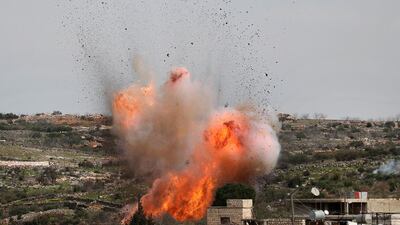
Warplanes attack the village of Al Bara in southern Idlib on March 5, 2020, a day before a ceasefire went into effect in the province. AFP -
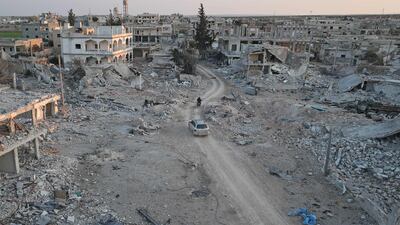
Destroyed buildings in Al Nayrab village, about 14 kilometres south-east of Idlib city. The city and its surroundings have suffered furious bombardment by Syrian forces and Russian jets since since December 2019. AFP -
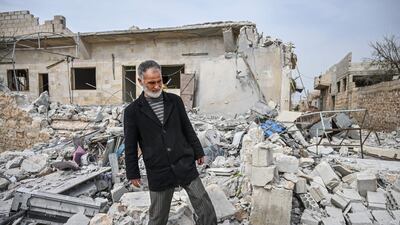
Malek Haj Khalil stands on the rubble of his home in Sarmin, about 8 kilometres south-east of Idlib city. AFP -
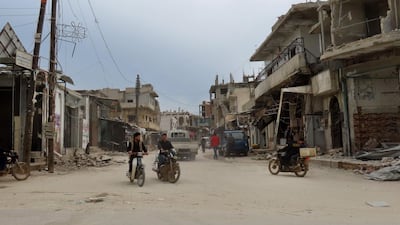
Syrians ride their motorcycles through a damaged neighbourhood in the town of Binnish in Idlib province. AFP -
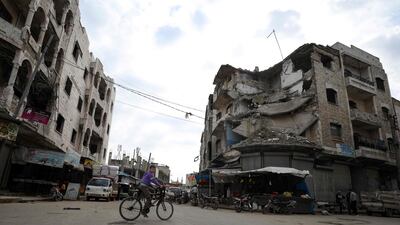
A boy rides his bicycle past damaged buildings in Idlib city. AFP -
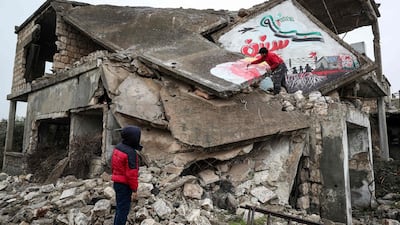
A boy watches as a man paints a mural on the roof of a collapsed building in Binnish to commemorate the ninth anniversary of the Syrian war. AFP -
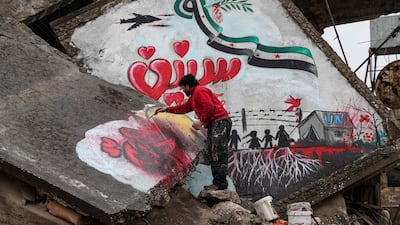
The mural shows a dove holding an olive branch in its beak flying over a Syrian opposition flag in the shape of the Arabic numeral 9, with the word 'years' below. AFP -

A mural on the wall of a destroyed school in Sarmin. The slogan refers to the Syrian government considering all rebels terrorists. AFP -

Like other towns in Idlib, Afis has sustained widespread destruction due to heavy fighting and air strikes. AFP -

A destroyed house in the village of Al Mastuma, about 7 kilometres south of Idlib city. AFP -
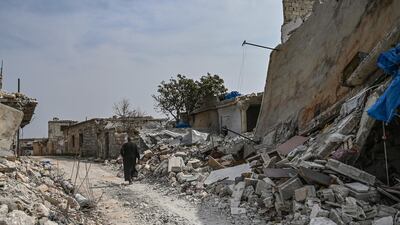
A man walks through a destroyed neighbourhood in Al Mastuma. AFP


Mr Jeffrey also argues that via sanctions "we are holding the regime accountable" for its crimes against its own civilians, including the use of chemical weapons and stopping the distribution of humanitarian aid. There is also the looming presence of Israel as it ramps up air strikes against Iranian targets in the country.
Given all that is going on, the fears and desires of Mr Makhlouf are of little real significance. More importantly, most of the people of Syria continue to suffer with little respite in sight. However, his situation does prompt wider questions.
Firstly, are international sanctions finally working? Squeezed between them and neighbouring Lebanon’s financial meltdown, the Assad regime is clearly being affected if it needs to push the likes of Mr Makhlouf into such a corner to access cash.
Kareem Shaheen: The war's ripple effect
The second big question is about reconstruction, should a political solution be found eventually. The World Bank estimates that the reconstruction effort in Syria will require nearly $400 billion. International donors are reluctant to commit to any funding as it stands, and Russia and Iran are not in a position to underwrite it either. Mr Al Assad would need to create a very attractive proposition to lure would-be investors.
Before now, Mr Makhlouf would have been poised to reap massive benefits from the rebuilding of Syria, as there was a time when little could happen economically without his involvement. But it is fair to say that he no longer will be so pivotal when reconstruction becomes a reality. That creates a vacuum for others to fill, which could prove useful for the Assad regime as it tries to win new allies and rebuild its tattered reputation.
Mustafa Alrawi is an assistant editor-in-chief at The National

