
While it has its charms, the London Wetland Centre is not a first-rank visitor attraction in a city bursting with international landmarks of culture and history. The wetlands do have a niche appeal, however, especially for families seeking a fun day out during the summer holiday period. So imagine how disconcerting it was to find that I could wander for huge sections a few days ago without seeing another patron.
The pandemic-triggered lockdown wiped out 20 per cent of the British economy in the first half of the year, although it has eased in recent months and the bounce-back in June was eight per cent.
As my trip to the wetlands in mid-August demonstrates, there is a powerful mental lock on people's outdoor movements. The Covid-19 death toll in the UK is among the highest in the world because the Conservative government waited just too long to trigger the stay-at-home message. There is a powerful correlation between the death toll at lockdown and the subsequent path of infection.
-
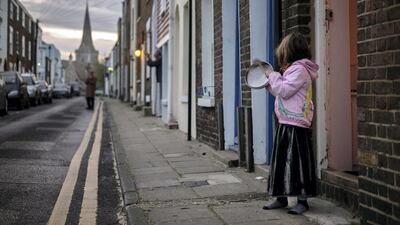
Neighbours clap for the NHS and other key workers. Danny Burrows -
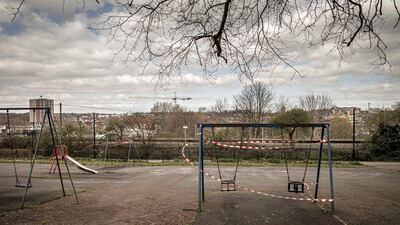
Taken on a bike ride round a local park in Bristol. Bill Ward Photography -
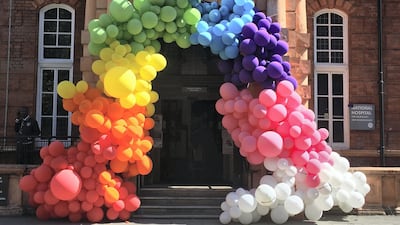
The rainbow balloon entrance at the National Hospital for Neurology and Neurosurgery. Historic England -
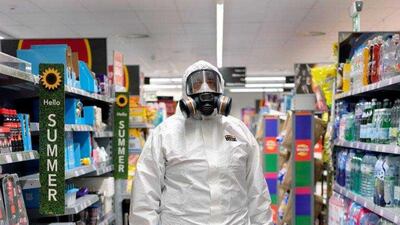
Shopping in Wolverhampton. Anand Chhabra -
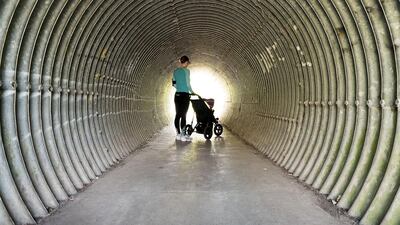
Photographed whilst enjoying some exercise during lockdown. Historic England -
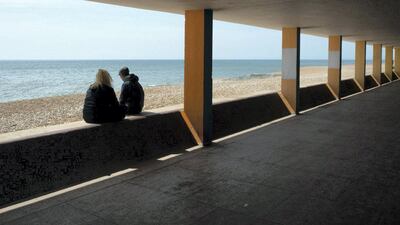
'Life in Lockdown' Bottle Alley, St Leonards-on-Sea. Chloe Dewe Mathews -
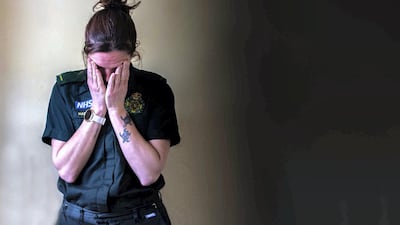
'Working more shifts, longer shifts, more emotionally draining shifts than ever before.' Historic England -
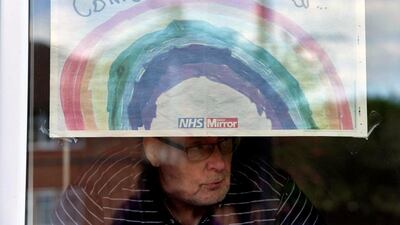
The rainbow became a symbol of honouring the NHS. Anand Chhabra -
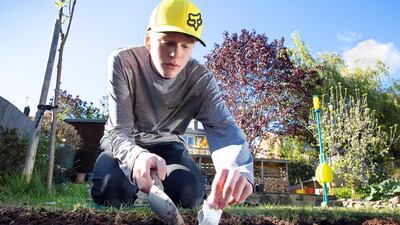
Owen Bull, just before his 14th birthday, planting vegetable seeds in the garden due to the difficulty in getting food deliveries during Covid 19 lockdown. Historic England -
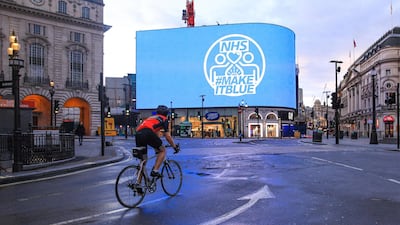
Piccadilly Circus in central London is usually packed with people and cars. Alla Bogdanovic -

This is the first week of lockdown when we first started the Joe Wicks PE sessions in the living room. Francesca Brecciaroli -
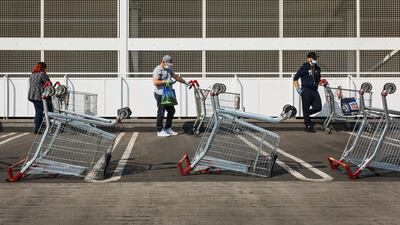
"It was the first time since the official lockdown I'd been able to visit the supermarket so the queuing outside was all new to me," said Michaela Strivens. Historic England


On the other side of the "sombrero-shaped" graph of the coronavirus caseload, the unwinding is fitful. More than its neighbours, the British economy has a lot of ground to make up. There is an undisguised race among countries to be at the forefront of the recovery. Unfortunately it is a race that even the magazine that Prime Minister Boris Johnson used to edit, The Spectator, last week declared his government was losing. Badly.
Much of British prosperity in recent decades was built on growth of the services sector following the relative eclipse of manufacture and raw materials. On top of that, a strong consumer bias within the economy made up for weakness in export-led sectors.
You might think that services are more easily adapted to the work-from-home shift than factory floor-reliant businesses in, say, Germany. But several factors turned that assumption on its head. For one, Germany found a combination of measures to ensure the outbreak was smaller. About four in five businesses did not shut down during the peak lockdown period.
Demand for the UK's services was also hard hit. Whatever happens from here, economists expect British retail sales to be one-quarter lower in 2020 than 2019.
The London Wetland Centre is a conservation hub but it provides a service. Every day it cannot open is a lost chunk of business. That its potential visitors are still reluctant to travel to its paths is an ongoing blow to its revenue.
A manicurist could only resume offering services on Saturday due to ongoing government curbs on specific sectors. Gyms have reopened but only under strictures of social distancing.
Journeys by car have finally returned to pre-crisis levels but this may be because risk-averse Britons are avoiding public transport. Thus actual levels of those on the move are still lower. Mobile phone data from around Europe shows the UK has the highest proportion of people at home during any given snapshot.
An effort to allow holidays abroad in countries designated for travel corridors has collapsed and the government is now facing the wrath of those in France, who are this weekend scrambling to get home after quarantine was suddenly reimposed.
Some businesses have adapted but it is questionable how viable new lines of activity are likely to be over the long run.
Turnbull and Asser, a central London tailor favoured by the dapper Prince Charles, turned its sewing machines to make personal protective equipment at the height of the hospital crisis. It is now selling vividly patterned face masks that resemble its distinctive cotton shirt range. The commuter mask sells for £45 while a tie from the firm sells for £133 and a made-to-measure shirt costs £245 before discounting.

Much attention has been given to opening schools and how restaurants can get back to business – one successful scheme has seen the government pick up part of the bill for eating out from Monday to Wednesday.
How to engineer a workplace-led resumption of normal life? Surveys have shown that only half of workers are back in the office and just 49 per cent of 2,000 employees surveyed last week expressed confidence in returning. In France, meanwhile, a full 84 per cent of employees are back.
The cumulative effect cannot be good. As the weeks elapse, it is hard to see how a snapback recovery can come about. And if it does not, investors could stop putting forward money in anticipation of growth. Faith in maintaining workers on the payroll as a smart strategy to anticipate the upturn will seep from employers. The drip, drip of lay-offs will further inhibit the prospect of recovery.
If there is a miracle rebound, it will have to come from government-led spending. According to theory, that means a rebalancing of the economy.
Upheaval looms while Britain is marooned in a cocooned state.
Damien McElroy is the London bureau chief of The National

