
With most European countries struggling to combat the coronavirus pandemic, the latest wave of terror attacks in several cities on the continent has provided an unwelcome reminder of the threat posed by Islamist militants.
And, to judge from the response of leading politicians to the upsurge in violence, there is a renewed determination to take a more robust approach in tackling the extremist ideology, a policy that, if not handled with care, risks alienating the majority of law-abiding Muslims who reside in the European Union.
After the recent attacks in the French cities of Paris and Nice, Austria has become the latest country to find itself the target of Islamist extremists after a 20-year-old gumnan killed four people and wounded 22 others before he was shot dead by police on Monday night.
-
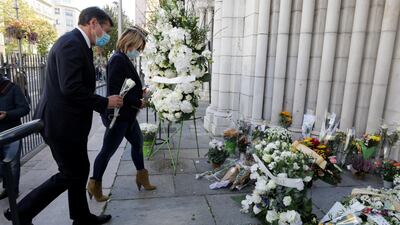
Mayor of Nice Christian Estrosi and his wife Laura pay tribute to the victims of a deadly knife attack at the Notre Dame church in Nice. Reuters -
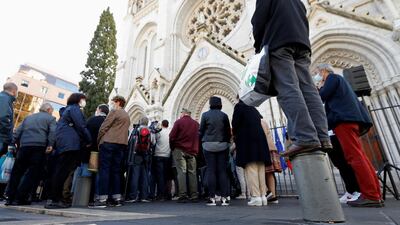
People gather in front of the Notre Dame church. Reuters -
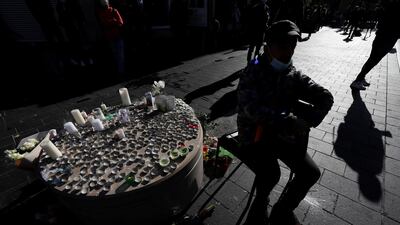
A man sits near candles and flowers placed in tribute to the victims. Reuters -
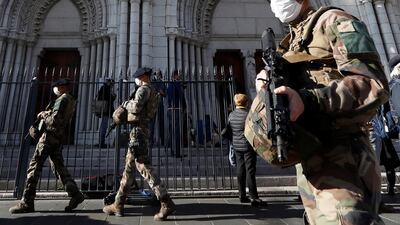
French soldiers patrol near the Notre Dame church. Reuters -
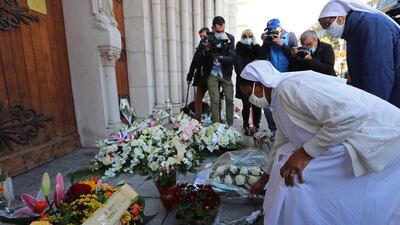
Two nuns lay flowers in front of the church in Nice. AFP -
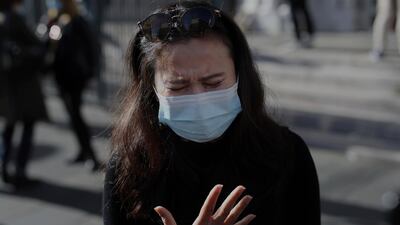
A woman cries as she speaks to reporters. AP Photo -
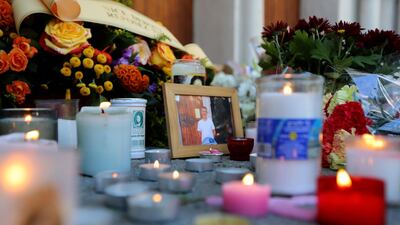
Tributes to one of the victims outside the church. AFP -
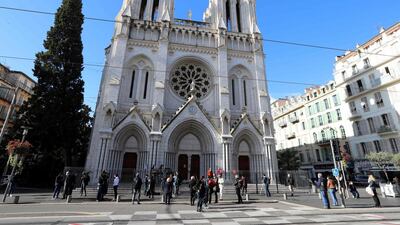
The scene outside the Notre Dame church on Friday morning. AFP -
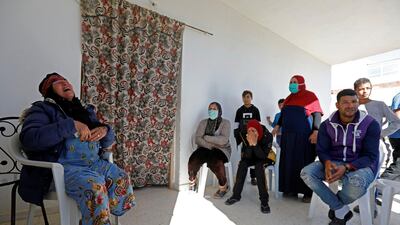
Gamra, the mother of Brahim Aouissaoui, who is suspected of carrying out Thursday's attack in Nice, reacts at her home in Tunisia. Reuters -

The Family home of Brahim Aouissaoui in Thina, a suburb of Sfax, Tunisia. Reuters


Armed with a pistol, a machete and a Kalashnikov-style assault rifle, the attacker, named as Kujtim Fejzulai, an Austrian citizen from the Vienna suburb of Modling, went on the rampage through the “party mile” of Vienna’s old town, targeting crowds enjoying a night out before the new virus lockdown.
Responding to the attack, Austrian Chancellor Sebastian Kurz has called on Europe to form a common front in what he calls a "war on Islamism". He says he will push for such an alliance during the European Leaders Meet this month.
Speaking to the German newspaper Die Welt, Mr Kurz said: "I expect an end to the misconceived tolerance, and for all the nations of Europe to finally realise how dangerous the ideology of political Islam is for our freedom and the European way of life."
Mr Kurz's call comes in the aftermath of French President Emmanuel Macron's uncompromising condemnation of extremists in the wake of the attacks in Paris and Nice.
After the Notre Dame basilica attack in Nice, in which three people were murdered by a Tunisian immigrant, Mr Macron vowed to continue the campaign against extremists, claiming that the attacks had been carried out in protest against “the values that are ours, for our taste for freedom, for this possibility on our soil to believe freely and not to give in to any spirit of terror. And I say it. with great clarity once again today: we will not give up".
-

Forensic police survey the scene of terrorist shootings in central Vienna, Austria, on Monday. AFP -

Austria's Interior Minister Karl Nehammer, centre,, the head of the Austrian Federal Police Franz Ruf, left, and Vienna police chief Gerhard Puerstl address a press conference in Vienna. AFP -

A broken plate lies on the ground next to chairs and tables of a cafe near Stephansplatz in Vienna after a shooting at several locations across central Vienna. AFP -

An unfinished piece of cake is seen on a table of a cafe near Stephansplatz in Vienna after terrorist shootings at several locations across central Vienna. AFP -
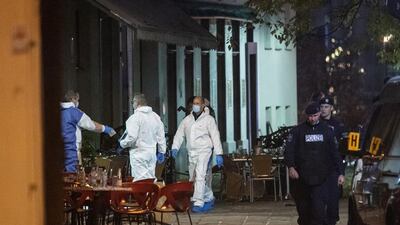
Forensic investigators at work after terrorist shootings in the first district of Vienna. EPA -

Armed police arrive at the first district near the state opera in central Vienna, following a shooting near a synagogue. AFP -

Austrian police gather after terrorist shootings in the first district of Vienna. EPA -

Police control a person at Mariahilferstrasse in central Vienna on November 2, 2020, following a shooting near a synagogue. AFP -

Armed police control a passage near the opera in central Vienna following a terrorist attack. AFP -

Armed police control a passage near the opera in central Vienna following a terrorist attack. AFP -

Armed policemen stand guard in a shopping street in the centre of Vienna following a terrorist attack. AFP -

Austrian police search two civilians in front of The Wiener Staatsoper following a terrorist attack. EPA -

Danish police secure the area near a synagogue in Copenhagen following a terrorist attack in the Austrian capital. AFP -

Armed policemen stand out of their car near the State Opera in the centre of Vienna following a terrorist attack. AFP -

Police block a street in Vienna city centre following terrorist shootings. Getty Images -

Heavily armed police speak to a passerby near the Vienna State Opera following a terrorist gun attack. Getty Images -

A man holds his hands up as police officers check him on a street after exchanges of gunfire in Vienna. Reuters -

Police officers check a person after gunshots were heard, in Vienna. Ronald Zak -

Austrian police guard visitor of The Wiener Staatsoper (Vienna State Opera) while they leave a metro station following gun attacks in the capital. EPA -

Austrian police guard a visitor while they leave The Wiener Staatsoper (Vienna State Opera) after a shooting near the Stadttempel synagogue in Vienna. EPA -

Heavily armed police stand near Schwedenplatz square in the city centre following reports of shots fired nearby. Getty Images -

An armed policeman outside the Interior Ministry in the centre of Vienna. AFP -

General Director for public safety Franz Ruf, Interior Minister Karl Nehammer and police chief of Vienna Gerhard Puerstl speak at a press conference. Getty Images -

Police special forces patrol after a shooting near the Stadttempel synagogue in Vienna, Austria. EPA -

Police cars patrol near Schwedenplatz square in Vienna following terrorist attacks in Austria's capital. Getty Images -

Heavily armed police stand near Schwedenplatz square in Vienna city centre following gun attacks across the Austrian capital on Monday. Getty Images


While it is true that many European countries – including France – have been reluctant to curb the activities of organisations such as Hamas and the Muslim Brotherhood in Europe, there are also measures that governments can undertake to prevent further attacks, such as improving their own security arrangements.
In Austria, for example, it emerged that the Vienna attacker had been released early from prison in December after serving two thirds of a 22-month term for trying to join ISIS in Syria. While the early evidence collected by the interior ministry suggests that the gunman acted alone, there are suspicions that he may have been in contact with extremists in other parts of Austria and neighbouring Switzerland. And even though Fejzulai was on a watch list by Austria’s BVT counterterrorism agency, he was still allowed to travel to Slovakia in July, where he bought assault rifle ammunition.

Questions about the effectiveness of security forces have also been raised by the Nice attack, where it now transpires that the terror suspect had arrived by train from Italy, which he had reached from Tunisia after being picked up by a humanitarian organisation in the Mediterranean.
The ease with which the Paris and Vienna attackers were able to operate inevitably raises questions about Europe’s open border policies as dictated by the Schengen Agreement.
But the uncompromising attitude of some European leaders to the latest terrorist incidents also raises fears that they might be in danger of over-reacting to the scale of the threat. Germany’s Free Democrats centre-right opposition party, for instance, has called on Chancellor Angelo Merkel to “stand firm” with her French and Austrian counterparts.
It is, however, important that leaders maintain a sense of proportion. After all, the overwhelming majority of the estimated 20 million Muslims residing in the EU are law-abiding citizens who have no interest in supporting the radical agenda espoused by militant groups. Any attempt to crack down on the extremists, therefore, must be done in a manner that does not alienate or disrupt the lives of this majority.

And, if Europe is about taking effective measures to stem the activities of extremists, then it should concentrate its focus on countries that support and encourage militant activities. Muslim Brotherhood, Hamas and Hezbollah would struggle to survive without the backing they receive from Turkey, Qatar and Iran. So Europe must start by holding these countries accountable for their actions.
For too long, Europe has turned a blind eye to the support these countries provide in the hope that, by maintaining a dialogue with them, they will be persuaded to mend their ways. It was mainly for this reason that the conclusions of a controversial report commissioned by the British government into the activities of the Muslim Brotherhood were never published.
Therefore, if Europe is really serious about tackling the militant threat, a good place to start would be to challenge the countries that provide them with the funds and support they need to flourish.
Con Coughlin is a defence and foreign affairs columnist for The National

