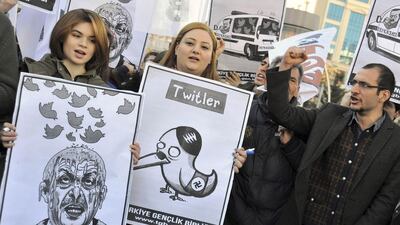
Turkish President Recep Tayyip Erdogan has many foes, but his greatest nemesis is not his freshly minted American counterpart Joseph Biden, his country's historic rival and neighbour Greece, or some meddling activist, journalist or opposition politician.
"This thing called social media is currently the worst menace to society," he said in 2013, as the Gezi Park protests raged across Turkey. The next year, he compared social media to "a murderer's knife".
Since the 2016 failed coup, Turkish authorities have all but eliminated independent voices from the media landscape. More than 250,000 websites have been blocked and 200 news outlets have been shuttered, including one that had been in business for less than a month. In the past five years, more than 3,400 journalists have been dismissed and 430 detained, according to a new report.
Social media has emerged as the primary remaining space for dissent, which explains why nearly 60 per cent of Turkish citizens get their news via social media and messaging apps and why such platforms – Twitter, in particular – are the bane of Mr Erdogan’s existence.
“We’ll eradicate Twitter,” the Turkish leader vowed in 2014, as reports of a massive corruption scandal shot around social media. “Everyone will witness the power of the Turkish Republic.”
Mr Erdogan's government has moved to muzzle discussions online almost since he came to power in 2003. Four years later, Turkish parliament passed a law regulating internet publications and an Ankara court blocked YouTube for criminal activity. Repeated blocks against Twitter, Whatsapp, Instagram and Wikipedia have followed.
As of early 2020, Turkish authorities had launched nearly 130,000 probes into insults against the president, most of them in response to social media posts. These investigations led to nearly 10,000 prison sentences, including 3,800 in 2019, an 87 per cent increase from the previous year. Turkey again led the world in Twitter censorship last year, with the most takedown requests, court orders and withheld tweets, according to Twitter’s latest Transparency Report, released earlier this month.
Yet despite all of this, the platforms have remained available in Turkey, enabling a new wave of critics to emerge after every crackdown. Until now.
Demonstrators shout slogans during a protest against a purge of thousands of education staff since an attempted coup in July, in front of the main campus of Istanbul University at Beyazit square in 2016. Reuters
Last July, Turkey passed a law requiring social media platforms with more than 1 million users to open an office within the country and be able to respond to Turkish government requests and court orders within 48 hours. Platforms that fail to establish a Turkish presence would face sizable fines followed by further government pressures.
Authorities levied 10m lira ($1.35m) fines against a swathe of platforms in November, spurring LinkedIn, YouTube, TikTok, Google and Dailymotion to follow the Russian site VKontakte in setting up an office in Turkey. A week ago, Facebook announced it would do the same, narrowly avoiding the advertising ban that went into effect the next day against Twitter, its video-streaming app Periscope and the image-sharing platform Pinterest.
Twitter is the most popular of these platforms, the most politically oriented and the one most used by activists and journalists driven out of more traditional channels. Thus, it is now the primary online battleground between the growing authoritarianism of the Turkish government and those who seek to expose its violations.
A fight for free speech online is also being waged in the US, where tech firms have moved to curb right-wing incitement in the wake of the Capitol siege. Within days of the attack, Facebook and Twitter locked then-president Donald Trump's accounts, followed by Snapchat and other platforms. Google, Apple and Amazon then moved to muzzle Parler, the chat app favoured by many of America's extreme right-wing voices. The EU has also begun enacting new policies to curb and control online content, particularly extremist views that could incite violence.
Shadi Ghanim's take on Twitter banning US President Donald Trump
Prominent critics have argued in response that government-backed Big Tech should not be able to control free speech, and indeed these efforts could provide Mr Erdogan with ammunition. Turkey’s leader could argue that if the US and Europe can take steps to stifle anti-democratic or anti-government voices, there should be no reason Turkey cannot do the same. Just as some have described the Capitol assault as a coup attempt, he might add, the Turkish government weathered a violent failed coup of its own and must ensure its own national security.
In fact, since the coup attempt Turkish officials and pro-government media have repeatedly suggested that the US was somehow behind the putsch, or at least supported it. Thus, any whiff of a link to the US puts one in bed with coup plotters and terrorists. The biggest social media platforms are, of course, American firms, and thus beyond the pale.
Earlier this month, after opposition Istanbul mayor Ekrem Imamoglu secured a traffic congestion grant from the US Trade and Development Agency, pro-government Sabah newspaper denounced the move with the headline “Istanbul’s data sold to the USA”. It’s all part of a narrative that portrays western governments and tech firms in cahoots to harness the world’s data for nefarious ends.
“The digital age has begun,” Mr Erdogan said last week. “Those who control data can establish their digital dictatorships by disregarding democracy, the law, rights and freedoms.”
Twitter chief Jack Dorsey backed the platform's ban of US President Donald Trump, but said it sets a 'dangerous' precedent. AFP
Turkish internet users have long been ahead of the curve, and may find ways to cope
The legal entities established in Turkey by social media platforms should expect to see a significant number of removal requests and court orders in the days ahead. Should they fail to comply, they are likely to be assessed significant fines and the possible shuttering of their Turkey office, which would leave them on the outside looking in.
That’s where Twitter is today, holding out in the face of a $1.17m fine, with more on the way, as well as the ad ban. If it continues to refuse to open a Turkey office, its bandwidth in Turkey will be reduced by 50 per cent in April, then by 95 per cent in May, essentially rendering its platform useless.
In a statement last week, Milena Buyum, Turkey Campaigner for rights watchdog Amnesty International, said the platforms that have complied with Turkey’s new regulations are “in serious danger of becoming an instrument of state censorship”.
The choice, then, is between accepting the Turkish government’s position and bowing to pressure to curtail free speech, or being forced out of Turkey, taking from Turks a crucial outlet for freedom of expression.
Turkey has become notorious in recent years for temporarily blocking access to popular sites, including Facebook and Twitter, in the wake of major events such as mass protests or terror attacks. Gary Cameron / Reuters
Turkish internet users have long been ahead of the curve, and may find ways to cope. They established one of the world’s first online dictionaries in 1999, a year and a half before Wikipedia. Today, Eksi Sozluk, as it is called, has over 2.8 million Twitter followers. They are known for finding ways around censorship, such as opening a new social media account, slightly tweaking the website URL or turning to Virtual Private Networks (VPNs), which disguise location and enable access to blocked platforms or websites.
But Turkish authorities have cracked down on VPNs, many of which are no longer accessible from Turkey, and now they are taking away social media, one by one. Will Twitter cave, like the others?
If it does, Mr Erdogan will have eliminated the primary remaining sanctuary for government critics, an invaluable achievement as he faces sagging support amid economic hardship. If Twitter holds its ground, the moment of truth will come in a few months, when the Turkish government will seek to squeeze the life out of its leader’s most troublesome foe.
David Lepeska is a Turkish and Eastern Mediterranean affairs columnist for The National

PROVISIONAL FIXTURE LIST
Premier League
Wednesday, June 17 (Kick-offs uae times) Aston Villa v Sheffield United 9pm; Manchester City v Arsenal 11pm
Friday, June 19 Norwich v Southampton 9pm; Tottenham v Manchester United 11pm
Saturday, June 20 Watford v Leicester 3.30pm; Brighton v Arsenal 6pm; West Ham v Wolves 8.30pm; Bournemouth v Crystal Palace 10.45pm
Sunday, June 21 Newcastle v Sheffield United 2pm; Aston Villa v Chelsea 7.30pm; Everton v Liverpool 10pm
Monday, June 22 Manchester City v Burnley 11pm (Sky)
Tuesday, June 23 Southampton v Arsenal 9pm; Tottenham v West Ham 11.15pm
Wednesday, June 24 Manchester United v Sheffield United 9pm; Newcastle v Aston Villa 9pm; Norwich v Everton 9pm; Liverpool v Crystal Palace 11.15pm
Thursday, June 25 Burnley v Watford 9pm; Leicester v Brighton 9pm; Chelsea v Manchester City 11.15pm; Wolves v Bournemouth 11.15pm
Sunday June 28 Aston Villa vs Wolves 3pm; Watford vs Southampton 7.30pm
Monday June 29 Crystal Palace vs Burnley 11pm
Tuesday June 30 Brighton vs Manchester United 9pm; Sheffield United vs Tottenham 11.15pm
Wednesday July 1 Bournemouth vs Newcastle 9pm; Everton vs Leicester 9pm; West Ham vs Chelsea 11.15pm
Thursday July 2 Arsenal vs Norwich 9pm; Manchester City vs Liverpool 11.15pm
Bob Honey Who Just Do Stuff
By Sean Penn
Simon & Schuster
Centre Court - from 4pm (UAE time)
Angelique Kerber (1) v Irina Falconi
Martin Klizan v Novak Djokovic (2)
Alexandr Dolgopolov v Roger Federer (3)
Court One - from 4pm
Milos Raonic (6) v Jan-Lennard Struff
Karolina Pliskova (3) v Evgeniya Rodina
Dominic Thiem (8) v Vasek Pospisil
Court Two - from 2.30pm
Juan Martin Del Potro (29) v Thanasi Kokkinakis
Agnieszka Radwanska (9) v Jelena Jankovic
Jeremy Chardy v Tomas Berdych (11)
Ons Jabeur v Svetlana Kuznetsova (7)
Stormy seas
Weather warnings show that Storm Eunice is soon to make landfall. The videographer and I are scrambling to return to the other side of the Channel before it does. As we race to the port of Calais, I see miles of wire fencing topped with barbed wire all around it, a silent ‘Keep Out’ sign for those who, unlike us, aren’t lucky enough to have the right to move freely and safely across borders.
We set sail on a giant ferry whose length dwarfs the dinghies migrants use by nearly a 100 times. Despite the windy rain lashing at the portholes, we arrive safely in Dover; grateful but acutely aware of the miserable conditions the people we’ve left behind are in and of the privilege of choice.
Emirates and Etihad fly to Johannesburg or Cape Town daily. Flights cost from about Dh3,325, with a flying time of 8hours and 15 minutes. From there, fly South African Airlines or Air Namibia to Namibia’s Windhoek Hosea Kutako International Airport, for about Dh850. Flying time is 2 hours.
The stay
Wilderness Little Kulala offers stays from £460 (Dh2,135) per person, per night. It is one of seven Wilderness Safari lodges in Namibia; www.wilderness-safaris.com.
Skeleton Coast Safaris’ four-day adventure involves joining a very small group in a private plane, flying to some of the remotest areas in the world, with each night spent at a different camp. It costs from US$8,335.30 (Dh30,611); www.skeletoncoastsafaris.com
Timeline
2012-2015
The company offers payments/bribes to win key contracts in the Middle East
May 2017
The UK SFO officially opens investigation into Petrofac’s use of agents, corruption, and potential bribery to secure contracts
September 2021
Petrofac pleads guilty to seven counts of failing to prevent bribery under the UK Bribery Act
October 2021
Court fines Petrofac £77 million for bribery. Former executive receives a two-year suspended sentence
December 2024
Petrofac enters into comprehensive restructuring to strengthen the financial position of the group
May 2025
The High Court of England and Wales approves the company’s restructuring plan
July 2025
The Court of Appeal issues a judgment challenging parts of the restructuring plan
August 2025
Petrofac issues a business update to execute the restructuring and confirms it will appeal the Court of Appeal decision
October 2025
Petrofac loses a major TenneT offshore wind contract worth €13 billion. Holding company files for administration in the UK. Petrofac delisted from the London Stock Exchange
Mercer, the investment consulting arm of US services company Marsh & McLennan, expects its wealth division to at least double its assets under management (AUM) in the Middle East as wealth in the region continues to grow despite economic headwinds, a company official said.
Mercer Wealth, which globally has $160 billion in AUM, plans to boost its AUM in the region to $2-$3bn in the next 2-3 years from the present $1bn, said Yasir AbuShaban, a Dubai-based principal with Mercer Wealth.
“Within the next two to three years, we are looking at reaching $2 to $3 billion as a conservative estimate and we do see an opportunity to do so,” said Mr AbuShaban.
Mercer does not directly make investments, but allocates clients’ money they have discretion to, to professional asset managers. They also provide advice to clients.
“We have buying power. We can negotiate on their (client’s) behalf with asset managers to provide them lower fees than they otherwise would have to get on their own,” he added.
Mercer Wealth’s clients include sovereign wealth funds, family offices, and insurance companies among others.
From its office in Dubai, Mercer also looks after Africa, India and Turkey, where they also see opportunity for growth.
Wealth creation in Middle East and Africa (MEA) grew 8.5 per cent to $8.1 trillion last year from $7.5tn in 2015, higher than last year’s global average of 6 per cent and the second-highest growth in a region after Asia-Pacific which grew 9.9 per cent, according to consultancy Boston Consulting Group (BCG). In the region, where wealth grew just 1.9 per cent in 2015 compared with 2014, a pickup in oil prices has helped in wealth generation.
BCG is forecasting MEA wealth will rise to $12tn by 2021, growing at an annual average of 8 per cent.
Drivers of wealth generation in the region will be split evenly between new wealth creation and growth of performance of existing assets, according to BCG.
Another general trend in the region is clients’ looking for a comprehensive approach to investing, according to Mr AbuShaban.
“Institutional investors or some of the families are seeing a slowdown in the available capital they have to invest and in that sense they are looking at optimizing the way they manage their portfolios and making sure they are not investing haphazardly and different parts of their investment are working together,” said Mr AbuShaban.
Some clients also have a higher appetite for risk, given the low interest-rate environment that does not provide enough yield for some institutional investors. These clients are keen to invest in illiquid assets, such as private equity and infrastructure.
“What we have seen is a desire for higher returns in what has been a low-return environment specifically in various fixed income or bonds,” he said.
“In this environment, we have seen a de facto increase in the risk that clients are taking in things like illiquid investments, private equity investments, infrastructure and private debt, those kind of investments were higher illiquidity results in incrementally higher returns.”
The Abu Dhabi Investment Authority, one of the largest sovereign wealth funds, said in its 2016 report that has gradually increased its exposure in direct private equity and private credit transactions, mainly in Asian markets and especially in China and India. The authority’s private equity department focused on structured equities owing to “their defensive characteristics.”
iPhone XS
With a 5.8-inch screen, it will be an advance version of the iPhone X. It will be dual sim and comes with better battery life, a faster processor and better camera. A new gold colour will be available. Price: Dh4,229
iPhone XS Max
It is expected to be a grander version of the iPhone X with a 6.5-inch screen; an inch bigger than the screen of the iPhone 8 Plus. Price: Dh4,649
iPhone XR
A low-cost version of the iPhone X with a 6.1-inch screen, it is expected to attract mass attention. According to industry experts, it is likely to have aluminium edges instead of stainless steel. Price: Dh3,179
Apple Watch Series 4
More comprehensive health device with edge-to-edge displays that are more than 30 per cent bigger than displays on current models.
Founder of the Muslim Brotherhood, Hassan al Banna, "accepted the political utility of violence"
Views of key Muslim Brotherhood ideologue, Sayyid Qutb, have “consistently been understood” as permitting “the use of extreme violence in the pursuit of the perfect Islamic society” and “never been institutionally disowned” by the movement.
Muslim Brotherhood at all levels has repeatedly defended Hamas attacks against Israel, including the use of suicide bombers and the killing of civilians.
Laying out the report in the House of Commons, David Cameron told MPs: "The main findings of the review support the conclusion that membership of, association with, or influence by the Muslim Brotherhood should be considered as a possible indicator of extremism."
Starring: Ramy Youssef, Steve Carell, Jason Schwartzman
Director: Jesse Armstrong
Rating: 3.5/5
The specs
Engine: 3.0-litre 6-cyl turbo
Power: 374hp at 5,500-6,500rpm
Torque: 500Nm from 1,900-5,000rpm
Transmission: 8-speed auto
Fuel consumption: 8.5L/100km
Price: from Dh285,000
On sale: from January 2022
The specs
Engine: 8.0-litre, quad-turbo 16-cylinder
Transmission: 7-speed auto
0-100kmh 2.3 seconds
0-200kmh 5.5 seconds
0-300kmh 11.6 seconds
Power: 1500hp
Torque: 1600Nm
Price: Dh13,400,000
On sale: now
Muslim Council of Elders condemns terrorism on religious sites
The Muslim Council of Elders has strongly condemned the criminal attacks on religious sites in Britain.
It firmly rejected “acts of terrorism, which constitute a flagrant violation of the sanctity of houses of worship”.
“Attacking places of worship is a form of terrorism and extremism that threatens peace and stability within societies,” it said.
The council also warned against the rise of hate speech, racism, extremism and Islamophobia. It urged the international community to join efforts to promote tolerance and peaceful coexistence.
How to volunteer
The UAE volunteers campaign can be reached at www.volunteers.ae , or by calling 800-VOLAE (80086523), or emailing info@volunteers.ae.
Checking: the obsession or thoughts focus on some harm coming from things not being as they should, which usually centre around the theme of safety. For example, the obsession is “the building will burn down”, therefore the compulsion is checking that the oven is switched off.
Contamination: the obsession is focused on the presence of germs, dirt or harmful bacteria and how this will impact the person and/or their loved ones. For example, the obsession is “the floor is dirty; me and my family will get sick and die”, the compulsion is repetitive cleaning.
Orderliness: the obsession is a fear of sitting with uncomfortable feelings, or to prevent harm coming to oneself or others. Objectively there appears to be no logical link between the obsession and compulsion. For example,” I won’t feel right if the jars aren’t lined up” or “harm will come to my family if I don’t line up all the jars”, so the compulsion is therefore lining up the jars.
Intrusive thoughts: the intrusive thought is usually highly distressing and repetitive. Common examples may include thoughts of perpetrating violence towards others, harming others, or questions over one’s character or deeds, usually in conflict with the person’s true values. An example would be: “I think I might hurt my family”, which in turn leads to the compulsion of avoiding social gatherings.
Hoarding: the intrusive thought is the overvaluing of objects or possessions, while the compulsion is stashing or hoarding these items and refusing to let them go. For example, “this newspaper may come in useful one day”, therefore, the compulsion is hoarding newspapers instead of discarding them the next day.
Source: Dr Robert Chandler, clinical psychologist at Lighthouse Arabia
