Sheikh Abdullah bin Zayed, UAE Minister of Foreign Affairs and International Co-operation, speaks to Donald Trump, US president at the time, and Israeli Prime Minister Benjamin Netanyahu in the Oval Office in September 2020. Ministry of Foreign Affairs and International Co-operation
Sheikh Abdullah bin Zayed, UAE Minister of Foreign Affairs and International Co-operation, meets Mike Pompeo, US secretary of state at the time. Wam
Sheikh Abdullah and Mr Pompeo in Washington. Wam
Sheikh Abdullah visits Washington in September last year. Wam
Sheikh Abdullah, UAE Minister of Foreign Affairs and International Co-operation, US President Donald Trump, centre, and Israeli Prime Minister Benjamin Netanyahu sign the Abraham Accord at the White House South Lawn. MOFAIC
Sheikh Abdullah and, from left, Bahrain's Foreign Minister Abdullatif Al Zayani, Israeli Prime Minister Benjamin Netanyahu and US President Donald Trump at the White House. MOFAIC
Sheikh Abdullah, Mr Al Zayani and Mr Netanyahu at the White House during the Abraham Accord signing ceremony. MOFAIC
Sheikh Abdullah and, from left, Mr Netanyahu, Mr Trump and Mr Al Zayani wave from the Truman Balcony at the White House. AFP
Sheikh Abdullah and, from left, Mr Al Zayani, Mr Netanyahu and Mr Trump sign the Abraham Accord. AFP
Sheikh Abdullah and, from left, Mr Al Zayani, Mr Netanyahu and Mr Trump after the signing ceremony. AFP
Sheikh Abdullah speaks from the Truman Balcony at the White House during the signing ceremony of the Abraham Accord. AFP
Sheikh Abdullah speaks as Mr Trump looks on before the signing of Abraham Accord on the South Lawn of the White House. AP
Sheikh Abdullah looks on from the White House as Mr Trump speaks at the Abraham Accord signing ceremony, also attended by Mr Al Zayani and Mr Netanyahu. AP
Sheikh Abdullah bin Zayed, UAE Minister of Foreign Affairs and International Co-operation, Israeli Prime Minister Benjamin Netanyahu, left, and Bahraini Foreign Minister Abdullatif Al Zayani stand on the Blue Room Balcony during the signing ceremony. AP
Sheikh Abdullah and Mr Al Zayani shortly before participating in the signing of the Abraham Accord. AFP
Sheikh Abdullah, with Mr Netanyahu, left, and Mr Al Zayani at the signing of the Abraham Accord on the South Lawn of the White House. AFP
US President Donald Trump speaks from the Truman Balcony at the White House during the signing ceremony of the Abraham Accord. AFP
President Donald Trump walks to the Abraham Accord signing ceremony at the White House with Sheikh Abdullah bin Zayed, UAE Minister of Foreign Affairs and International Co-operation, Israeli Prime Minister Benjamin Netanyahu, and Bahrain's Foreign Minister Abdullatif Al Zayani. AP
US Secretary of State Mike Pompeo arrives at the White House to attend the Abraham Accord signing ceremony hosted by President Donald Trump. EPA
Sheikh Abdullah bin Zayed, UAE Minister of Foreign Affairs and International Co-operation, meets US President Donald Trump in the Oval Office of the White House before the signing of Abraham Accord. AFP
Sheikh Abdullah bin Zayed, UAE Minister of Foreign Affairs and International Co-operation, in the Oval Office. AFP
Sheikh Abdullah bin Zayed, UAE Minister of Foreign Affairs and International Co-operation, meets US President Donald Trump in the Oval Office of the White House. AFP
Sheikh Abdullah with Mr Trump in the Oval Office. AFP
Sheikh Abdullah bin Zayed, UAE Minister of Foreign Affairs and International Co-operation, with by President Donald Trump at the White House. Mustafa Alrawi / The National
The UAE delegation led by Sheikh Abdullah bin Zayed, Minister of Foreign Affairs and International Co-operation, with US President Donald Trump at the White House. Mustafa Alrawi / The National
Sheikh Abdullah bin Zayed, UAE Minister of Foreign Affairs and International Co-operation, is welcomed to the White House by US President Donald Trump. EPA
Sheikh Abdullah and Mr Trump outside the White House. AFP
Sheikh Abdullah bin Zayed speaks to Mr Trump after arriving at the White House. Reuters
White House Senior Adviser Jared Kushner walks away following a television interview on the North Lawn at the White House in Washington. Reuters
US President Donald Trump and First Lady Melania Trump welcome the arrival of Prime Minister of Israel Benjamin Netanyahu and his wife Sara on the North Lawn of the White House in Washington DC. AFP
A delegation of senior UAE officials led by Sheikh Abdullah bin Zayed, UAE Minister of Foreign Affairs and International Co-operation, prepares to depart for the White House to sign the Abraham Accord. MOFAIC
US President Donald Trump welcomes Bahraini Foreign Minister Abdullatif Al Zayani. AFP
Bahraini Foreign Minister Abdullatif Al Zayani arrives at the White House in Washington DC. AFP
US President Donald Trump welcomes Bahraini Foreign Minister Abdullatif Al Zayani on the North Lawn of the White House in Washington, DC. AFP
Preparations at the White House for the signing of the Abraham Accord.
Preparations under way at the White House for the signing of the Abraham Accord.
Preparation at the White House for the signing of the Abraham Accord. The National
In the four years since he entered the White House, US President Donald Trump has been at the heart of numerous controversies. From the initial claims that his 2016 election victory was the result of Russian meddling, to more recent accusations that his administration has failed to meet the challenge of the coronavirus pandemic, Mr Trump can rightfully claim to be the most controversial occupant of the Oval Office the American presidency has ever witnessed.
This is no doubt an accolade that Mr Trump, whose approach to politics owes much to his previous experience as a successful television personality, would be happy to accept.
But while the endless controversies over the rights and wrongs of his approach to various issues have dominated most of the headlines during his presidency, this has resulted in less attention being paid to equally important aspects of his administration, such as the revival in America's economic fortunes – at least until the arrival of Covid-19 – as well as his unconventional approach to world affairs, where it could be argued that his administration has notched up several notable achievements.
This is particularly true in the Middle East, where Mr Trump’s novel approach to a number of challenges that have plagued previous American administrations has achieved a modicum of success. From the moment he entered the White House, Mr Trump made it clear to all and sundry that he would be adopting a very different approach to his predecessors when it came to addressing the region’s many challenges.
For a start, his "America First" approach meant that Washington would no longer support and sustain the large-scale military interventions that had become the norm since the September 11 attacks in 2001. Mr Trump's priority, instead, has been to focus all his attention on withdrawing American forces from the region at the earliest possible opportunity, with the result that his presidency has witnessed significant reductions in the number of US service personnel based in the region.
The policy has not been without controversy. The resignations of former defence secretary James Mattis and former national security adviser John Bolton were prompted primarily by Mr Trump's insistence on pursuing his withdrawal policy, thereby ending America's involvement in conflicts in countries such as Iraq and Afghanistan, which the White House claims has cost the American taxpayer an astronomical $7 billion.
At the same time the Trump administration has also invested an enormous amount of energy in addressing the key underlying causes of conflict in the region, namely Iran, ISIS, the Taliban and the Arab-Israeli discord.
It could be argued that, had it not been for the political capital the White House has invested in reviving the moribund Middle East peace process, this week's historic meeting between Sheikh Abdullah bin Zayed, Minister of Foreign Affairs and International Co-operation, and Gabi Ashkenazi, his Israeli opposite number, in Berlin may never have taken place. Instead, thanks to the unstinting efforts of Jared Kushner, the President's son-in-law, Washington's commitment to the process has resulted in the UAE, together with Bahrain, signing the Abraham Accords, a move Sheikh Abdullah said should help to "strengthen international stability".
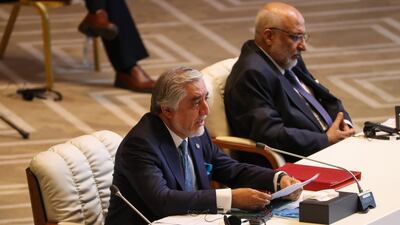
Abdullah Abdullah, chairman of Afghanistan's High Council for National Reconciliation, speaks at the opening session of the peace talks with the Taliban in the Qatari capital Doha. AFP
US Secretary of State Mike Pompeo speaks during the opening session of the peace talks between the Afghan government and the Taliban in the Qatari capital Doha. AFP
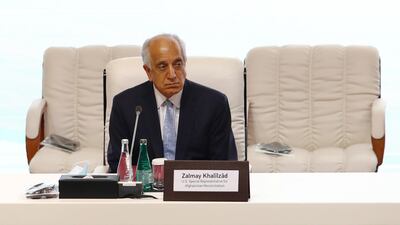
Zalmay Khalilzad, the US envoy for peace in Afghanistan, awaits the opening of talks between the Afghan government and Taliban insurgents in Doha. Reuters
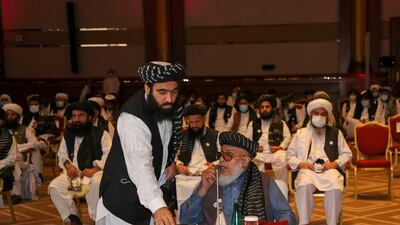
Mullah Abdul Ghani Baradar, the leader of the Taliban delegation, speaks at the launch of peace talks with the Afghan government in Doha, Qatar. REUTERS
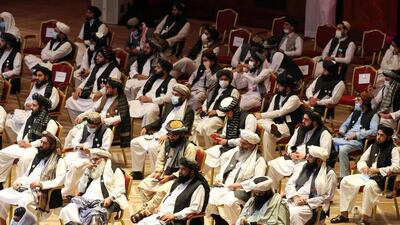
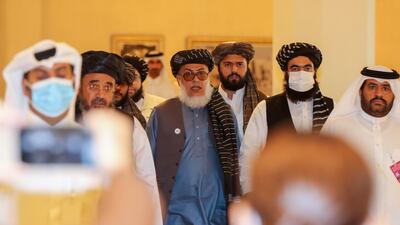
Members of the Taliban delegation attend the opening session of the peace talks with the Afghan government in Doha. AFP
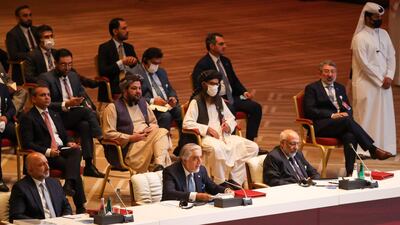
Abdullah Abdullah, centre, chairman of Afghanistan's High Council for National Reconciliation, speaks the opening session of the peace talks between the Afghan government and the Taliban in the Qatari capital Doha. AFP
Taliban negotiator Abbas Stanikzai, centre, arrives for the opening session of the peace talks between the Afghan government and the Taliban. AFP
Abdullah Abdullah arrives at the talks venue with the government delegation. AFP
Taliban negotiator Abbas Stanikzai, seated, attends the opening session of the peace talks with the Afghan government. AFP
Indeed, it could be argued that Mr Trump’s decisive action has redefined the map of the Middle East, drawing a distinction between governments that uphold the virtues of moderation and stability, and those – such as Iran, Turkey and Syria – that seek to sow discord and unrest.
Washington's peace initiative with the Taliban is another area where the Trump administration's very different approach to Afghanistan's long-running civil war has surprised its critics. The negotiations between the Taliban and the Afghan government still have a long way to go before a comprehensive peace agreement is signed. But the fact that Washington has been able to sign an accord with the Taliban, with the prospect of ending two decades of continuous conflict, is nevertheless a significant achievement – and one that will enable Mr Trump to fulfil his pledge to reduce America's military presence in the country.
Iranian commander Qassem Suleimani was killed in a US air strike in January. AP Photo
The other compelling feature of Mr Trump's approach to the challenges facing the modern Middle East is that, while investing heavily in numerous peace initiatives, his administration has been uncompromising in its dealings with America's foes. In this context, Washington's response to the challenge posed by Iran and ISIS, in particular, have had a dramatic impact on their ability to harm America's interests.
The Trump administration's decision to withdraw from the flawed nuclear deal with Iran and re-impose sanctions against the regime has had a devastating impact on Tehran's ability to meddle in the affairs of its Arab neighbours. With the Iranian economy crippled by the sanctions, the regime no longer has the resources available to continue financing its terrorist infrastructure throughout the region at the same level it did previously.
ISIS leader Abu Bakr Al Baghdadi. Al Furqan Media via AP
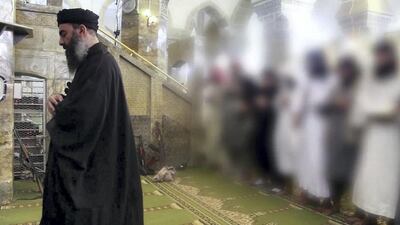
This July 5, 2014 photo shows an image grab taken from a propaganda video released by Al Furqan Media showing Abu Bakr Al Baghdadi addressing Muslim worshippers at a mosque in the militant-held northern Iraqi city of Mosul. AFP
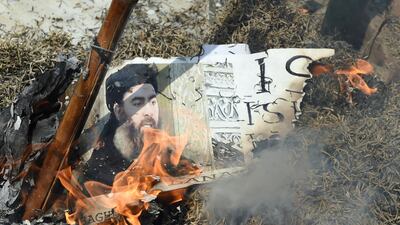
Indian Shiite Muslim demonstrators burn an effigy of ISIS leader Abu Bakr Al Baghdadi during a protest in New Delhi on June 9, 2017, after twin attacks by ISIS on Iran's parliament and the tomb of the republic's revolutionary founder. AFP
A handout picture released by the Iraqi Ministry of Interior shows a photograph purportedly of Abu Bakr Al Baghdadi. AFP
An image grab taken from a propaganda video released on July 5, 2014 by Al Furqan Media shows Abu Bakr Al Baghdadi leading prayers at a mosque in the militant-held northern Iraqi city of Mosul. AFP
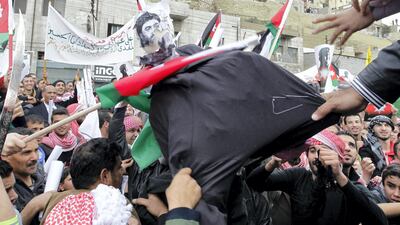
Jordanian protesters tear at a dummy representing Abu Bakr Al Baghdadi during a demonstration on February 6, 2015 in the capital Amman in solidarity with a Jordanian pilot murdered by the extremist group. AFP
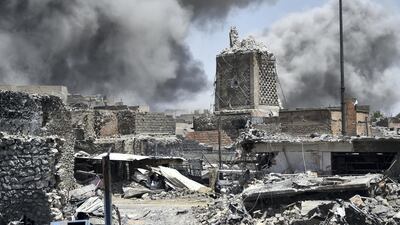
Smoke billows behind Mosul's destroyed ancient leaning minaret, known as the "Hadba" (Hunchback), in the Old City on June 30, 2017, after the area was retaken by the Iraqi forces from ISIS fighters. Explosions destroyed the mosque where Abu Bakr Al Baghdadi gave his first sermon as leader of ISIS. AFP
The carefully targeted assassination of Quds Force commander Qassem Suleimani in January also dealt a significant blow to Tehran’s ability to destabilise the region. Similarly, the targeted campaign against ISIS has seen the movement’s attempts to establish its so-called caliphate in Iraq and Syria reduced to rubble.
Instead of spreading terror throughout the region, the organisation is on the run, while the architects of its reign of terror, such as Abu Bakr Al Baghdadi, have either been killed or face being brought to justice, as is the case with the two British extremists known as "The Beatles" who have now been flown to the US to stand trial for their crimes.
Mr Trump’s presidency may have enjoyed its fair share of controversy but, so far as the Middle East is concerned, it should be seen as a measure of his success that America’s enemies in the region are desperately hoping that he loses next month’s presidential election.
Con Coughlin is a defence and foreign affairs columnist for The National

Soft power was first mentioned in 1990 by former US Defence Secretary Joseph Nye. He believed that there were alternative ways of cultivating support from other countries, instead of achieving goals using military strength. Soft power is, at its root, the ability to convince other states to do what you want without force. This is traditionally achieved by proving that you share morals and values.
Dubai launched the pilot phase of its real estate tokenisation project last month.
The initiative focuses on converting real estate assets into digital tokens recorded on blockchain technology and helps in streamlining the process of buying, selling and investing, the Dubai Land Department said.
Dubai’s real estate tokenisation market is projected to reach Dh60 billion ($16.33 billion) by 2033, representing 7 per cent of the emirate’s total property transactions, according to the DLD.
Houthis: Iran-backed rebels who occupy Sanaa and run unrecognised government
Yemeni government: Exiled government in Aden led by eight-member Presidential Leadership Council
Southern Transitional Council: Faction in Yemeni government that seeks autonomy for the south
Habrish 'rebels': Tribal-backed forces feuding with STC over control of oil in government territory
What sanctions would be reimposed?
Under ‘snapback’, measures imposed on Iran by the UN Security Council in six resolutions would be restored, including:
An arms embargo
A ban on uranium enrichment and reprocessing
A ban on launches and other activities with ballistic missiles capable of delivering nuclear weapons, as well as ballistic missile technology transfer and technical assistance
A targeted global asset freeze and travel ban on Iranian individuals and entities
Authorisation for countries to inspect Iran Air Cargo and Islamic Republic of Iran Shipping Lines cargoes for banned goods
Living in...
This article is part of a guide on where to live in the UAE. Our reporters will profile some of the country’s most desirable districts, provide an estimate of rental prices and introduce you to some of the residents who call each area home.
Syria v Australia
2018 World Cup qualifying: Asia fourth round play-off first leg
Venue: Hang Jebat Stadium (Malacca, Malayisa)
Kick-off: Thursday, 4.30pm (UAE)
Watch: beIN Sports HD
* Second leg in Australia scheduled for October 10
How to apply for a drone permit
Individuals must register on UAE Drone app or website using their UAE Pass
Add all their personal details, including name, nationality, passport number, Emiratis ID, email and phone number
Upload the training certificate from a centre accredited by the GCAA
Submit their request
What are the regulations?
Fly it within visual line of sight
Never over populated areas
Ensure maximum flying height of 400 feet (122 metres) above ground level is not crossed
Users must avoid flying over restricted areas listed on the UAE Drone app
Only fly the drone during the day, and never at night
2017: Golden State bt Cleveland 4-1
2016: Cleveland bt Golden State 4-3
2015: Golden State bt Cleveland 4-2
2014: San Antonio bt Miami 4-1
2013: Miami bt San Antonio 4-3
2012: Miami bt Oklahoma City 4-1
2011: Dallas bt Miami 4-2
2010: Los Angeles Lakers bt Boston 4-3
2009: Los Angeles Lakers bt Orlando 4-1
2008: Boston bt Los Angeles Lakers 4-2
The Voice of Hind Rajab
Starring: Saja Kilani, Clara Khoury, Motaz Malhees
Director: Kaouther Ben Hania
Rating: 4/5
England Test squad
Ben Stokes (captain), Joe Root, James Anderson, Jonny Bairstow, Stuart Broad, Harry Brook, Zak Crawley, Ben Foakes, Jack Leach, Alex Lees, Craig Overton, Ollie Pope, Matthew Potts
Starring: Baneen Ahmad Nayyef, Waheed Thabet Khreibat, Sajad Mohamad Qasem
Rating: 4/5
Mercer, the investment consulting arm of US services company Marsh & McLennan, expects its wealth division to at least double its assets under management (AUM) in the Middle East as wealth in the region continues to grow despite economic headwinds, a company official said.
Mercer Wealth, which globally has $160 billion in AUM, plans to boost its AUM in the region to $2-$3bn in the next 2-3 years from the present $1bn, said Yasir AbuShaban, a Dubai-based principal with Mercer Wealth.
“Within the next two to three years, we are looking at reaching $2 to $3 billion as a conservative estimate and we do see an opportunity to do so,” said Mr AbuShaban.
Mercer does not directly make investments, but allocates clients’ money they have discretion to, to professional asset managers. They also provide advice to clients.
“We have buying power. We can negotiate on their (client’s) behalf with asset managers to provide them lower fees than they otherwise would have to get on their own,” he added.
Mercer Wealth’s clients include sovereign wealth funds, family offices, and insurance companies among others.
From its office in Dubai, Mercer also looks after Africa, India and Turkey, where they also see opportunity for growth.
Wealth creation in Middle East and Africa (MEA) grew 8.5 per cent to $8.1 trillion last year from $7.5tn in 2015, higher than last year’s global average of 6 per cent and the second-highest growth in a region after Asia-Pacific which grew 9.9 per cent, according to consultancy Boston Consulting Group (BCG). In the region, where wealth grew just 1.9 per cent in 2015 compared with 2014, a pickup in oil prices has helped in wealth generation.
BCG is forecasting MEA wealth will rise to $12tn by 2021, growing at an annual average of 8 per cent.
Drivers of wealth generation in the region will be split evenly between new wealth creation and growth of performance of existing assets, according to BCG.
Another general trend in the region is clients’ looking for a comprehensive approach to investing, according to Mr AbuShaban.
“Institutional investors or some of the families are seeing a slowdown in the available capital they have to invest and in that sense they are looking at optimizing the way they manage their portfolios and making sure they are not investing haphazardly and different parts of their investment are working together,” said Mr AbuShaban.
Some clients also have a higher appetite for risk, given the low interest-rate environment that does not provide enough yield for some institutional investors. These clients are keen to invest in illiquid assets, such as private equity and infrastructure.
“What we have seen is a desire for higher returns in what has been a low-return environment specifically in various fixed income or bonds,” he said.
“In this environment, we have seen a de facto increase in the risk that clients are taking in things like illiquid investments, private equity investments, infrastructure and private debt, those kind of investments were higher illiquidity results in incrementally higher returns.”
The Abu Dhabi Investment Authority, one of the largest sovereign wealth funds, said in its 2016 report that has gradually increased its exposure in direct private equity and private credit transactions, mainly in Asian markets and especially in China and India. The authority’s private equity department focused on structured equities owing to “their defensive characteristics.”
Living in...
This article is part of a guide on where to live in the UAE. Our reporters will profile some of the country’s most desirable districts, provide an estimate of rental prices and introduce you to some of the residents who call each area home.