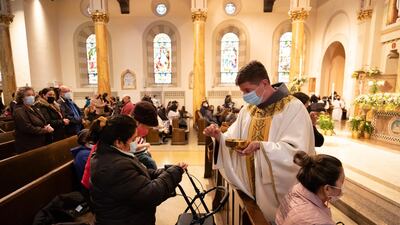

Just in time for Easter, a new survey revealed an astonishing change in religious adherence in the US. For the first time in eight decades of asking about this issue, the polling organisation Gallup found that less than 50 per cent of American adults belonged to a church, synagogue or mosque. This was down from 70 per cent in 1999, a proportion of the population that had remained almost constant since the late 1930s. Across the Atlantic, it has been reported that in the UK’s most recent census the percentage of people describing themselves as Christian is expected to fall below 50 per cent for the first time.
These findings represent milestones. For, if we leave aside the communist states – which in any case made a kind of “religion” of their totalitarian ideologies – to be human has meant to be religious throughout history. There have always been non-believers too, although miniscule in number in most parts of the world. But all societies have had their gods. That the US and UK appear to be on the road to rejecting theirs deserves more attention than it is getting.
As I've noted before when addressing this phenomenon, the western countries where this trend has been recorded increasingly run the risk of failing to understand the 84 per cent of the world (according to Pew research) in which religious affiliation is clear and growing.
To take one example: Monty Python's Life Of Brian is more likely to be criticised today for Eric Idle's portrayal of a character who wished to change his gender, than for what many Christians said was its blasphemous mockery of Jesus Christ when the film was released in 1979. Western societies have not only dropped any prohibitions against blasphemy; they have effectively dismissed the idea itself as groundless.
So it is no wonder that they refuse to grasp the offence that caricatures of the Prophet Mohammed cause many Muslims. "You shouldn't be upset," many people in the West repeatedly tell Muslims around the world – since they can no longer even imagine that certain subjects should be unthinkably off-limits because they transgress against the realm of the divine.
These countries also run the risk of current and future generations failing to comprehend fully their own histories and heritages, so integral has religion been to both, as the historian Tom Holland described comprehensively in his book Dominion: The Making of the Western Mind.
While it is up to people to think for themselves about such matters, and of course non-believers are perfectly capable of living lives of conscience, what has filled the space formerly occupied by religion is not encouraging.
As the author Ed West wrote in a perceptive essay in Unherd recently: "What is left is not the rationalist paradise some naive public philosophers were claiming at the start of the 21st century, but… endless moral panics, a world seen in stark black and white between good and evil, competitive sanctimony and the sentimental glorification of victimhood."
The “New Atheists” Mr West is referring to – the likes of Richard Dawkins, Daniel Dennett and Sam Harris – thought, as Professor Dennett once put it to me, that “when it comes to facts, and explanations of facts, science is the only game in town”. But even if most of us, including people of faith, are prepared to accept his point, science cannot be the basis of any morality of consequence; and when the attempt has been made, it has often had murderous results, as the history of the vogue for eugenics in the first part of the 20th century shows.

Science does not satisfy the hunger for rules and a framework by which to conduct a moral life that religion does. The pure rationalism of the New Atheists is not enough. So many millennials "who have turned away from traditional organised religion", according to a report in the Los Angeles Times, are embracing practices such as tarot, astrology and crystals – the benefits of which are unclear, to put it mildly.
Others suggest, persuasively, that the search for meaning and conviction has been channelled into politics and ideological intensity. There are several problems with this. These new certainties have all the force of religion for many, but are in a lot of ways far more rigid and divisive. They are not the “broad churches” that most religions, with their centuries of debate among scholars, are. And whatever the faults of religions, which have of course been misused frequently over the centuries to justify war, oppression and intolerance, they all situate humanity in a place of humility before something greater. Some of these new certainties, on the other hand, place the "self" above all else. The individual is judge and jury guided by “his or her truth”.
What, to paraphrase the writer and poet WB Yeats, these “passionate intensities” lack are any fleshed-out concepts of forgiveness and redemption. Hardly a week goes by without people being forced to resign from their jobs because of past comments on social media. Fulsome apologies are obligatory; but when are they allowed to return in good standing and cast off the mantle of shame? No one knows, is the answer.

The Abrahamic religions, on the other hand, all recognise the need to address human fallibility. The Quran states: “Despair not of the mercy of Allah, Lo! Allah forgiveth all sins. Lo! He is the Forgiving, the Merciful.” In the Bible, Jesus urged a crowd not to rush to judge a woman accused of adultery, saying: “He that is without sin among you, let him cast the first stone at her.” Repentance and forgiveness are similarly emphasised in Judaism.
The gulf of misunderstanding between, say, liberal California and Kuala Lumpur, Malaysia, where I live and religion is the norm, is bad enough. But if what is replacing conventional faith in western countries is either the dubious practices of “new age” charlatans, or harsh new convictions that put the individual above the community while failing to acknowledge humanity’s inherent frailty, that is worse. The US, UK and other countries could have reason to regret deserting religion.
Sholto Byrnes is an East Asian affairs columnist for The National

