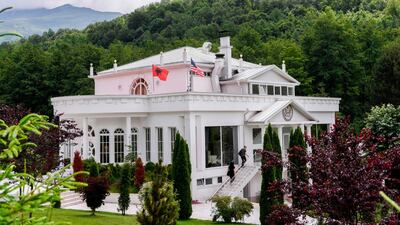

The Serbia-Kosovo dispute is back in the news more than two decades after the war ended.
A peace summit that was to be held over the weekend at the White House between the presidents of both countries had to be postponed. But Kosovo's Prime Minister Avdullah Hoti and Serbia's President Aleksandar Vucic met the president of the European Commission Ursula von der Leyen in Brussels on June 26. And France and Germany are preparing to host a Belgrade-Pristina meeting in July.
Why the sudden burst of interest in Balkans initiatives?
It is fair to say the Trump administration kicked things off. There were “goodwill” talks at the White House in March between Mr Vucic and his Kosovar counterpart Hashim Thaci. Then in mid-June, Richard Grenell, Donald Trump’s special envoy for Serbia-Kosovo dialogue, announced further talks between the two leaders. With Mr Trump having earlier called for “a historic accord”, there was excitement and trepidation about a US-brokered final deal for a contentious partition.
The EU was pointedly not invited. The snub drew a sniffy response from the bloc’s envoy for Belgrade-Pristina dialogue, Miroslav Lajcak. Within 24 hours of Mr Grenell’s bombshell tweet, Mr Lajcak was in the capitals of both Serbia and Kosovo. It was seen as a piqued attempt by the EU to play catchup in its own backyard.
Opinions are divided about the Trump administration’s motivation in pushing dialogue in a divided corner of Europe. Some say that Mr Trump wanted to appear statesmanlike before the November 3 US presidential election. Having failed to secure any worthwhile foreign policy successes on North Korea and Iran, a photo opportunity as the Balkans’ peacemaker-in-chief would have been handy for his re-election campaign.
But there is also the possibility of a more strategic calculus. US re-engagement would go some way towards pushing back China and Russia’s own efforts to expand their influence in the Balkans. The EU has less sway than it might want.
Despite years of trying, the bloc has had little success in shepherding Serbia and Kosovo towards the gradual “normalisation” of their relationship. Meanwhile, both Serbia and Kosovo have grown increasingly cynical about the EU’s promise to one day embrace them as member states. Serbia’s laborious six-year attempt to join the EU is sputtering. Kosovo, which the EU regards as a potential candidate for membership, is yet to be granted even visa-free access to the bloc despite meeting the required criteria.
It is significant that in the early days of the coronavirus crisis, Mr Vucic disdained European solidarity as a “fairy tale” even as he praised the promptness with which the Chinese despatched medical assistance to Belgrade. As for Mr Thaci, he has said he would personally participate only in peace talks led by the White House, not the EU envoy.
As it turned out, the June 27 Washington summit got derailed because Mr Thaci was indicted on war crimes charges by an EU and US-backed tribunal in The Hague. Just three days before the pomp and circumstance of a possible White House agreement, the Kosovar president was charged for his alleged role during the 1998-99 Kosovo War and its aftermath.
The timing puts a question mark on Mr Thaci’s involvement in future peace talks, no matter who is mediating. In the short term, this is likely to be the EU. All the signs point to the bloc viewing the western Balkans with new urgency, if only to retain its relevance and stature in the region. With Germany assuming the EU’s six-month rotating presidency on July 1, the stalled Kosovo-Serbia dialogue is expected to be one of its priorities.
-

A file picture of President of the Republic of Kosovo Hashim Thaci playing with ethnic Serb children in the village of Rubovc, Kosovo, 10 February 2008. Mr Thaci has been charged with a range of crimes against humanity and war crimes, including murder, enforced disappearance of persons, persecution, and torture. Valdrin XHemaj / EPA -
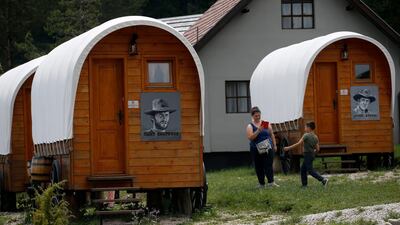
In this photo taken on June 25, 2020, visitors walk by wagons adorned with portraits of famous Western movie actors at El Paso City theme park in village of Vodice, on the Zlatibor mountain, Serbia. Darko Vojinovic / AP -

Prime Minister of Kosovo Avdullah Hoti speaks to the media in Pristina on June 03, after a parliament session. Armend Nimani / AFP -

US special envoy Richard Grenell is welcomed by Kosovo President Hashim Thaci in Pristina, Kosovo, October 9, 2019. Laura Hasani/ Reuters -
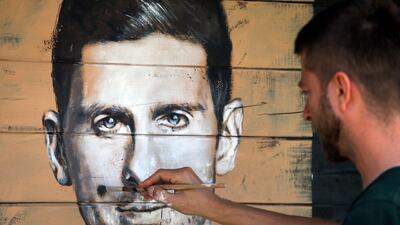
Marko Janjic, an artist, draws a portrait of Serbian tennis player Novak Djokovic on a house in Vodice, Serbia, June 25, 2020. Djokovic tested positive for the coronavirus after taking part in a tennis exhibition series he organised in Serbia and Croatia. Darko Vojinovic / AP -
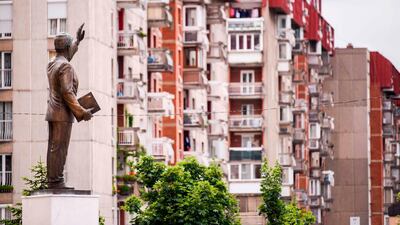
The statue of former US President Bill Clinton at a boulevard named after him, in Pristina, Kosovo, June 23. Armend Nimani / AFP -

Cars drive past a boulevard named after former US President Bill Clinton in Pristina on June 23. Armend Nimani / AFP -
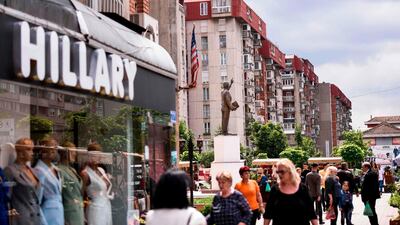
Pedestrians walk past a clothing store named after Hillary Clinton next to the statue of former US President Bill Clinton in Pristina on June 23. Armend Nimani / AFP -

President of the Republic of Serbia Aleksandar Vucic during a press conference with Special Representative for the Pristina-Belgrade Dialogue Miroslav Lajcak, following an official visit in Belgrade, Serbia, 22 June 2020. Koca Sulejmanovic / EPA -
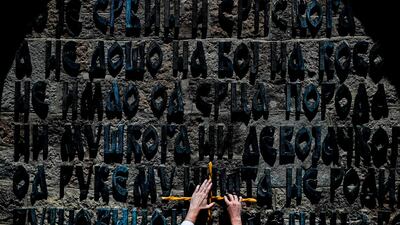
A Serbian man fixes candles to a wall of the Gazimestan memorial during a ceremony marking the historic "Battle of Kosovo" at a memorial in Gazimestan, on the outskirts of Pristina on June 28. The ceremony marks the Battle of Kosovo in 1389 when the Serbian army was defeated by the Ottoman Empire. Armend Nimani / AFP


That said, it is not clear how, or even if, the EU can further a deal. Two years ago, both Mr Thaci and Mr Vucic had mooted a land swap as a way to finally end decades of wrangling. The Trump administration expressed openness to exploring the idea. However, some European leaders, led by German chancellor Angela Merkel, opposed it. The argument goes that such a redrawing of borders would normalise ethnic divisions. Europe also fears that any land swap could become a destabilising template for the region.
It is true that “Balkanisation”, a term that retains its two-century-old negative connotations, is a worrying prospect. Were Kosovo and Serbia to begin serious talks on redrawing their borders, there could be a domino effect all around the region.
Serbs are a minority in Albanian-dominant Kosovo and many still consider themselves citizens of Serbia. Any exchange of territory would be a fraught and difficult matter. Serbs also live in Bosnia-Hercegovina, where they have their own republic. What’s to stop Bosnian Serbs demanding a referendum on the status of Republika Srpska, which is one of the two entities that make up Bosnia and Hercegovina? Serbia might have to push back on Bosniak Muslim calls for a Greater Bosnia. And western Macedonia, which is a part of Greece, as well as Montenegro, could be faced with demands from their Albanian communities for a Greater Albania.
What is the alternative? The tensions between Serbia and Kosovo have gone on for far too long. After the 1991 break-up of Yugoslavia, Nato launched a bombing campaign against Serbia to stop what Nato described as ethnic cleansing of Kosovo’s mostly Muslim Albanians. The war ended in June 1999 and Kosovo, an autonomous province of Serbia, declared independence in 2008. An uneasy impasse followed with Serbia refusing to recognise Kosovo’s statehood.
EU-mediated negotiations, which lasted nine years from 2011, did not break the deadlock. If both countries were to be drawn deeper and tighter into the bloc it would technically lessen the relevance of national borders. That might be a way forward. But that would need the EU to be decisive and determined.

