

“They are already standing up. Stand with them,” I replied to a nice British woman on Twitter a few days ago, after she wrote, “We have to stand up for Turkish women.”
Like many others in the West, she was appalled by the skyrocketing number of women killed in my country, and infuriated by the police violence during this year’s International Women’s Day march in Istanbul. Her seemingly insignificant choice of preposition – “for”, instead of “with” – was telling the thousand-year-long story of our divided femininity that we, as women around the world, need to get rid of today before it is too late.
I am a woman from the “bridge” that connects the East and the West. At least, that was what we were taught in school while growing up in Turkey. In every classroom, there was a map showing Anatolia and Istanbul right in the middle, between the East and the West. That map told us that we were of both, yet also of neither. But our inbetweenness, this trapped existence in an unending act of crossing without arriving at either end, came with a privilege: we still like to think that we know both ends of the bridge.
Looking back at that bridge now, I think, if “geography is destiny”, as the Arab philosopher Ibn Khaldun said once, then perhaps as a female Turkish writer I am destined to invent a shared language that could bridge the lived experience of womanhood in the East and West, despite the imagined divide. There should be a vocabulary that prevails over the perpetual machine that produces the false images of Middle Eastern and Western women. There should be a language of “standing with”, not of “standing for”.
-
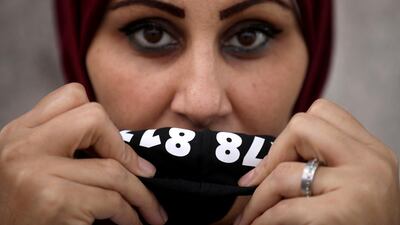
A Lebanese woman displays a protective mask hiding a hot number distributed by the NGO ABAAD in Beirut on December 8, 2020. Photo by Patrick Baz/ ABAAD. -
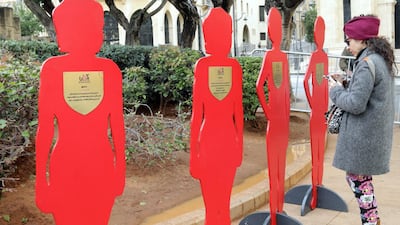
A picture taken on January 27, 2018, shows figures representing women, killed by male relatives in Lebanon, including eight killed in the past 60 days, during a rally organised by activists from KAFA. KAFA is an NGO that works for eradicating gender-based violence and exploitation of women and children. AFP. -
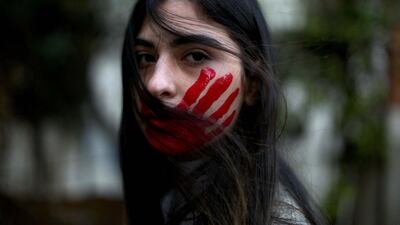
A Lebanese woman poses with her face painted with a red hand during a demonstration against sexual harassment, rape and domestic violence in the Lebanese capital Beirut on December 7, 2019. AFP -

Lebanese woman hang a banner on their balcony in Beirut on April 16, 2020 during an awareness campaign by the Lebanese NGO ABAAD against domestic violence. in light of the current lockdown, many women in Lebanon who are victims of domestic violence found themselves stuck at home with their abusers. Photo by Patrick Baz / ABAAD -
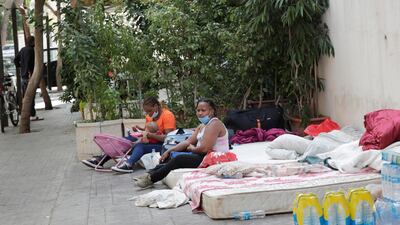
Kenyan domestic workers camp on August 20, 2020 outside the Kenyan consulate in Beirut after losing their jobs due to the economic crisis to demand repatriation back home. - An estimated 250,000 domestic workers -- mostly from Ethiopia, the Philippines and Sri Lanka -- live in Lebanon, many in conditions condemned by rights groups. Those conditions have worsened in recent months as Lebanon is grappling with its worst economic crisis in decades, as well as a coronavirus lockdown. AFP -
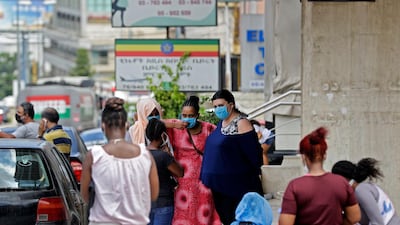
Ethiopian domestic workers who were dismissed by their employers gather with their belongings outside their country’s embassy in Hazmiyeh, east of Beirut, on June 24, 2020. Around 250,000 migrants -- usually women -- work as housekeepers, nannies and carers in Lebanese homes, a large proportion Ethiopian and some for as little as $150 a month. None are protected by the labour law. AFP. -

Ethiopian domestic workers who were dismissed by their employers gather with their belongings outside their country’s embassy in Hazmiyeh, east of Beirut, on June 24, 2020. AFP.


A bitter laughter comes over me whenever I see European and American book covers depicting a veil when a Middle Eastern woman writer tells her story. Those stories of ours that are singled out for appreciation in the West have not, in their essence, changed since the first privileged white man centuries ago snuck into a harem to tell his friends back home about the "Turkish delight” he encountered.
Now, it is in fact we, the women, giving the insider info from the harem: the private lives of the region’s women, their hidden stories, the secrets of “Oriental beauty”. But the fact that now, these stories told by and for women are also billed as some kind of “unveiling” is, in a way, also tragic. The “unveiling” feeds into an unquenchable, and harmful and exoticising, curiosity.
More importantly, it conceals our shared reality: the heart of the resentment that can be experienced by women and the brokenness womanhood can suffer does not change from the East to the West. It is the brokenness of knowing we could have been much more than we are now, had we been counted as equal and dignified humans for the last several thousand years.
It is this reality that needs a lot of unveiling. We need it to bridge the East and the West. We need it to break this perpetual machine that degrades Middle Eastern women to sexualised victims and Western women to witless voyeurs of 21st-century harems. Most of all, we need it with greater, global urgency. In coming years we all will need a new language to talk, organise and mobilise, simply to survive the massive attack on women happening in so many places.
Five years ago at a book event in London, after I discussed with the audience the oppression that Turkey is suffering, one woman was so moved that, wringing her hands, she asked me compassionately, “What can we do for you?” Her raised eyebrows were fixed in a delicate balance between pity and genuine concern.
Under the spotlight on the stage, I remember pausing for a second to unpack the invisible baggage of her question: the fact that she saw me as a needy victim; her confidence in her own country’s immunity from the political malaise that ruined mine; her unshaken assumption that Britain, which was experiencing its own political turmoil and economic crisis, was in an ideal position to help anyone.
Her inability to acknowledge that we were all drowning in the same political insanity provoked me. I finally managed to calibrate this combination of thoughts into a slightly embarrassed response: “Well, now I feel like a baby panda waiting to be adopted via a website.”
-
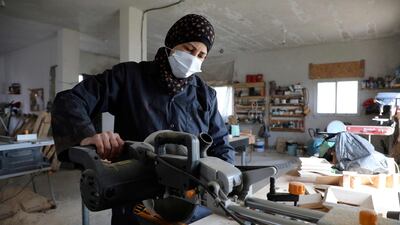
A Palestinian woman works at a carpentry shop in Al Walajah village, close to the West Bank city of Bethlehem. Five years ago, a group of housewives began recycling waste timber into usable products, which were sold to souvenir shops. AFP -

A Palestinian woman works at a carpenter workshop, established and run by a group of women, in the village of Al Walajeh near the West bank town of Bethlehem. AFP -
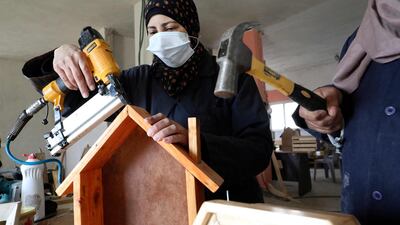
A Palestinian woman works at a carpenter workshop, established and run by a group of women, in the village of Al Walajeh near the West bank town of Bethlehem. AFP -

A Palestinian woman works at a carpenter workshop, established and run by a group of women, in the village of Al Walajeh near the West bank town of Bethlehem. AFP -
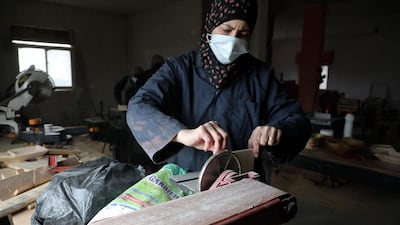
A Palestinian woman works at a carpenter workshop, established and run by a group of women, in the village of Al Walajeh near the West bank town of Bethlehem. AFP -
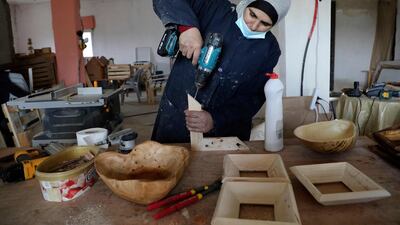
A Palestinian woman works at a carpenter workshop, established and run by a group of women, in the village of al-Walajeh near the West bank town of Bethlehem. AFP -
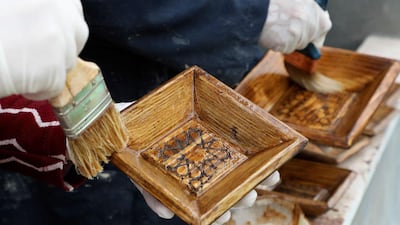
Palestinian women work at a carpenter workshop, established and run by a group of women, in the village of Al Walajeh near the West bank town of Bethlehem. AFP -
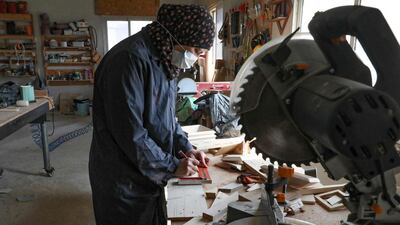
A Palestinian woman works at a carpenter workshop, established and run by a group of women, in the village of Al Walajeh near the West bank town of Bethlehem. AFP -
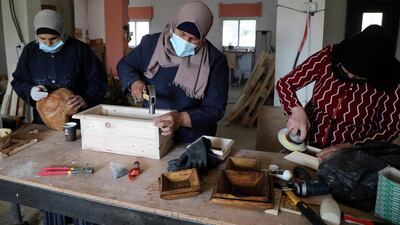
Palestinian women work at a carpenter workshop, established and run by a group of women, in the village of Al Walajeh near the West bank town of Bethlehem. AFP


This moment, I am pretty sure, has happened to most Middle Eastern women who have dared to talk about their country in Western cities. Many of us felt like adopted pandas even when our counterparts in the West had no mal-intent.
To get rid of this matter of imagined superiority and inferiority, all of us have to see the current conditions of the world clearly. The party is over. If we do nothing, this could well be the age of disintegration. All that is solid will melt and even the most seemingly formidable institutions will no longer be trusted.
This is an age of unpredictability and insecurity; the rule of law is disappearing in so many places. And when it does, the first damage is incurred by women, as has been the case throughout human history. You might even ask yourself, who else would know how to operate in such circumstances better than Middle Eastern women? Who else could tell the story of how to be in the face of uncertainty?
Now could be a tempting time for women in the East to ask back to the West, “What can we do for you?”
At the book event, I did flip the question back around to the woman expressing so much concern for me. “Actually, what can I do for you?” I asked.
But in reality, we do not have the luxury of playing that game of smugness and pity for much longer. This is the time to find the language of "with". It is the only response to the self-destructive hysteria of power and greed perpetuated by patriarchy. It involves giving our attention to one another, being with one another, rather than having a manufactured curiosity for one another.
This kind of curiosity is like being poked with a stick. It is childlike, but not innocent. The word somehow includes harassment, even unintentionally. Even at its purest, the curiosity alienates, and divides the observer from the observed.
But attention comes from love, from genuine interest, and it eventually leads to a humane connection. A new language requires at least two people. One cannot invent it alone. So my question to my sisters in the East and the West is how can we imagine a female language of attention? I ask a question here because I know that stories are built only by one half through talking. The other half involves someone shutting up and listening. So I shut up and listen to you now. How can we speak the language of “with”?
Ece Temelkuran is a Turkish journalist and novelist

