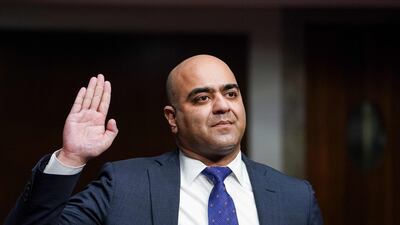

This month, US President Joe Biden announced the nomination of Zahid Quraishi, a magistrate judge in New Jersey since 2019, for the United States District Court for New Jersey.
If selected, it would make Mr Quraishi the first Muslim federal judge in America. And yet, even in the middle of his nomination hearings, a US senator asked Mr Quraishi: “What do you know about Sharia law?”
This line of inquiry is problematic for many reasons. For one, it is the modern equivalent of the popular, last-century version of asking a Catholic politician, on the verge of taking public office, whether he or she will pledge "loyalty to the pope or the constitution".
When Mr Biden announced he would nominate Mr Quraishi, it was presented as an effort to ensure that the federal judiciary reflected the “full diversity of the American people”.
Mr Quraishi's career shows him to be a deeply established figure: 21 years as a federal prosecutor and as a defence attorney and a US military officer. Yet, Senator Dick Durbin felt the need to ask Mr Quraishi about "Sharia law", even though he said he was "almost embarrassed" to do, but felt he had to because it was likely to "come up at some point". Senator Durbin may have meant well, but the question just shows how deep-seated some problems still are.
More than 60 years ago, then Senator John F Kennedy, as he ran for president of the US, had to respond to critics who were concerned that a Catholic like him could not be loyal to the US constitution. After all, only a decade before, a best-selling book by Paul Blanchard called American Freedom and Catholic Power said Catholics were a threat to liberal democracy. Catholics were considered loyal to the Vatican in Rome. And as far as Blanchard was concerned, Rome stood for "anti-democratic social policies" that were "intolerant," "separatist," and "un-American". But Blanchard might have only expressed what a number of Protestants in America thought, which is why the book did so well.
It wasn't so long ago that Al Smith, the Democratic nominee for president in 1928, had to respond to an article in the Atlantic magazine that questioned whether a Roman Catholic could be loyal to both the constitution and the pope.
But this is 2021. One would presume that America has moved on – and certainly, it has when it comes to Catholics. After all, Kennedy did become president of the US, and Joe Biden’s Catholicism was not a stumbling block when he ran for office either. Yet, when it comes to Muslims, some sections of society still view the world in unsettling and parochial ways.
The reality is that for many Muslims, the Sharia is how they understand their religion, in the same way that Jews engage with halakha, or Catholics with canon law. Practising Muslims observe the Sharia on a daily basis – in how they live their lives, conduct their prayers, their rituals and more generally, their ethics. How people even become Muslim is organised through the Sharia. And asking Mr Quraishi about "Sharia law" calls into question the troubling ways in which some people, even in high office, look at Muslims and more widely, at Islam.
A recent book by American author Asma Uddin, When Islam is not a Religion, elaborates on this. Religious freedom is supposed to be a crucial part of American democracy – and certainly when it comes to Christians and Jews, it is hard to argue that such freedom does not exist.
But in recent years, some politicians and commentators, have tried to make the case that religious freedom does not apply to Muslims.
Take, for example, what a Republican state legislator in Oklahoma, John Bennett, said in 2014: “Islam is not even a religion; it is a political system that uses a deity to advance its agenda of global conquest.”
This is a peculiar claim, and contrary to the First Amendment of the US constitution. And yet Mr Bennett is far from being the only one who holds such beliefs.
Michael Flynn, former US national security adviser, during the Trump administration, told an Act for America conference: "Islam is a political ideology" that "hides behind the notion of it being a religion."
Other commentators too have tried to make similar arguments. Indeed, former US President Donald Trump himself declared: "I think Islam hates us”. He didn't say "extremism"; he referred to Islam.
The US has come a long way and made great progress in countless fields. But when it comes to abolishing people's prejudices, there is much more that needs to be done.
Whether Mr Quraishi is the right person for the job or not cannot be determined by a religious test. Those are supposed to be banned by the US constitution. If the US constitution is truly of value, it must protect all citizens equally from religious tests: believers and non-believers alike, protecting all religious communities – including, it must be said, Muslims.
Dr HA Hellyer, a Carnegie Endowment scholar, is a senior fellow at the Royal United Services Institute and Cambridge University

