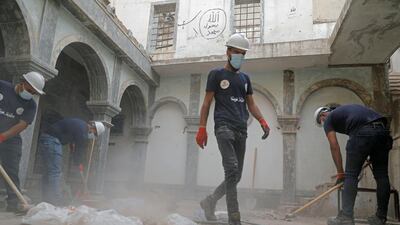
When the black flags of ISIS stopped flying in Mosul in July 2017, two feelings prevailed. The first was relief following the city’s liberation, the second was determination to rebuild.
Today, this determination is achieving real results. As part of Unesco’s flagship initiative to “Revive the Spirit of Mosul”, we are launching an international architectural competition to rebuild one of the city’s most symbolic sites: Al Nouri mosque. Architects around the world now have a unique opportunity to help restore Mosul’s symbolic buildings – and help revive the spirit of the city itself.
Indeed, places like Al Nouri mosque, Al Hadba minaret and the churches of Al Tahera and Al Saa’a are so much more than stones. Dominating Mosul’s skyline, they are part of the city’s identity. Reconstructing these buildings is not just a question of restoring physical structures. It is also a question of rebuilding human lives. Mosul’s mosque, minaret and churches play a key role in cultural, social and economic well-being. By restoring these buildings, the city will create benefits for its people.
This is the goal of the project “Reviving the Spirit of Mosul by Rebuilding its Historical Landmarks”, funded by the UAE. Accompanying local residents and the Iraqi Ministry of Culture and Sunni Endowment, this initiative includes the restoration and reconstruction of Al Nouri mosque complex and Al Hadba minaret, as well as the rehabilitation of Al Tahera and Al Saa’a churches. It will create jobs, allowing young people to develop skills and contribute to social cohesion and community reconciliation, in Mosul and throughout Iraq.
Much progress has already been made. At Al Nouri mosque and Al Hadba minaret, documentation and assessments have been completed. The sites have been secured and rubble removed. Historical fragments have been collected, and the remaining structures have been stabilised. At Al Tahera church, rubble has been removed, fencing and security cameras have been installed and security guards have been employed. At Al Saa’a church, the site is currently being secured.
Architects around the world now have a unique opportunity to help restore Mosul's symbolic buildings
The next major milestone in this initiative is the international architectural competition to select the design of the Al Nouri complex. This includes conserving the prayer hall and integrating it into a new building. It also includes creating new buildings within the complex, rehabilitating some historic buildings, and landscaping the site. By creating new spaces for education, social and cultural activities, the complex will play much more than a religious role – it will serve the entire community.
Entries for this competition are now open. Architects from around the world can submit proposals, with the winner being announced in spring 2021. An international jury will select the winning design and four runners-up.
Today, we call on architects across the globe to take part in this competition, and contribute to the reconstruction of this important city. Mosul may have been destroyed by conflict, but its social, cultural and historical foundations remain. By building on these strengths, the city can drive its own renaissance. By rebuilding its monuments, the city can improve its people’s lives and livelihoods.
Noura Al Kaabi is the UAE Minister of Culture and Youth
Audrey Azoulay is the director-general of Unesco
Dr Hasan Nadhem is the Minister of Culture, Tourism and Antiquities of Iraq
Dr Saad Hameed Kambash is president of Sunni Endowments in Iraq

MATCH INFO
Juventus 1 (Dybala 45')
Lazio 3 (Alberto 16', Lulic 73', Cataldi 90 4')
Red card: Rodrigo Bentancur (Juventus)
Mercer, the investment consulting arm of US services company Marsh & McLennan, expects its wealth division to at least double its assets under management (AUM) in the Middle East as wealth in the region continues to grow despite economic headwinds, a company official said.
Mercer Wealth, which globally has $160 billion in AUM, plans to boost its AUM in the region to $2-$3bn in the next 2-3 years from the present $1bn, said Yasir AbuShaban, a Dubai-based principal with Mercer Wealth.
“Within the next two to three years, we are looking at reaching $2 to $3 billion as a conservative estimate and we do see an opportunity to do so,” said Mr AbuShaban.
Mercer does not directly make investments, but allocates clients’ money they have discretion to, to professional asset managers. They also provide advice to clients.
“We have buying power. We can negotiate on their (client’s) behalf with asset managers to provide them lower fees than they otherwise would have to get on their own,” he added.
Mercer Wealth’s clients include sovereign wealth funds, family offices, and insurance companies among others.
From its office in Dubai, Mercer also looks after Africa, India and Turkey, where they also see opportunity for growth.
Wealth creation in Middle East and Africa (MEA) grew 8.5 per cent to $8.1 trillion last year from $7.5tn in 2015, higher than last year’s global average of 6 per cent and the second-highest growth in a region after Asia-Pacific which grew 9.9 per cent, according to consultancy Boston Consulting Group (BCG). In the region, where wealth grew just 1.9 per cent in 2015 compared with 2014, a pickup in oil prices has helped in wealth generation.
BCG is forecasting MEA wealth will rise to $12tn by 2021, growing at an annual average of 8 per cent.
Drivers of wealth generation in the region will be split evenly between new wealth creation and growth of performance of existing assets, according to BCG.
Another general trend in the region is clients’ looking for a comprehensive approach to investing, according to Mr AbuShaban.
“Institutional investors or some of the families are seeing a slowdown in the available capital they have to invest and in that sense they are looking at optimizing the way they manage their portfolios and making sure they are not investing haphazardly and different parts of their investment are working together,” said Mr AbuShaban.
Some clients also have a higher appetite for risk, given the low interest-rate environment that does not provide enough yield for some institutional investors. These clients are keen to invest in illiquid assets, such as private equity and infrastructure.
“What we have seen is a desire for higher returns in what has been a low-return environment specifically in various fixed income or bonds,” he said.
“In this environment, we have seen a de facto increase in the risk that clients are taking in things like illiquid investments, private equity investments, infrastructure and private debt, those kind of investments were higher illiquidity results in incrementally higher returns.”
The Abu Dhabi Investment Authority, one of the largest sovereign wealth funds, said in its 2016 report that has gradually increased its exposure in direct private equity and private credit transactions, mainly in Asian markets and especially in China and India. The authority’s private equity department focused on structured equities owing to “their defensive characteristics.”
